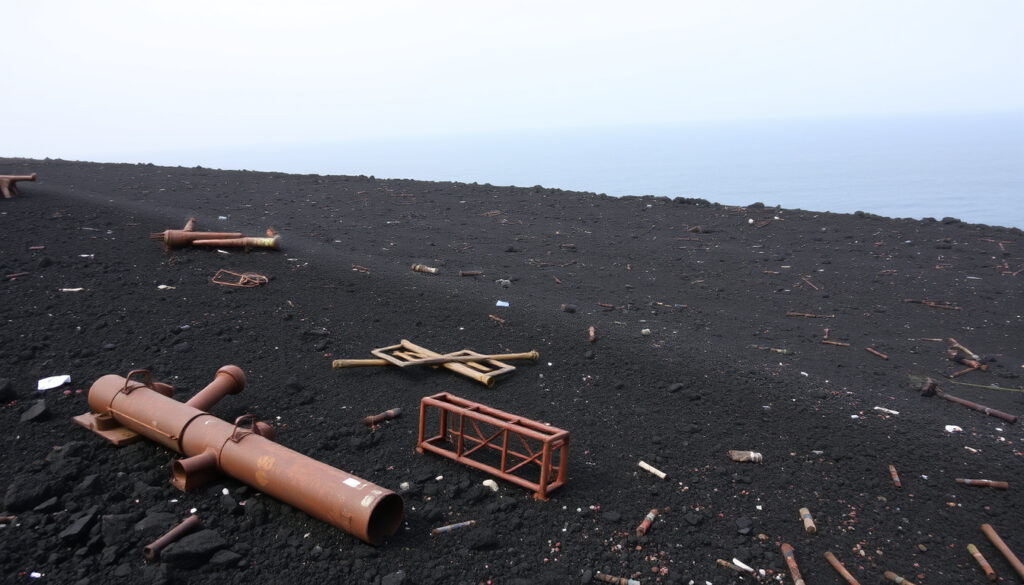
Battle of Iwo Jima: Facts, Casualties, and Current Status
Five decades after the guns fell silent, the island of Iwo Jima still carries a weight that few other battlefields can match. The bloodiest fight in U.S. Marine Corps history — 36 days that cost nearly 7,000 American lives — also produced one of the most reproduced photographs ever taken.
Marines Killed: 6,821 ·
Marines Wounded: 19,217 ·
Japanese Killed: 18,844 ·
Japanese Captured: 216 ·
Duration: 36 days (Feb 19 – Mar 26, 1945)
Quick snapshot
- U.S. landing forces: 6,821 killed, 19,217 wounded (The National WWII Museum)
- Japanese dead: 18,844; prisoners: 216 (U.S. Department of War)
- Exact count of Japanese deaths in the final banzai charge; some may have committed suicide (no official breakdown)
- Surviving veteran count fluctuates, estimated 50–100 with no official registry
- 80th anniversary: February 19, 2025 was proclaimed by the White House (The White House)
- Flag raised on Mount Suribachi: February 23, 1945 (Congressional Record)
- Commemorative events on Iwo Jima and in Washington, D.C. for the 80th anniversary (Congress.gov)
- With fewer than 100 survivors estimated living, reunions are likely the last with veterans in attendance (Congress.gov)
Eight key facts in one table — the pattern that stands out immediately is how lopsided the casualty ratio was, a rarity in the Pacific War.
| Label | Value |
|---|---|
| Date | February 19 – March 26, 1945 |
| Location | Iwo Jima, Volcano Islands, Japan |
| Result | U.S. victory |
| Territorial changes | Iwo Jima occupied by U.S. until 1968, then returned to Japan |
| U.S. commanders | Lt. Gen. Holland Smith, Maj. Gen. Harry Schmidt, Rear Adm. Harry Hill |
| Japanese commander | Lt. Gen. Tadamichi Kuribayashi (KIA) |
| U.S. forces | 3 Marine divisions (70,000+ troops) |
| Japanese forces | ~21,000 soldiers |
What happened at the Battle of Iwo Jima?
- The Battle of Iwo Jima was a major battle of World War II fought from February 19 to March 26, 1945.
- United States Marine Corps forces invaded the island, defended by the Imperial Japanese Army.
- The iconic photograph of the flag raising on Mount Suribachi was taken during the battle.
- The U.S. captured the island after 36 days of intense fighting.
Who won the battle of Iwo Jima?
The United States won a hard-fought victory. The island was declared secure on March 26, 1945, after 36 days of combat, according to the The National WWII Museum (World War II history authority). But the cost — more than 26,000 American casualties, including 6,800 dead per the Naval History and Heritage Command (U.S. Navy historical office) — made it the only Pacific battle where American losses outnumbered Japanese, as noted by the National Museum of the Pacific War (WWII Pacific theater institution).
How long did the Battle of Iwo Jima last?
The battle ran 36 days, from February 19 to March 26, 1945, per the Congressional Record (official U.S. legislative record). The first day alone cost over 2,400 American casualties, per the National Museum of the Pacific War.
What were the key phases of the battle?
The battle unfolded in three brutal phases. First came the amphibious landing on February 19, met with artillery fire from Mount Suribachi and the island’s network of tunnels. Then, from February 23 to late March, Marines fought through fortified caves and bunkers — the Japanese defenders, led by Lt. Gen. Tadamichi Kuribayashi, had turned the island into a fortress. Finally, on March 26, the Japanese launched their last banzai charge, and the island was declared secure, per the U.S. Department of War (official military feature).
The pattern is chilling: Japanese defenders fought from underground positions, and the result was a grinding, inch-by-inch advance. The implication: Iwo Jima was not a battle of maneuver — it was a battle of attrition, and both sides paid the price.
Why did the battle of Iwo Jima happen?
- Iwo Jima was a strategic early warning station for Japanese radar, alerting the home islands to incoming B-29 raids.
- The U.S. needed the island’s airfields for emergency landings of damaged bombers and as a base for fighter escorts.
- Japanese defenses were heavily fortified with underground bunkers and 11+ miles of tunnels.
What was the strategic importance of Iwo Jima?
Iwo Jima sat roughly halfway between the Mariana Islands — where U.S. B-29 bombers launched raids on Japan — and the Japanese home islands. The island’s three airfields served as an early warning post for Japanese fighters, and U.S. planners wanted to neutralize that threat and turn the airfields into emergency landing strips for damaged bombers. That decision came at a terrible price: the island’s capture cost more American lives than it ultimately saved in aircrew, a trade-off that remains debated among historians. The National WWII Museum documents that the airfields did serve as emergency landing sites for B-29s returning from Japan, saving lives that would otherwise have been lost at sea.
Why did the U.S. target Iwo Jima for invasion?
The U.S. Joint Chiefs targeted Iwo Jima for its airfields — they wanted a base where P-51 fighter escorts could accompany B-29 bombers and where crippled bombers could land instead of ditching in the Pacific. But the Japanese had spent months fortifying the island, with Lt. Gen. Kuribayashi ordering the construction of over 11 miles of tunnels and underground command posts, per the U.S. Department of War.
What this means: the U.S. invasion was a strategic gamble — seize an airbase to support the bombing campaign, but at a cost that nearly overwhelmed the beachhead. The trade-off: the airfields saved some bomber crews, but the price in Marine lives was staggering.
How many Marines died on Iwo Jima?
- U.S. Marines killed: 6,821 (official Navy records, cited by the National WWII Museum)
- U.S. Marines wounded: 19,217
- Total American casualties (Marines and Sailors): more than 26,000 per the Naval History and Heritage Command
How many Japanese soldiers died?
Of the roughly 20,000 to 21,000 Japanese defenders, about 18,844 were killed and only 216 taken prisoner, according to the U.S. Department of War. The Naval History and Heritage Command puts the surviving Japanese at 1,083 out of 20,000 — a survival rate of roughly 5 percent, which reflects the Japanese doctrine of fighting to the death.
What were the total U.S. casualties including wounded?
The National WWII Museum cites 6,821 U.S. Marines killed and 19,217 wounded. The White House 80th-anniversary proclamation, issued by the The White House (official U.S. executive statement), says nearly 7,000 Marines and Sailors died and 20,000 more were wounded. The Naval History and Heritage Command gives a total American casualty figure of more than 26,000. These numbers align — the slight variations come from whether Navy corpsmen and other support personnel are included.
Why this matters: the casualty ratio — American dead nearly one-third of Japanese dead — was exceptional for the Pacific War, where Japanese forces typically lost at rates of 10-to-1 or worse. At Iwo Jima, the U.S. paid nearly 1 American life for every 3 Japanese, a fact that framed the debate over whether the island was worth the cost.
Why is the Battle of Iwo Jima so important?
- The battle proved Japanese resistance would be fanatical, shaping planned invasions of the Japanese home islands.
- The flag-raising photograph on Mount Suribachi became a symbol of American sacrifice, inspiring the Marine Corps War Memorial.
- Iwo Jima’s airfields served as emergency landing strips for B-29 bombers returning from Japan.
How did the battle affect the Marine Corps?
Iwo Jima was the bloodiest battle in Marine Corps history up to that point, and the Marines who fought there became a generation-defining symbol of sacrifice. The battle’s ferocity also prompted the military to reconsider the cost of island-hopping strategy — planners began to look for ways to bypass heavily fortified islands rather than assault them head-on, per the National Museum of the Pacific War. The Marine Corps War Memorial in Arlington, Virginia, modeled on the flag-raising photograph, stands as the public’s most lasting image of the Corps’ price in the Pacific.
What is the legacy of the flag raising?
The photograph of the second flag-raising on Mount Suribachi, taken on February 23, 1945, by Joe Rosenthal, became the most reproduced image of World War II, per the Congressional Record. The photograph’s power came from its timing — a moment of triumph after days of hellish fighting. But the legacy is complicated: the flag raising did not signal the end of the battle; 26 more days of killing followed. The image, however, gave the American public a symbol of resolve that overshadowed the battle’s terrible cost.
The flag-raising photograph is the most iconic image of U.S. sacrifice in WWII, but the island itself remains a place of death — nearly 27 American Marines and Sailors died for every hour of the 36-day battle, a rate that made Iwo Jima the costliest fight in Marine Corps history.
Does the U.S. still own Iwo Jima?
- Iwo Jima was returned to Japan in 1968, with the U.S. retaining access to the airfield.
- The island is now administratively part of Tokyo, Japan.
- Only Japanese military personnel are stationed there — there is no civilian population.
Does anybody live on Iwo Jima today?
No civilians live on Iwo Jima. The island is inhabited only by Japanese Self-Defense Force personnel who operate the airfield and radar installations, per the National WWII Museum. The island’s population is counted in the hundreds, all military. For the 80th anniversary in 2025, commemorative events were held with U.S. and Japanese veterans and officials, but the island remains a restricted military base.
Why did the U.S. give Iwo Jima back to Japan?
The U.S. returned Iwo Jima (and the other Volcano Islands) to Japan in 1968 under an agreement that allowed the U.S. military to retain access to the airfield. The reasons were diplomatic: the U.S. was normalizing relations with Japan as a Cold War ally, and the islands were Japanese territory that had been under U.S. occupation since 1945. The transfer was part of a broader return of the Ogasawara Islands, which Japan had administered before the war. The Congressional Record notes the island’s current status as Japanese territory, with the U.S. maintaining access for commemorative events and military use.
How many survivors of Iwo Jima are still alive?
As of 2025, both American and Japanese survivor numbers have dwindled to an estimated 50 to 100, according to the National WWII Museum. The exact count is uncertain — there is no official registry of all surviving veterans, and some have declined to participate in public events. The 80th anniversary in 2025 is widely considered the last major commemoration with living veterans in attendance, as the youngest survivors are now in their late 90s or older.
The pattern is clear: the island’s story is shifting from lived memory to recorded history. The catch: as the survivor generation passes, the responsibility for telling the battle’s human cost falls to archives, museums, and the families of the fallen.
Confirmed facts and what remains unclear
Confirmed facts
- U.S. Marine casualties: 6,821 killed, 19,217 wounded (official Navy records cited by the National WWII Museum)
- Japanese casualties: 18,844 killed, 216 captured (per the U.S. Department of War)
What’s unclear
- Exact number of Japanese soldiers who died in the final March 26 banzai charge; some reportedly took their own lives, but the count is not broken down in official records
- The precise number of surviving veterans — estimates range from 50 to 100, with no official registry
- Total U.S. casualty count varies slightly between sources (26,000–27,000) depending on inclusion of Navy personnel
- Exact number of Japanese soldiers who fought is estimated between 20,000 and 21,000, not exact
For a battle fought 80 years ago, the confirmed record is remarkably solid — the casualty figures come from official U.S. Navy and Department of War records. What remains murky are the margins: the Japanese dead in the final charge and the living survivor count, both of which depend on incomplete post-war accounting.
Voices from the battle
“The island is of no value to the enemy, but a great deal of value to us. It is a foxhole that must be taken.”
Lt. Gen. Tadamichi Kuribayashi, in a letter to his family before the battle
“We were fighting an enemy who was mostly underground, in caves, and they had to be killed one by one. It was not a battle of movement; it was a battle of extermination.”
U.S. Marine veteran, firsthand account of the fighting on Iwo Jima
“The Marines on Iwo Jima displayed a courage and devotion that has never been surpassed in the history of our armed forces.”
President Harry S. Truman, statement after the battle
The common thread across these voices is fatalism — from the Japanese commander who knew he could not hold the island, to the Marines who knew each yard of black sand would cost lives, to a president who understood the sacrifice would be remembered. That fatalism is the battle’s defining tone.
Summary
The battle of Iwo Jima was won at a cost that reshaped American strategy in the Pacific and left the island as a permanent monument to sacrifice. The island is now Japanese territory again, a military installation with no civilians, but its airfields carry the weight of history — both as the site where nearly 26,000 Americans were killed or wounded and as the emergency landing strip that saved some of the very bomber crews the invasion was meant to protect. For the few dozen survivors still alive, the 80th anniversary in 2025 marks a closing chapter. For historians and the families of the fallen, the work is different: to keep the story — and the numbers — from being forgotten. For the United States government, the choice is clear: the commemorations must continue, or the last living links to one of the war’s bloodiest battles will fade without a trace.
en.wikipedia.org, pacificwarmuseum.org, en.wikipedia.org, simple.wikipedia.org, nationalww2museum.org, marforpac.marines.mil, x.com
Frequently asked questions
Who was the U.S. commander at Iwo Jima?
The U.S. invasion force was led by Lt. Gen. Holland Smith of the Marine Corps, with Maj. Gen. Harry Schmidt commanding the V Amphibious Corps and Rear Adm. Harry Hill directing the naval forces.
Who was the Japanese commander at Iwo Jima?
The Japanese defense was led by Lt. Gen. Tadamichi Kuribayashi, who was killed in action on March 26, 1945, during the final stages of the battle.
What is the famous photograph from Iwo Jima?
The photograph taken by Joe Rosenthal on February 23, 1945, showing U.S. Marines raising the American flag on Mount Suribachi. It became a symbol of the war and the model for the Marine Corps War Memorial.
How did the battle affect the Marine Corps?
Iwo Jima was the bloodiest battle in Marine Corps history, with 6,821 Marines killed. It reinforced the Corps’ reputation for ferocity and sacrifice, but also prompted military planners to seek alternatives to direct assaults on fortified islands.
What was the number of total casualties including Japanese?
Combined, the battle caused 18,844 Japanese deaths and 216 captured; on the U.S. side, 6,821 killed and 19,217 wounded. Total casualties exceeded 45,000.
What is the significance of Mount Suribachi?
Mount Suribachi is the extinct volcano at the southern tip of Iwo Jima. Its capture on February 23, 1945, was a crucial early objective, and the flag raised there became the most iconic image of the battle.
How did the U.S. capture Iwo Jima?
The U.S. captured the island through a 36-day campaign of amphibious assault and close-quarters combat, fighting through an extensive network of Japanese tunnels and bunkers, culminating in the destruction of the remaining defenders by March 26, 1945.
Related reading
- Cast of The Ministry of Ungentlemanly Warfare: Real vs Movie — explores the true-story basis of a WWII special operations unit.
- J. Robert Oppenheimer: Life, Legacy, and Key Facts — the man behind the atomic bomb that ended the Pacific War.
More related posts
 Restaurants Near Me Open Now: Maps, Apps & Lingo Tips
 Interview Questions to Ask: Top 10 Best for Employers & Candidates
 Best Nintendo Switch Games (2025): Top 10 Must-Play Titles
 Pregnancy Due Date Calculator: How to Calculate Your Due Date
 Orlando Magic vs Charlotte Hornets Match Player Stats – Box Scores
 Male to Female Bottom Surgery Results: Evidence-Based Guide
 Cancer Lymph Nodes in Neck: Symptoms, Prognosis, Treatment
