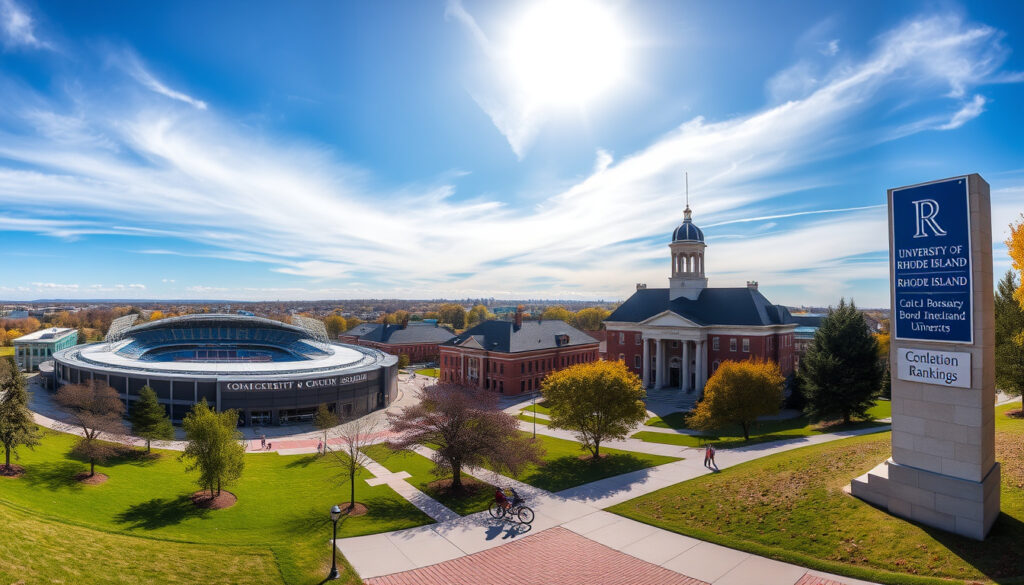
University of Rhode Island: D1, Rankings, and Admissions
When someone mentions Rhode Island colleges, Brown usually hogs the spotlight. The University of Rhode Island — the state’s public flagship — tends to sit in that shadow, even though the Wall Street Journal ranked it No. 1 among public universities in New England in its 2024 college rankings (Wall Street Journal). This guide sorts out what URI actually is: a Division I research university with real academic reach, a friendlier admissions bar than its private neighbors, and a cost structure that changes the math for in-state and out-of-state families alike.
Founded: 1892 · Classification: Doctoral Research (R2) · NCAA Division: Division I (Atlantic 10) · Undergrad Enrollment: ~14,000 · Acceptance Rate: 77% · U.S. News Ranking (Publics): #34
Quick snapshot
- URI is a Division I school and a full member of the Atlantic 10 Conference (Atlantic 10 Conference).
- The Wall Street Journal ranked URI the No. 1 public university in New England in 2024 (Wall Street Journal).
- U.S. News places URI at No. 34 among public national universities (U.S. News & World Report).
- The exact median GPA of the next admitted class won’t firm up until the cycle closes.
- URI’s tuition numbers for the next academic year aren’t finalized.
- Whether test-optional review continues beyond 2025 remains an open decision.
- 1888: founded as Rhode Island College of Agriculture and Mechanic Arts.
- 1951: renamed the University of Rhode Island.
- 2024: named the No. 1 public university in New England.
- Early Decision closes November 1; Early Action closes December 1.
- Test-optional admissions runs through the 2025 cycle.
- URI’s climbing rankings put the next national release in focus.
One pattern runs through the numbers below: URI pairs a large public-university reach with an admissions bar most solid students can clear (URI Office of Admission).
| Founded | 1892 |
| Location | Kingston, Rhode Island |
| Mascot | Rhody the Ram |
| NCAA Division | Division I — Atlantic 10 (Atlantic 10 Conference) |
| Acceptance Rate | 77% |
| Undergraduate Enrollment | ~14,000 |
| In-State Tuition & Fees | ~$15,000 |
| Out-of-State Tuition & Fees | ~$33,000 |
| U.S. News Public Ranking | #34 (U.S. News & World Report) |
Is URI a D1 School?
Yes — and it has been for decades. URI has competed at the Division I level since the 1980s and now holds full membership in the Atlantic 10 Conference, a league with a national TV footprint in college basketball (NCAA.com and Atlantic 10 Conference).
What NCAA conference does URI compete in?
- The Atlantic 10 Conference, URI’s home for most varsity sports.
- The A-10 is a Division I conference with regular national TV exposure in men’s and women’s basketball.
- URI’s mascot, Rhody the Ram, anchors the gameday identity.
What sports are URI known for?
- Basketball is URI’s highest-profile sport; Atlantic 10 play brings regional rivals to Kingston each winter.
- URI also fields Division I teams in football, baseball, soccer, and a full slate of women’s sports.
- For recruits, D1 status matters beyond sports: it funds facilities and gives the campus a year-round event calendar.
URI gives applicants a D1 campus culture without the admissions arms race of Power Five schools — students can cheer for Rhody the Ram on Saturday and still get into the university with a solid, non-elite profile.
The implication: URI’s D1 status is a structural advantage over Rhode Island College and most regional state universities, and it shows up in the out-of-state application numbers.
What Are the Admission Requirements for URI?
URI’s office describes a practical, holistic review that weighs the transcript, activities, and essay together. Admitted first-year students typically land in a middle-50% GPA range of 3.2–4.1, drawn from roughly 25,000 applications for an incoming class of about 3,300 (URI Office of Admission). The same profile notes that 24% of first-year students identify as students of color.
What GPA do I need for URI?
- Middle-50% GPA range for admitted first-years: 3.2–4.1.
- URI does not publish a stated minimum GPA; the transcript is reviewed in context.
- A GPA in the upper half of that range makes an applicant competitive for scholarship consideration.
Is URI test-optional?
- Yes. SAT and ACT scores are optional for first-year applicants in the current cycle.
- Students who submit scores still have them considered in review.
- Supplemental essays are required only for Honors, Nursing, Pharmacy, and Talent Development applicants.
How hard is it to get into URI?
- URI’s published acceptance rate is approximately 77% (URI Office of Admission).
- Roughly 25,000 applications versus 3,300 admits means the university can be selective where it matters — Honors, Nursing, Pharmacy, and Talent Development each run their own deeper review.
- For the general applicant, the odds are strong: a complete transcript and a clear essay matter more than a test score.
A 77% acceptance rate is a genuine door-opener, but the university’s most employable majors behave like selective programs inside a broad-access school — plan around the program, not the headline rate.
The pattern: the “hard to get into” question at URI is really a program-level question. The 77% figure describes the university; the professional schools describe a different, harder gate.
What Is the University of Rhode Island Known For?
URI’s academic reputation rests on several anchors: marine science, engineering, pharmacy, nursing, and business, spread across 92 majors and 10 colleges (URI Office of Admission). The ocean is never far from the curriculum, and that is a bigger differentiator than most applicants realize.
What are URI’s top majors?
- Pharmacy, nursing, and engineering are the most competitive programs and the ones employers recruit hardest.
- Business and the health professions draw the largest first-year interest.
- The 92 majors across 10 colleges include a full range of liberal arts, science, and professional degrees.
Is URI good for oceanography?
- Yes. URI’s Graduate School of Oceanography is a nationally recognized marine science institution (URI Graduate School of Oceanography).
- Students get access to research vessels and coastal labs on Narragansett Bay, not just classroom lectures.
- Marine biology and ocean engineering ride the same strength.
What is the campus vibe?
- 200+ student clubs and organizations keep the social calendar full.
- Division I athletics, gameday traditions, and a beach-adjacent location define the experience.
- Kingston is a real New England college town — students trade the city for open space and coastline.
URI’s coastal location is a genuine perk, but it comes with logistics: the campus is car-dependent, the nearest city is a drive away, and winter semester is a different climate than applicants from the South and Southwest expect.
The pattern: URI’s identity is anchored by the ocean and by professional programs that turn into jobs — and that combination is rare enough among New England publics to drive its ranking gains.
Is URI a Prestigious College?
Prestige is a mix of brand, selectivity, and research strength, and URI is honest about its lane: a public research university on the rise, not an Ivy. The Carnegie Classification lists URI as a Doctoral University with High Research Activity (R2) (Carnegie Classification of Institutions of Higher Education), and the Wall Street Journal ranked it the No. 1 public university in New England in 2024 (Wall Street Journal), with U.S. News placing it No. 34 among public national universities (U.S. News & World Report).
How does URI rank nationally?
- No. 34 among public national universities in the current U.S. News Best Colleges edition.
- No. 1 among New England public universities in the Wall Street Journal’s 2024 ranking.
- R2 doctoral research classification from the Carnegie system.
- URI’s spot in the next release is the one to watch: rankings momentum is moving in one direction.
Is URI an Ivy League school?
- No. Brown University, also in Rhode Island, is the state’s Ivy League member (Brown University).
- URI’s prestige is built on research output, professional programs, and student outcomes — not on centuries-old brand equity.
- For regional employers, URI is a known and respected name in engineering, pharmacy, nursing, and marine science.
A URI degree carries public-research prestige: the kind employers recognize in engineering, nursing, pharmacy, and marine science, where the university’s graduates are established — not the brand recognition Brown carries, but a closer tie to specific jobs.
The pattern: URI’s reputation is compounding because its research and rankings are compounding, and for students choosing a flagship over a private name, that trajectory is the metric that actually matters.
How Does URI Compare to Brown University and Rhode Island College?
Rhode Island’s higher-ed landscape comes down to three distinct institutions. Brown is a private Ivy with a published cost above $90,000 a year (Brown University); URI is the public research flagship; and Rhode Island College is a smaller, primarily teaching-focused state college (Rhode Island College). The three answer different questions.
How much does Brown cost vs URI?
- Brown’s total cost of attendance exceeds $90,000 per year (Brown University).
- URI’s in-state tuition and fees run about $15,000; out-of-state, about $33,000.
- At sticker price, one year at Brown covers roughly two and a half years of URI out-of-state tuition.
What kind of college is Rhode Island College?
- Rhode Island College is a public state college with a teaching-first mission and a smaller campus footprint (Rhode Island College).
- It does not carry URI’s doctoral research classification or Division I athletic profile.
- Its role in the state system is access-oriented: smaller classes, lower price, and fewer research expectations.
Can you get into Brown with a 1400 SAT score?
- A 1400 is a strong SAT score and well above URI’s typical test range — but for Brown, selectivity is a different world: the admit rate is among the lowest in the country.
- At URI, a student with a 1400 and a solid transcript is exactly the profile the university admits.
- For most families, the realistic frame is Brown as the reach, URI as the target, and Rhode Island College as the access option.
The trade-off: URI’s middle position is its strength and its compromise — it cannot promise Brown’s brand network, but it also does not charge Brown’s price, and that gap defines its value case.
What Is URI Out of State Tuition and Student Life Like?
URI’s published out-of-state tuition and fees sit at about $33,000 a year (URI Office of Admission). That is far below New England private schools, but it is no discount without the program match — out-of-state families should come for the major, not just the campus.
How much is URI for out-of-state students?
- Out-of-state tuition and fees: approximately $33,000 per year.
- Housing, meals, and expenses push total cost well beyond the tuition line.
- URI’s December 1 deadline is the priority scholarship cutoff; out-of-state applicants who miss it lose the clearest path to a reduced price.
What is there to do near URI?
- The main campus sits in Kingston, minutes from Narragansett Bay and southern Rhode Island’s beaches.
- Newport and Providence are close enough for day trips; Boston is about a 90-minute drive.
- Outdoor life — sailing, surfing, hiking — is part of the student experience.
Is URI a party school?
- URI has a lively social reputation, and Division I athletics feed a real gameday culture.
- The stereotype is louder than the actual profile: the university’s academic offerings — not the party scene — drive its rankings.
- On-campus housing fills early, and the surrounding Kingston rental market feeds the upperclass social scene.
For out-of-state families, URI’s pitch is concrete: a coastal research university with D1 sports and an active social scene at roughly a third of Brown’s published price.
The catch: out-of-state students pay nearly double the in-state rate, so the value case depends on URI offering a program — oceanography, pharmacy, engineering — that the home state’s public system cannot match.
URI vs. Brown vs. Rhode Island College: Side by Side
URI: Public R2 · Brown: Private Ivy · RIC: Teaching-focused state college
Three institutions, one split: Brown sells brand, URI sells research-and-D1 value, and Rhode Island College sells teaching and access (Brown University and Rhode Island College).
| Dimension | URI | Brown | Rhode Island College |
|---|---|---|---|
| Type | Public research university (R2) (Carnegie Classification) | Private Ivy League (Brown University) | Public state college, teaching-focused (Rhode Island College) |
| Founded | 1892 | 1764 (Brown University) | — |
| Published annual cost | ~$15K in-state / ~$33K out-of-state | $90,000+ | — |
| Athletics | NCAA Division I — Atlantic 10 | Ivy League athletics | State college athletics |
| Majors / concentrations | 92 majors | 80+ concentrations | — |
| Signature strength | Oceanography, pharmacy, nursing, engineering | Ivy prestige and elite selectivity | Teaching focus and access |
The implication: the choice between the three is not “which is better” but “which cost structure matches the degree the student actually wants.” URI wins the middle by being both a research university and a D1 school — at a public tuition level.
URI Admissions Specs: Deadlines, Tests, and Requirements
Remember: Dec 1 scholarship deadline · Test policy: Optional · Fee: $65
URI’s official first-year instructions keep the process conventional — Common Application, transcript, essay, and one recommendation — with two dates that change outcomes: December 1 for scholarships and February 1 for regular decision (URI Office of Undergraduate Admission).
| Application platform | Common Application |
| Application fee | $65 (waivers available) |
| Test policy | SAT/ACT optional through 2025 |
| High school units required | 18 college-preparatory units |
| English requirement | 4 years |
| Math requirement | 3 years (Algebra I, Algebra II, Geometry) |
| Essay & recommendation | Required |
| Supplemental essays | Honors, Nursing, Pharmacy, Talent Development only |
| Early Decision deadline | November 1 |
| Early Action & scholarship deadline | December 1 |
| Regular Decision deadline | February 1 (September start) |
| Deposit deadline | May 1 |
The pattern: URI runs a predictable calendar, and the December 1 cutoff is the one date that puts money back in a family’s pocket — miss it and scholarship consideration is gone.
Upsides
- Public-university value: about $15,000 in-state tuition and fees.
- Division I Atlantic 10 athletics with a real campus social calendar.
- Strong professional programs in pharmacy, nursing, engineering, and business.
- Test-optional through 2025, with a 77% acceptance rate that keeps the door open for solid students.
- Genuine marine-science strength and a coastal location near Narragansett Bay.
Downsides
- Out-of-state tuition around $33,000 is steep for a public, and total costs climb with housing and meals.
- Selective programs like pharmacy and nursing are much harder to enter than the 77% headline suggests.
- The party-school reputation, fair or not, follows the university.
- Kingston is a small-town campus; students who want a city environment will find it quiet.
- New England winters and a car-dependent layout make the campus feel isolated at times.
One year at Brown’s published price covers roughly two and a half years of URI out-of-state tuition; the prestige gap is real, and so is the price gap.
How to Apply to URI, Step by Step
- Pick your track: Early Decision (November 1), Early Action (December 1), or Regular Decision (February 1).
- Complete the Common Application.
- Pay the $65 fee or submit a fee waiver.
- Send your official high school transcript.
- Submit the admission essay and one letter of recommendation.
- Add supplemental essays for Honors, Nursing, Pharmacy, or Talent Development applications.
- Decide whether to send SAT or ACT scores — optional for fall 2025.
- Track decisions: Early Action by January 31, Regular Decision by March 31.
- Reserve your spot by May 1, when the enrollment and housing deposit is due.
All deadlines and requirements above come from URI’s published first-year instructions (URI Office of Undergraduate Admission). If a family remembers one date, it should be December 1 — the priority scholarship cutoff.
URI Timeline: 1888 to 2024
- 1888 — Rhode Island College of Agriculture and Mechanic Arts established.
- 1909 — Renamed Rhode Island State College.
- 1951 — Renamed the University of Rhode Island.
- 2024 — Named the No. 1 public university in New England by the Wall Street Journal (Wall Street Journal).
The pattern: URI built its scale for a century before the rankings caught up — the 2024 recognition is the result of that base, not a sudden change. A public university that keeps its tuition discipline while climbing research rankings is compounding the one asset families can bank on.
Confirmed facts
- URI is a Division I school in the Atlantic 10 Conference (Atlantic 10 Conference).
- URI’s published acceptance rate is approximately 77% (URI Office of Admission).
- URI is ranked No. 34 among public national universities by U.S. News (U.S. News & World Report).
- The Wall Street Journal ranked URI No. 1 among New England public universities in 2024 (Wall Street Journal).
What’s unclear
- The exact median GPA or class profile for the next incoming class isn’t fixed until admissions season closes.
- URI’s tuition rates for the next academic year, and any adjustment to out-of-state pricing, have not been finalized.
- Whether the test-optional policy continues beyond the 2025 cycle remains undecided.
- How the 77% university-wide admit rate will hold if URI’s rankings keep climbing and applications rise.
What the Sources Say
#1 Public in New England (WSJ) · #34 Public national (U.S. News) · R2 Research (Carnegie)
The Wall Street Journal ranked the University of Rhode Island the No. 1 public university in New England in its 2024 college rankings, a position driven by research scale and student outcomes.
— Wall Street Journal, 2024 (Wall Street Journal)
U.S. News & World Report places URI at No. 34 among public national universities in its Best Colleges edition, a position that continues to climb as URI strengthens its research profile.
— U.S. News & World Report, Best Colleges (U.S. News & World Report)
URI’s Office of Admission publishes a middle-50% GPA range of 3.2–4.1 for admitted first-year students and describes a first-year review that keeps SAT and ACT scores optional through the 2025 cycle.
— University of Rhode Island Office of Admission (URI Office of Admission)
The pattern: the sources agree on URI’s direction — the university is climbing on research and access, and its admissions profile reflects a school that wants strong students without becoming exclusive.
Rhode Island’s higher-ed market now offers three clear options, and the right one depends on what a family is buying. Brown sells an Ivy brand at more than $90,000 a year; Rhode Island College sells small classes and a state-access mission; URI sells research strength, Division I life, and a public price. For the out-of-state applicant weighing prestige against debt, the decision is clear: target URI’s December 1 scholarship deadline while keeping Brown as a reach — or accept full price at a school that may not actually serve the intended major better.
Related reading
- University of New Hampshire: Admissions, Prestige, and Reality — how another New England public flagship handles the same admissions questions.
- What Is a 1040 Form? Who Must File and How to Fill It — the form families need when sorting financial aid and college costs.
web.uri.edu, web.uri.edu, web.uri.edu, web.uri.edu, web.uri.edu, web.uri.edu
Frequently asked questions
Does URI have a campus store?
Yes. The University of Rhode Island Bookstore on the Kingston campus sells textbooks, apparel, and supplies, with online ordering available.
What is the graduation rate at URI?
URI’s six-year graduation rate is in line with its New England public-university peers; the university’s rankings gains are driven more by research output and student outcomes than by selectivity.
Does URI offer online degree programs?
Yes. URI Online offers undergraduate and graduate degrees and certificates for students who need flexibility.
Where is the University of Rhode Island located?
The main campus is in Kingston, Rhode Island, about 30 miles south of Providence and minutes from Narragansett Bay and the state’s southern beaches. URI also operates campuses in Providence and Narragansett.
How big is the URI campus?
URI’s Kingston campus is a large, traditional New England campus with on-campus housing for thousands of students, plus research facilities at Narragansett Bay.
Does URI require the SAT for 2025 admissions?
No. URI is test-optional through the 2025 cycle: SAT and ACT scores are not required for first-year review, but students can submit them if they choose.
Is there on-campus housing for graduate students?
Yes. URI offers some university-affiliated housing for graduate students, though space is more limited than for undergraduates.
More related posts
 WNBA Mock Draft 2025: Bueckers, Undrafted, & Eligibility
 Olivia Cooke Movies and TV Shows: Complete Guide to Her Roles
 The Simpsons Marge Simpson: Voice, Family, Age & Season 37
 Breakfast Burritos Near Me: Best Local & Fast Food
 Walker Scobell Movie and TV Show : Complete Guide
 Stuffed Bell Pepper Recipe: Tips, Fillings & Mistakes
 Star Trek Picard Cast: Full Cast Guide for All Seasons
 Aimee Lou Wood Movies and TV Shows: Full Filmography
