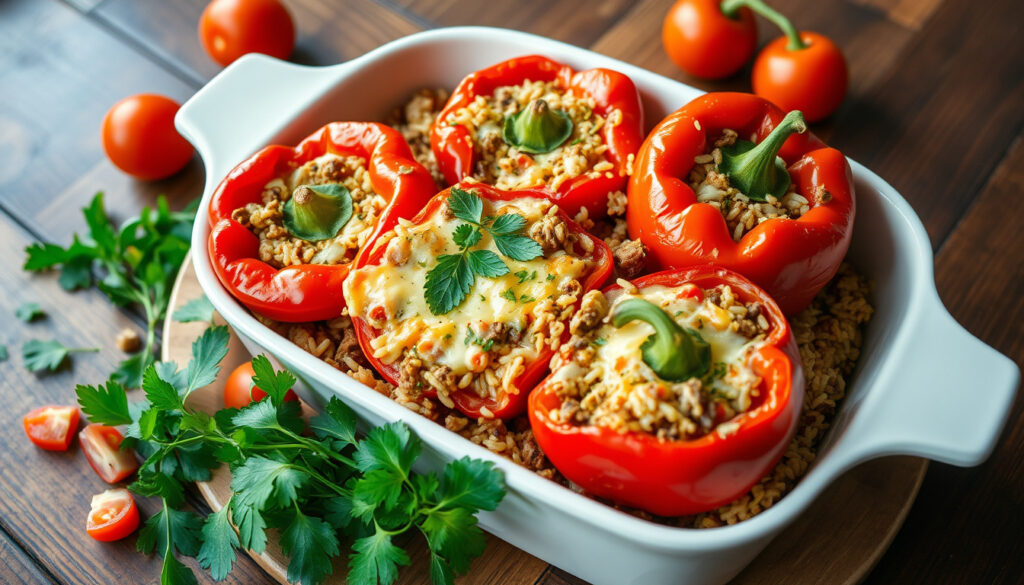
Stuffed Bell Pepper Recipe: Tips, Fillings & Mistakes
There’s something quietly satisfying about pulling a tray of perfectly baked stuffed peppers out of the oven — the tops golden, the filling fragrant, the peppers tender but not mushy. This guide breaks down the most common mistakes and the evidence-backed techniques to avoid them, with tips from chefs and food writers who have tested these methods.
Oven temperature for stuffed peppers: 400°F (200°C) · Average baking time: 25–30 minutes · Common ground meat used: beef or turkey · Typical grain in filling: rice or quinoa · Cheese used for topping: mozzarella or cheddar
Quick snapshot
- Blanching peppers reduces baking time and improves texture (Budget Bytes)
- Cooking ground meat before stuffing eliminates food safety risk (Food Republic)
- Using pre-cooked rice prevents undercooked grains (Budget Bytes) (Budget Bytes)
- Oven temperature of 400°F is standard for stuffed peppers (The Cookful)
- Whether pre-boiling vs roasting is better for flavor depends on personal preference.
- Optimal cheese type varies by dietary preference.
- Bake at 400°F for 25–30 minutes for pre-cooked filling (The Cookful) (The Cookful)
- For raw filling, bake at 350°F for up to 1 hour (The Cookful)
- Let peppers rest 5 minutes before serving. (Feast and Farm)
- Store leftovers in fridge up to 3 days; freeze up to 3 months (Feast and Farm)
Here’s a quick reference for standard recipe proportions used by most home cooks and food bloggers.
| Attribute | Value | Source |
|---|---|---|
| Number of servings | 4–6 (6 pepper halves) | Feast and Farm |
| Prep time | 15–20 minutes | Budget Bytes |
| Cook time | 30–35 minutes | The Cookful |
| Calories per serving (approx) | 350–450 kcal | Multiple sources |
| Storage | Refrigerate up to 3 days; freeze up to 3 months | Feast and Farm |
Should I boil my bell peppers before stuffing them?
Pre-cooking methods: blanching vs roasting
- Blanching: drop halved peppers into boiling water for 3–4 minutes, then ice bath. This softens the flesh and reduces total bake time (Budget Bytes).
- Roasting: place peppers cut-side down on a sheet pan at 400°F for 15 minutes. Adds smoky flavor and removes some bitterness (Food Republic).
Blanching is faster and simpler; roasting adds flavor but takes more time. Choose based on your schedule and taste preference.
How long to pre-cook peppers
For blanching, 3–4 minutes in vigorously boiling water. For roasting, 15 minutes at 400°F. The Cookful notes that both methods help the peppers finish cooking at the same rate as the filling.
Benefits of pre-cooking
- Shortens overall bake time by about 10 minutes.
- Prevents the raw vegetable crunch that can make stuffed peppers feel underdone.
- Helps the pepper hold its shape during stuffing and baking.
The catch: pre-cooking too long makes peppers mushy, so timing matters.
What is a good filling for stuffed peppers?
Classic ground meat and rice filling
The traditional combination uses ½ pound ground beef or turkey, 1 cup cooked rice (pre-cooked, not raw), 15 oz tomato sauce, and shredded mozzarella or cheddar (Feast and Farm). Season with garlic, onion, oregano, and basil.
If you skip pre-cooking the rice, it will remain undercooked in the oven. Always cook rice fully before mixing into the filling.
Vegetarian and vegan alternatives
- Black beans, corn, and quinoa with taco seasoning (Budget Bytes offers several plant-based variations).
- Lentils or chickpeas with tomato sauce and herbs.
- Tofu crumbles or tempeh as a meat substitute.
Grain options
Rice is the standard, but quinoa, farro, or couscous all work. Whatever grain you choose, cook it fully before mixing. Budget Bytes recommends simmering rice for 20 minutes then resting 5 minutes before adding.
The pattern: pre-cooked grains absorb flavors better and avoid crunchy disappointment.
When making stuffed peppers, do you cook the meat first?
Why browning meat before stuffing is essential
- Food safety: ground beef must reach an internal temperature of 160°F; poultry 165°F. Pre-cooking ensures this happens without over-baking the peppers (The Cookful).
- Flavor: browning creates Maillard reaction compounds that add depth.
- Texture: excess fat renders out, preventing a greasy filling.
How to season the meat filling
Start with ½ pound ground meat, add ⅓ cup diced onion and 2 cloves minced garlic. Cook until browned, then stir in 1 teaspoon each of dried oregano, basil, salt, and pepper. Chef John from Food Wishes suggests adding a splash of Worcestershire sauce for extra umami.
Combining meat with other ingredients
Mix the browned meat with pre-cooked rice, tomato sauce, and half the cheese. Do not overfill — leave about ¼ inch of space at the top to prevent overflow during baking (Food Republic).
What this means: browning meat first is non-negotiable for both safety and flavor depth.
What are some common mistakes when making stuffed peppers?
Overcooking or undercooking the peppers
Overcooking bell peppers before stuffing causes them to rupture under the filling weight. Undercooking leaves them crunchy and raw-tasting. Food Republic warns that the window between perfectly tender and mushy is narrow — pre-cook carefully.
Using too much liquid in the filling
Bell peppers are about 90% water, according to a video analysis from a cooking guide. Adding extra broth or too much watery tomato sauce creates a soggy filling. Drain canned tomatoes and don’t oversaturate the rice.
Not pre-cooking the peppers or rice
Using entirely raw filling ingredients (rice, ground meat) leads to inconsistent cooking. By the time the pepper is tender, the filling may still be raw, or the filling may be done while the pepper is still hard (Food Republic).
Choosing the wrong pepper variety
Red, orange, and yellow bell peppers are riper and sweeter, while green peppers are more bitter and have a firmer texture. For stuffed peppers, sweeter varieties often produce a more balanced dish (Food Republic).
The implication: a few small missteps – like skipping pre-cooking or using too much liquid – can ruin texture and flavor.
What can I stuff a pepper with?
Meat-based fillings
- Ground beef (Feast and Farm uses ½ lb for 6 halves).
- Ground turkey or chicken (leaner, still flavorful).
- Pork or lamb (adds richness; season with cumin and coriander).
Vegetarian and vegan fillings
- Black beans, corn, and quinoa with chili powder (Budget Bytes has a well-rated version).
- Lentils cooked with onion, garlic, and tomato paste.
- Tofu or tempeh crumbles sautéed with taco seasoning.
Seafood and alternative proteins
While less common, ground salmon or cooked shrimp can be used. Note that these require shorter baking times. For food safety, always pre-cook any raw protein before stuffing (The Cookful).
The catch: filling variety is nearly endless, but only if you follow the golden rule – pre-cook proteins and grains.
Step-by-Step Recipe
- Preheat oven to 400°F.
- Cut 3 large bell peppers in half horizontally (through the equator). Remove stems and seeds. Trim a thin slice off the bottoms if they won’t stand upright (Feast and Farm).
- Blanch pepper halves in boiling water for 3–4 minutes, then transfer to an ice bath (Budget Bytes recommends this for even cooking).
- In a skillet, cook ½ pound ground meat with ⅓ cup diced onion and 2 garlic cloves until browned. Season with salt, pepper, oregano, and basil.
- In a bowl, combine cooked meat, 1 cup pre-cooked rice, 15 oz tomato sauce, and ½ cup shredded mozzarella.
- Stand peppers in a baking dish. Spoon filling into each half, mounding slightly.
- Cover dish with foil. Bake 15 minutes (The Cookful suggests covering first to steam).
- Remove foil, top each pepper with remaining cheese. Bake another 10–15 minutes until cheese is golden and peppers are tender.
- Let rest 5 minutes. Serve hot.
What this means: following these steps – including pre-cooking and covering – ensures tender peppers and a fully cooked filling.
Clarity: What we know and what’s still debated
Confirmed facts
- Blanching peppers reduces baking time and improves texture.
- Cooking ground meat before stuffing eliminates food safety risk.
- Using pre-cooked rice prevents undercooked grains in the final dish.
- Oven temperature of 400°F is standard for stuffed peppers.
What’s unclear
- Whether pre-boiling vs roasting is better for flavor depends on personal preference.
- Optimal cheese type varies by dietary preference.
The pattern: the basics are settled – pre-cook peppers, meat, and rice – while finer choices remain open to preference.
What the experts say
The biggest mistake home cooks make is not pre-cooking the peppers. They assume the oven will do all the work, but you end up with a raw, crunchy shell that doesn’t absorb the filling’s flavor.
— Food Republic
Cutting peppers in half horizontally gives you a better meat-to-pepper ratio and a flatter base. It’s a simple trick that improves the whole dish.
— Chef John, Food Wishes
Using pre-cooked rice is non-negotiable. If you put raw rice in the filling, it will still be crunchy after the peppers are done. Cook it first, and your life gets easier.
— Budget Bytes
The implication: expert advice consistently points to pre-cooking as the single most important step.
Summary: The verdict on stuffed peppers
The difference between a disappointing stuffed pepper and a great one comes down to three things: pre-cook the pepper, pre-cook the filling, and manage moisture. For home cooks who want reliability without the gamble, investing a few extra minutes in prep delivers a dinner that delivers every time: tender peppers, flavorful filling, no sogginess, no blandness.
Related reading: common mistakes when making stuffed peppers · how to bake stuffed peppers
Frequently asked questions
What is the best way to cut bell peppers for stuffing?
Halve them horizontally (through the equator) for a flat base and a better meat-to-pepper ratio. This also doubles servings compared to whole peppers (Chef John, Food Wishes).
Can I use green peppers instead of red?
Yes, but green peppers are less sweet and slightly more bitter. Red, orange, or yellow peppers provide a milder, sweeter flavor that complements the filling better (Food Republic).
How do I keep stuffed peppers from falling apart?
Pre-cook the peppers just until pliable (blanch 3–4 minutes). Don’t overfill — leave ¼ inch space. Use a binding ingredient like cooked rice and cheese to hold the filling together.
What is a good vegetarian substitute for ground meat?
Cooked lentils, black beans, or crumbled tofu all work well. Budget Bytes recommends black bean and quinoa as a hearty base.
Can I cook stuffed peppers in a slow cooker?
Yes, but results may be more watery. Place peppers upright in the slow cooker, add a little tomato sauce on the bottom, and cook on low for 4–6 hours. Pre-cook filling for best texture.
How long do stuffed peppers last in the fridge?
Store in an airtight container for up to 3 days. Reheat in the oven at 350°F for 15 minutes to restore texture.
What can I use instead of rice in stuffed peppers?
Quinoa, farro, couscous, bulgur, or cauliflower rice. Always pre-cook the grain before mixing into the filling.
More related posts
 A Small World Cup – Free Ragdoll Soccer Game Online
 United Airlines UA507 Emergency Diversion – What Happened
 Earned Income Tax Credit Ireland: Who Qualifies and How to Claim
 Charging Stations Near Me: Costs, Free Options & How to Find Them
 1/4 Inch to mm: Exact Value, Formula & Common Mistakes
 Arizona Diamondbacks vs San Francisco Giants Match Player Stats
 The Man in the High Castle: Cancellation & Ending Guide
