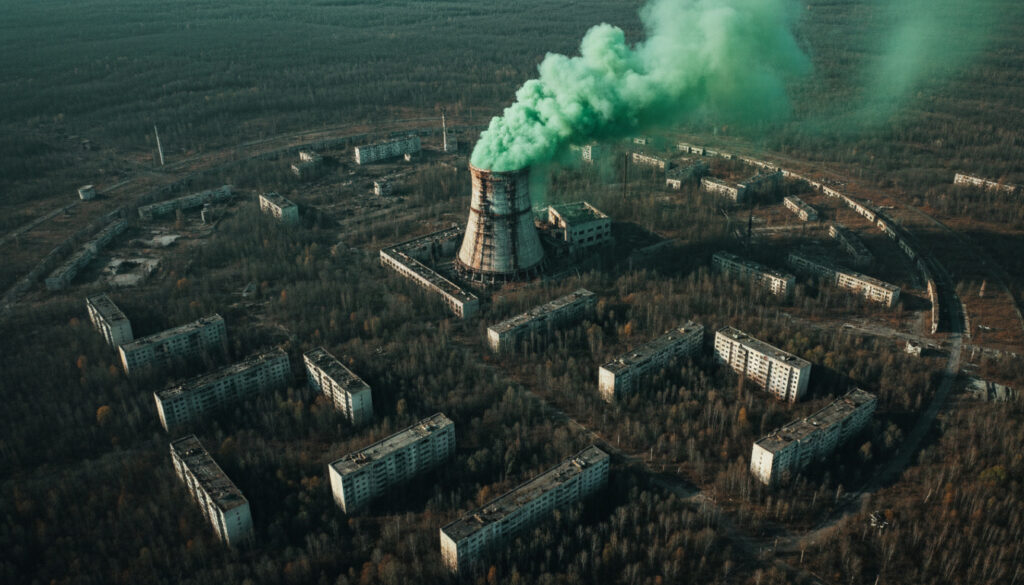
Chernobyl Miniseries – Plot, Cast, Accuracy and Facts
The 2019 HBO miniseries Chernobyl reconstructs the catastrophic 1986 nuclear disaster with unflinching precision. Over five episodes, the drama traces the explosion at the Chernobyl Nuclear Power Plant and the subsequent crisis that threatened millions across Europe.
Created by Craig Mazin and directed by Johan Renck, the series eschews sensationalism for methodical storytelling. It examines the human cost through scientists, politicians, and first responders who confronted an invisible enemy.
Released to universal acclaim, the production garnered ten Emmy Awards and sparked renewed global interest in one of history’s worst man-made disasters.
What Is the Chernobyl Miniseries About?
5-episode HBO miniseries (2019)
Craig Mazin
Jared Harris, Stellan Skarsgård
10 Emmys, 96% Rotten Tomatoes
- Historical Foundation: The narrative dramatizes the April 26, 1986 explosion at Reactor 4 and its immediate aftermath.
- Scope: Episodes cover the initial containment efforts, the risk of a secondary thermal explosion, and the subsequent trial of plant officials.
- Thematic Focus: Central themes include Soviet institutional secrecy, scientific heroism, and the physical toll of radiation exposure.
- Critical Reception: Critics praised the series for sustained tension and meticulous production design, earning near-perfect aggregate scores.
- Cultural Impact: The broadcast generated significant tourism increases to the Chernobyl Exclusion Zone and renewed debate over nuclear safety.
| Fact | Detail |
|---|---|
| Release Date | May 6, 2019 |
| Final Episode | June 3, 2019 |
| Episodes | 5 |
| Runtime per Episode | 60–72 minutes |
| Primary Platform | Max (formerly HBO Max) |
| Production Partners | HBO (US) and Sky UK |
| Filming Locations | Lithuania and Ukraine |
| Emmy Wins (2019) | 10 including Outstanding Limited Series |
| Writers Guild Recognition | Scripts released as free PDFs June 2019 |
Is the Chernobyl Miniseries Accurate to True Events?
The series grounds its narrative in documented history while acknowledging necessary dramatic adjustments. Historical records confirm the core events: the reactor explosion occurred on April 26, 1986, and the subsequent cleanup involved massive human sacrifice.
Most central characters represent real individuals. Valery Legasov served as deputy director of the Kurchatov Institute and led scientific efforts to contain the disaster. Boris Shcherbina held the position of deputy chairman of the Council of Ministers. Anatoly Dyatlov operated as deputy chief engineer during the fateful safety test.
Ulana Khomyuk, portrayed by Emily Watson, does not represent a single historical figure. Mazin confirmed the character composites multiple Soviet scientists who investigated the disaster, particularly those from the Belarusian Academy of Sciences.
Creator Craig Mazin prioritized historical fidelity but consolidated timelines and characters for narrative clarity. The companion podcast details specific deviations, including reconstructed dialogues and condensed institutional responses.
Cast and Crew Behind Chernobyl
Principal Cast
Jared Harris anchors the series as Valery Legasov, capturing the physicist’s transformation from institutional loyalist to whistleblower. Stellan Skarsgård portrays Boris Shcherbina, the government official navigating bureaucratic obstruction while confronting the crisis’s severity.
Emily Watson appears as Ulana Khomyuk, the fictional physicist who uncovers the reactor design flaws. Paul Ritter plays Anatoly Dyatlov, the engineer whose decisions during the safety test remain historically contentious. Jessie Buckley delivers a harrowing performance as Lyudmilla Ignatenko, wife of firefighter Vasily Ignatenko (Adam Nagaitis).
Supporting performances include Con O’Neill as plant director Viktor Bryukhanov, Adrian Rawlins as chief engineer Nikolai Fomin, and David Dencik as General Secretary Mikhail Gorbachev.
Production Team
Craig Mazin wrote all five episodes and served as executive producer alongside Carolyn Strauss and Jane Featherstone. Johan Renck directed the entire series, maintaining visual continuity across episodes. The production filmed primarily in Vilnius, Lithuania, utilizing decommissioned Soviet-era power plants to replicate the Chernobyl facility.
Where to Watch the Chernobyl Miniseries
The miniseries premiered on HBO on May 6, 2019, with the finale airing June 3, 2019. The complete series currently streams exclusively on Max in the United States.
Subscription availability varies by region. The series moved to the Max platform following the 2023 rebranding of HBO Max. Physical media editions include Blu-ray and DVD releases containing supplementary documentary material.
International broadcast rights reside with Sky Atlantic in the United Kingdom and various regional partners globally. Unlike the Karate Kid Legends Cast reunion projects, this production maintains a singular, complete narrative without sequel installments.
Episode Guide and Release Chronology
- : Principal photography commences in Lithuania and Ukraine, utilizing Soviet-era facilities to ensure architectural authenticity.
- : “1:23:45” premieres on HBO, depicting the explosion and immediate emergency response.
- : “Please Remain Calm” airs, introducing the threat of a second explosion and Ulana Khomyuk’s investigation.
- : “Open Wide, O Earth” broadcast, focusing on Lyudmilla Ignatenko’s personal tragedy and decontamination planning.
- : “The Happiness of All Mankind” details the robotic debris clearance and biorobot operations.
- : Finale “Vichnaya Pamyat” (“Memory Eternal”) airs, covering the 1987 trial and Legasov’s testimony.
- : The series dominates the 71st Primetime Emmy Awards, securing ten statues including Outstanding Limited Series.
- : Content migrates to Max platform following Warner Bros. Discovery streaming restructuring.
Distinguishing Documented Facts From Dramatic License
- The reactor explosion occurred April 26, 1986 during a safety test
- Legasov and Shcherbina led the government response
- Firefighters suffered acute radiation syndrome
- The sarcophagus required human labor to construct
- Design flaws in RBMK reactors were classified state secrets
- Specific dialogue between officials (reconstructed)
- Ulana Khomyuk as a single individual (composite character)
- Exact timeline of radiation discovery (condensed)
- Khomyuk’s interactions with Legasov (invented for narrative)
- Some personal relationship details (dramatic license)
Cultural Resonance and Historical Reckoning
The series arrived during renewed global anxieties about institutional transparency and ecological catastrophe. By emphasizing the human cost over technical minutiae, the production resonated with audiences unfamiliar with nuclear engineering. Tourism to the Chernobyl Exclusion Zone increased approximately 40% following the broadcast, according to Ukrainian government data.
In Russia and Ukraine, the series prompted debate about historical memory and Soviet culpability. Unlike celebrity personal narratives such as the Zahara Jolie-Pitt Spelman Name Change, this production focused on systemic institutional failures and collective sacrifice.
Educational institutions incorporated the series into curricula covering Cold War history and engineering ethics. The release of Mazin’s shooting scripts as free PDFs in June 2019 facilitated academic analysis of the adaptation process.
Statements from the Creator and Cast
“The lesson of Chernobyl isn’t about nuclear power. It’s about what happens when you refuse to accept unwelcome information, when you prioritize your own ego over the truth.”
— Craig Mazin, Creator/Writer
“We weren’t interested in villainy. We were interested in the architecture of denial.”
— Jared Harris regarding Legasov’s character
While the series accurately depicts acute radiation syndrome symptoms and mortality rates, some medical professionals noted that the speed of certain character deaths was accelerated for dramatic effect. The official production materials acknowledge these timeline compressions.
Why Chernobyl Remains Essential Viewing
The Chernobyl miniseries succeeds by transforming technical catastrophe into human tragedy without sacrificing historical integrity. Through meticulous performances by Jared Harris and Stellan Skarsgård, alongside Craig Mazin’s researched screenplay, the five-episode arc delivers both educational value and profound emotional impact. Its examination of institutional denial remains urgently relevant.
Frequently Asked Questions
Does Chernobyl miniseries have a season 2?
No. The production concluded as a complete limited series after five episodes. Craig Mazin and HBO have not announced continuation plans.
Where can I watch the Chernobyl miniseries trailer?
Official trailers featuring cast and creator interviews are available on HBO’s Max platform and YouTube.
How many episodes are in Chernobyl?
The series contains five episodes, with runtimes ranging from 60 to 72 minutes each.
Is the Chernobyl miniseries suitable for all audiences?
The series contains graphic depictions of radiation sickness injuries and intense emotional content. Viewer discretion is advised for sensitive audiences.
Did the real Valery Legasov record tapes?
Yes. Legasov recorded audio cassettes detailing the disaster and its causes. These recordings circulated among Soviet scientists and contributed to the historical record, though their exact discovery timeline was adjusted for the series.
What does “Vichnaya Pamyat” mean?
The finale’s title translates from Ukrainian and Russian as “Memory Eternal,” a traditional funeral remembrance phrase reflecting the episode’s memorial theme.
Are the miners and biorobots portrayed accurately?
The coal miners who tunneled beneath the reactor and the “biorobots” (soldiers clearing radioactive debris) were real contingents. Their portrayal draws from documented accounts, though individual characterizations are dramatized.
Why did Emily Watson play a fictional character?
Mazin created Ulana Khomyuk to represent the numerous female scientists from Belarus and Ukraine who contributed to the investigation, consolidating their work into a single narrative perspective.
More related posts
 Broadway at the Beach: Walking, Flags, and Local Tips
 Dining Table Set for 6: Verified Facts & Dimensions
 Catherine the Great Furniture: The Erotic Cabinet Mystery
 When Did the PS5 Come Out? Launch Date, Regions & Variants
 Part Time Job Near Me: Find Jobs in Dublin & Get Hired 2025
 Stages of Hand, Foot and Mouth Disease: Day-by-Day Guide
 3I/ATLAS Interstellar Object: Facts, Risk & NASA Updates
