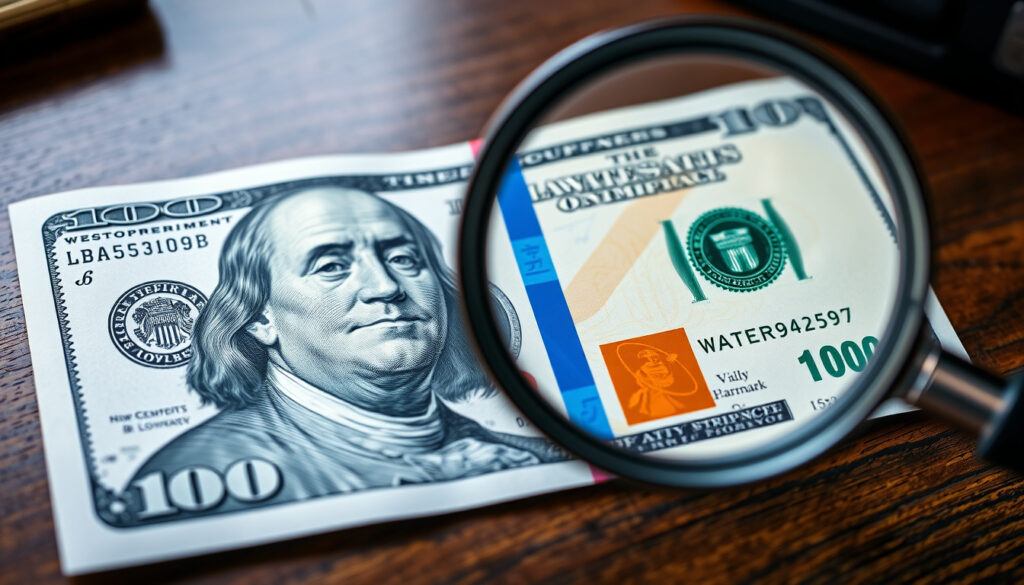
New $100 Bill: Security Features, Old vs. New, How to Spot Fakes
You’ve probably held a $100 bill and wondered about that blue stripe — or whether the old bills in your wallet are still worth anything. The new $100 bill, officially issued as Series 2013, brought the most dramatic security upgrade to U.S. currency in decades, and understanding its features is simpler than most people think.
Current $100 bill series introduced: 2013 ·
Cost to produce one $100 bill: 12.5 cents ·
Security features on new $100 bill: Over 10, including 3D security ribbon and color-shifting bell ·
Old $100 bill legal tender status: Still valid for all transactions ·
Estimated lifespan of a $100 bill: About 15 years
Quick snapshot
- Current $100 bill is Series 2013, released October 8, 2013 (BBC News)
- Blue 3D security ribbon is woven into paper, not printed (U.S. Currency Education Program)
- Old $100 bills remain legal tender regardless of series (Wikipedia)
- Exact release date for a potential next full redesign beyond signature changes
- Whether a completely new security overhaul will be introduced in the near future
- July 2026: President Trump posted image of $100 bill with his signature, but no design overhaul announced (CNN)
- No official announcement of a new security redesign beyond the current Series 2013
- Signature updates may occur with Treasury Secretary changes
Here are the essential details about the Series 2013 $100 bill.
| Label | Value |
|---|---|
| Issued | October 8, 2013 |
| Series | Series 2013 |
| Portrait | Benjamin Franklin |
| Cost per note | 12.5 cents |
| Security ribbon | Blue 3D, woven, not printed |
| Color-shifting ink | Bell in inkwell changes copper to green |
| Watermark | Portrait of Benjamin Franklin visible from both sides |
| Security thread under UV | Glows pink |
| Raised printing | Intaglio printing on portrait and numerals |
| Microprinting | Present on collar, borders, and numerals |
Is there a new $100 bill coming out?
When was the current $100 bill issued?
- The current $100 bill — Series 2013 — entered circulation on October 8, 2013 (BBC News).
- It was originally scheduled for 2010 but delayed due to a production flaw involving the security ribbon (Wikipedia (U.S. hundred-dollar note)).
- The redesign included the blue 3D security ribbon and color-shifting bell — the most significant security upgrade since the 1996 series (CNET (technology news)).
Will a new $100 bill be released in 2026?
- No official announcement has been made by the Federal Reserve or Treasury for a new security redesign in 2026.
- In July 2026, President Trump posted an image of a $100 bill bearing his signature, but this was a signature update — not a design overhaul (CNN (political news)).
- The Series 2013 note remains the current standard issue.
The pattern: signature updates follow Treasury Secretary changes, but a full security redesign requires years of development. No timeline for that has been set.
The Bureau of Engraving and Printing typically announces new series years when a Treasury Secretary signs the note. A signature change signals new production, but not new security features. The next meaningful redesign will come with a public safety rationale.
What is the newest series 100 dollar bill?
What series is the latest $100 bill?
- The latest is Series 2013, which began circulating October 8, 2013 (BBC News).
- Series 2009 and earlier used older designs without the blue 3D ribbon or color-shifting bell.
- Series 2013 replaced the Series 2009 note, which had only been in production for a few years and lacked the advanced security ribbon (Wikipedia).
How can I find the series year on a $100 bill?
- Look at the face of the note: the series year is printed in the bottom right corner, near Benjamin Franklin’s portrait.
- It appears near the Federal Reserve seal and includes the series year (e.g., “SERIES 2013”).
- Notes printed after 2013 may also have signatures from different Treasury officials but the series designation remains “2013” unless a new series is released.
What this means: the series year is your quickest reference for whether a bill belongs to the current generation or an older one. Any bill marked 2013 or later has the blue ribbon and color-shifting bell.
What are the differences between the old and new US 100-dollar bills?
Six major differences separate the old Series 2009 (and earlier) from the new Series 2013 — and one visual cue makes identification immediate.
| Feature | Old $100 bill (pre-2013) | New $100 bill (Series 2013) |
|---|---|---|
| 3D security ribbon | None | Blue woven ribbon with moving bells and “100” |
| Color-shifting inkwell | None | Copper bell turns green when tilted |
| Watermark | Portrait watermark | Enhanced portrait watermark, visible both sides |
| Security thread under UV | Solid thread glows differently | Thread glows pink under UV light |
| Raised intaglio printing | Present | Enhanced, especially on portrait and large “100” |
| Microprinting | Limited | Extensive: collar, borders, numerals |
The trade-off: older bills lack the blue ribbon entirely, making them visually distinct — but both remain legal tender. The ribbon is the single fastest way to spot a Series 2013 note at a glance.
For the average person, the blue 3D ribbon eliminates confusion. If you see a blue strip woven into the paper (not printed on top), you’re holding a Series 2013 note. No ribbon means a pre-2013 bill — still valid, just with fewer anti-counterfeit layers.
Thus the blue ribbon is the definitive visual cue between old and new designs.
What security features were added to the new $100 bill?
- 3D security ribbon: Woven into the paper — when tilted, bells and “100” images move side to side and up and down (U.S. Currency Education Program).
- Color-shifting bell: The bell in the copper inkwell changes from copper to green when the note is tilted (BBC News).
- Watermark portrait: A faint image of Benjamin Franklin visible from both sides when held to light (Chase Alumni Association).
- UV security thread: Embedded vertical thread glows pink under ultraviolet light.
- Microprinting: Tiny text on Franklin’s collar, the borders, and the large numeral 100.
- Raised intaglio printing: The portrait and “100” numerals have a distinct texture you can feel.
How does the blue ribbon differ from older designs?
- The blue ribbon is woven into the paper itself — it is not a printed strip (CNET (technology news)).
- It contains thousands of microscopic lenses that create the illusion of movement (Chase Alumni Association).
- Older $100 bills had a solid security thread without the lens-based movement effect.
- The ribbon’s color is a distinct blue — no previous U.S. denomination used a visible colored ribbon woven into paper.
How to tell if a new $100 bill is real
What are the steps to verify a $100 bill?
- Step 1 — Tilt for the ribbon: Hold the bill and tilt it. The blue ribbon’s images of bells should shift to “100” as you move it (U.S. Currency Education Program).
- Step 2 — Check the bell: Tilt the bill to see the copper bell in the inkwell change from copper to green (BBC News).
- Step 3 — Look for the watermark: Hold the bill up to the light. A faint portrait of Benjamin Franklin should appear on the right side (Chase Alumni Association).
- Step 4 — Check under UV light: The security thread glows pink under ultraviolet light.
- Step 5 — Feel the texture: Real currency is printed on cotton-linen paper with raised intaglio printing that you can feel on the portrait and large “100” (Wikipedia).
- Step 6 — Check microprinting: Look for tiny text on Franklin’s collar and along the borders of the note.
What tools are needed to check authenticity?
- No tools required for Steps 1-3: Tilt and light checks can be done anywhere.
- UV light: A basic UV lamp (often found at retail counters) reveals the pink glowing thread.
- Magnifying glass: Useful for microprinting verification but not essential for the tilt test.
- Most counterfeits fail the tilt test — the ribbon movement is extremely difficult to replicate.
The implication: you can verify a $100 bill’s authenticity in about 15 seconds without any special equipment. The tilt test alone catches nearly all amateur counterfeits.
Do all $100 bills have a blue stripe?
What is the blue stripe on a $100 bill?
- The blue stripe is the 3D security ribbon — a woven ribbon embedded in the paper, not printed on the surface (U.S. Currency Education Program).
- It contains microscopic lenses that create a moving effect when tilted.
- The ribbon runs vertically from the top to the bottom of the note, slightly right of center.
Which $100 bills have the 3D security ribbon?
- Only Series 2013 and later $100 bills have the blue 3D ribbon (BBC News).
- All older series (Series 2009 and earlier) do not have the blue ribbon.
- The ribbon is exclusive to the $100 denomination — no other U.S. note uses a colored woven ribbon.
Why this matters: if you see a $100 bill without the blue ribbon, it is simply an older design — not counterfeit. The ribbon is the differentiator, not a test of validity.
Can I still use old 100-dollar bills?
Are old $100 bills still legal tender?
- Yes. All U.S. currency regardless of series remains legal tender for all debts, public and private (Wikipedia).
- The U.S. government does not recall or demonetize old series notes.
- Merchants may refuse any banknote for their own business reasons, but legally the bill is valid.
Will banks accept old $100 bills?
- Banks accept old $100 bills for deposit, exchange, and withdrawal.
- You can exchange old-style $100 bills for new ones at most banks, though some may have limits on currency exchanges without an account.
- The Federal Reserve continues to distribute older series notes until they are worn out and removed from circulation.
The trade-off: while old bills are legal tender, some businesses with counterfeit-detection policies may be more cautious with pre-2013 notes because they lack the latest security features. If you’re traveling or making a large purchase, using Series 2013 notes reduces friction.
What does a fake $100 bill feel like?
What texture differences indicate a counterfeit?
- Real currency is printed on a blend of 75% cotton and 25% linen — distinct from standard paper.
- Authentic bills have a crisp, slightly rough texture due to intaglio printing.
- Counterfeits often feel stiffer, waxy, or too smooth compared to genuine currency.
- The raised printing on the portrait and numerals should be palpable — fakes typically lack this depth.
Are there common paper mismatches in fake $100 bills?
- Many counterfeits use standard printer paper, which lacks the cotton-linen blend’s durability and distinct feel.
- Fake bills may tear more easily or feel thinner than genuine notes.
- Some counterfeits attempt to simulate texture with coatings, but they rarely replicate the specific resistance of real currency paper.
The catch: texture-based detection is reliable only if you handle currency regularly. For most people, the tilt test remains the fastest and most accurate method.
Counterfeiters try to replicate the blue ribbon, but the movement effect — bells shifting to “100” — is nearly impossible to fake with standard printing. The tilt test is your single best defense because it tests the one feature counterfeiters cannot currently reproduce.
Therefore, the tilt test is recommended as the primary verification method.
Timeline: The $100 bill through history
- 1914: First $100 Federal Reserve Note issued with portrait of Benjamin Franklin.
- 1996: Series 1996 introduced with enlarged portrait and watermark for the first time (Wikipedia).
- 2010 (scheduled): Planned release of the redesigned $100 note delayed due to a production flaw in the security ribbon.
- October 8, 2013: Series 2013 $100 bill enters circulation — blue 3D security ribbon and color-shifting bell debut (BBC News).
- July 2026: President Trump posts image of $100 bill with his signature — no new design overhaul announced (CNN (political news)).
The pattern: major redesigns happen roughly every 15-20 years. The 2013 note replaced a 1996-era design. The next full redesign may not arrive until the late 2020s or early 2030s.
Confirmed facts and what remains unclear
Confirmed facts
- The current $100 bill is Series 2013, released October 8, 2013 (BBC News).
- Old $100 bills (all previous series) remain legal tender (Wikipedia).
- The blue 3D security ribbon is a woven feature present only on Series 2013 and later notes (U.S. Currency Education Program).
What remains unclear
- The exact release date for a potential next full redesign (beyond signature changes) is unknown.
- Whether the Federal Reserve will introduce a new design with different colors or materials.
- Whether any future redesign will retain the blue ribbon or replace it with a different technology.
- Whether the color-shifting bell will appear in future denominations.
- Whether the cotton-linen paper composition will be maintained in future redesigns.
“The security features in the redesigned $100 note are intended to be easy for the public to verify but difficult for counterfeiters to reproduce.”
— U.S. Currency Education Program (Decoding Dollars PDF)
“The new $100 bill includes a blue 3D security ribbon and a color-shifting bell — features that make it one of the most secure notes ever produced.”
— BBC News (technology reporting)
For the average person in the U.S., the choice is straightforward: use Series 2013 notes for the easiest verification. For travelers particularly, carrying new bills reduces scrutiny at exchange counters and retail outlets. The old bills still spend just fine — but when you can tilt and see that bell change color, you have confidence no counterfeit can match.
youtube.com, wikihow.com, securitymagazine.com, youtube.com, wikihow.com, reddit.com, youtube.com
Frequently asked questions
Are new $100 bills worth more than old ones?
No. All U.S. $100 bills are worth exactly $100 regardless of series year. The U.S. government does not assign premium value to newer designs. Collectors may pay more for certain rare series, but face value remains the same for everyday use.
How long does a $100 bill typically last in circulation?
A $100 bill has an estimated lifespan of about 15 years due to its higher denomination and less frequent handling compared to smaller bills (Wikipedia). By contrast, a $1 bill lasts about 6.6 years.
Can a $100 bill be traced if stolen?
Standard U.S. currency does not have tracking chips or serial number tracking for the general public. Law enforcement may track serial numbers in criminal investigations, but the average person cannot trace a stolen bill.
What should I do if I receive a suspected counterfeit $100 bill?
Do not return it to the passer. Note the description and contact local law enforcement or the U.S. Secret Service. Handle the bill minimally and place it in a protective envelope. Reporting counterfeit currency helps authorities track and shut down counterfeiting operations.
Do other U.S. denominations have similar security features?
The $100 bill is the only U.S. denomination with a colored woven security ribbon. Other denominations use security threads, watermarks, and color-shifting ink, but the blue 3D ribbon is unique to the $100 note (U.S. Currency Education Program).
What is the blue stripe actually made of?
The blue 3D security ribbon is made of a synthetic material woven into the paper. It contains microscopic lenses that create the movement effect when tilted. It is not a printed feature — it is physically embedded in the currency paper during manufacturing.
Can I exchange old $100 bills for new ones at the bank?
Yes. Most banks will exchange old series $100 bills for current Series 2013 notes, subject to availability. Some banks may have limits on currency exchanges for non-account holders, but account holders can typically exchange without restrictions.
Is there an expiry date for US dollars?
No. U.S. currency never expires. All series remain legal tender indefinitely. The Federal Reserve does not demonetize old notes — they simply remove worn bills from circulation as they become unfit for use.
More related posts
 Pixar Movies in Order: Complete List (1995–2026)
 New Balance 9060 Black Cat Review: Real? Price, Fit, and More
 Towing Company Near Me: Prices, Costs & 24/7 Ireland Services
 Home Depot Black Friday 2025: Deals & Spring Sale Guide
 How Much Is Health Insurance – 2025 Costs Explained
 Pinky and the Brain: Quotes, Cancellation, Kid-Friendliness
 Where to Watch Tracker TV Show: All Streaming Options
 When Do Babies Start Walking? Average Age, Signs & Red Flags
