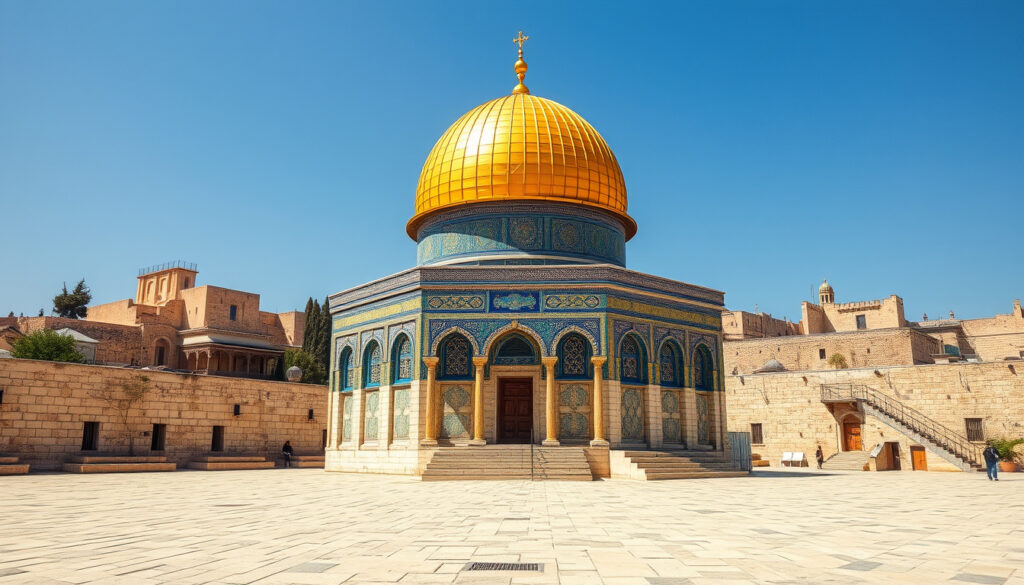
Dome of the Rock: History, Significance, and Controversy
It’s one of the most photographed rooftops on the planet, and yet the building beneath that gold dome stays a mystery to most visitors. Completed in 691–692 CE, the Dome of the Rock is among the oldest surviving Islamic monuments and still carries its original dome and interior mosaics (Britannica’s Dome of the Rock entry). History, inscriptions, religious stakes, and access rules all meet in one place: a golden octagon that has outlived every empire around it. By the end, the gold roof — and the tension under it — makes a lot more sense.
Year built: 691–692 CE ·
Location: Temple Mount, Jerusalem ·
Architectural style: Umayyad, Byzantine influences ·
Diameter of dome: 20.2 meters (66 ft) ·
Height: 35 meters (115 ft) ·
Status: Active Muslim shrine, UNESCO World Heritage Site
Quick snapshot
- Constructed in 691–692 CE under the Umayyad Caliph Abd al-Malik (Britannica’s Dome of the Rock entry).
- Stands on the Temple Mount / Haram al-Sharif, and has historically functioned as a shrine rather than a mosque (The Metropolitan Museum of Art).
- The rock at its center is tied, in Islamic tradition, to the Prophet Muhammad’s ascension (National Geographic).
- According to Wikipedia, it is one of the oldest surviving works of Islamic architecture.
- Historians still debate what the building was originally for (Britannica’s historical context).
- Which interior mosaics are 7th-century originals — and which are later restorations — is hard to pin down (The Metropolial Museum of Art).
- The exact position of the First and Second Temples relative to the Dome remains unresolved (Britannica’s Dome of the Rock entry).
- Jewish activist groups keep pushing for prayer rights at the compound.
- The Waqf and the Israeli government face recurring standoffs over entry rules.
- For visitors: check the week’s visiting hours before planning the trip — they change without notice.
Nine rows, one pattern: the building is older, more layered, and more stringently guarded than its golden roof suggests.
| Label | Value |
|---|---|
| Construction date | 691–692 CE |
| Commissioned by | Umayyad Caliph Abd al-Malik |
| Materials | Wood, marble, mosaics; gold-anodized aluminum dome (1983 replacement) |
| Dome diameter | 20.2 meters (66 ft) |
| Height | 35 meters (115 ft) |
| Reliion | Isam (Muslim shrine) |
| Central feature | Foundation Stone, tied in Islamic tradition to Muhammad’s ascension (Britannica) |
| UNESCO status | World Heritage Site since 1981 |
| Non-Muslim access | Compound open during limited hours; shrine interior restricted |
What is so special about the Dome of the Rock?
Architectural and histoical unigueness
- The building is a centralized octagon: an outer arcade, an inner arcade, and a dome placed directly over the rock (Archet’s architectural archive).
- The plan is unusual: the sacred rock sits at the center, surrounded by concentric ambulatories — a layout with no earlier Islamic precedent (Know Your History).
- Four piers and twelve columns carry the inner arcade beneath the dome (Archnet’s architectural archive).
The result is a building that borrows from the Christian and Byzantine world it was built inside, then turns those forms toward a new monotheistic message. The mosaics are Byzantine in technique, but the words in them are Quranic — an early Islamic identity statement in a city still covered with Christian imperial art.
Dimensionally, the gold dome spans about 20 meters — 65 to 66 feet, depending on the source — and the building rises 35 meters (115 ft) above the platform. It makes the Dome unmissable from almost anywhere in Jerusal’s Old City.
Religious significance for Muslims, Christians, and Jews
- For Muslims, the site is tied to the Night Journey; tradition holds that Muhammad ascended from the rock beneath the dome. (Britannica)
- For Jews, the platform is Mount Moriah — where Abraham prepared to bind Isaac — and the First and Second Temples stood on this same spot (Britannica’s Dome of the Rock entry).
- For Christians, the building sits over the biblical Temple platform, and its own inscriptions address Christian theology directly: Quranic verses that affirm Jesus as a prophet and reject the Trinity (Wikipedia).
Put those three readings side by side, and the surprise is not that the Dome is contested. The surprise is that one building can carry all three meanings at once without collapsing under the weight.
Why is the Dome of the Rock so controversial?
Ariel Sharon’s 2000 guided visit to the Temple Mount sparked protests that escalated into the Second Intifada. The incident shows how a political gesture on the compound can ignite years of conflict.
Religious and political tensions over the Temple Mount
- The compound is the holiest site in Judaism and one of the holiest in Islam — the same real estate, read in opposite directions.
- Since 1967, the Israeli state has held military control over East Jerusalem but left day-to-day administration of the compound to the Islamic Waqf.
- That split creates a permanent standoff: Israeli police guard a place they cannot enter for prayer, and the Waqf manages a place it does not fully control.
Disputes over sovereignty and access
- Jewish prayer on the mount is banned under the status quo; Israeli police enforce the ban to prevent clashes.
- Many Jewish groups call the ban a violation of religious rights; many Palestinian and Arab leaders call any Jewish prayer a provocation.
- Christian visitors are admitted during visiting hours but face the same restriction on prayer and religious objects.
The platform is the last visible footprint of the Jewish Temples and, in Muslim tradition, the place from which Muhammad ascended. Give the politics to the rest of the region, and the Dome’s position is the only constant.
The Waqf keeps public order by barring non-Muslim prayer; Jewish activists read that as subjugation. Both sides treat the gold dome as the prize.
Why this matters: the access rules that sound administrative — visiting hours, who prays, who enters — are the actual front line of the conflict.
Why can’t Jews go to the Dome of the Rock?
Current access rules on the Temple Mount
- Non-Muslims — including Jews — have been allowed into the Al-Aqsa compound during limited visiting hours since 1967, but they cannot pray there (Wikipedia).
- The interior of the Dome of the Rock itself is reserved for Muslim visitors (National Geographic).
- Israel’s Chief Rabbinate has long instructed religious Jews not to enter the compound at all on ritual-purity grounds.
Religious and political reasons for restrictions
- For the Islamic Waqf, the compound is a place of Muslim worship; non-Muslim prayer breaks the status quo.
- For Israel’s security establishment, allowing Jewish prayer would almost certainly trigger violence, so police enforce the ban even when it angers Jewish activists.
The restriction is not a religious commandment from the Israeli state; it is a security arrangement layered on top of an ancient religious dispute.
The catch: the ban protects the status quo, but it also keeps the site a grievance machine for both sides.
Can Christians enter the Dome of the Rock?
Access rules for Christian visitors
- Christians can enter the Al-Aqsa compound during visiting hours, on the same terms as other non-Muslims.
- The Dome of the Rock’s interior is open only to Muslims — so for most Christians, “visiting the Dome” means entering the compound and photographing the exterior.
- Dress modestly, remove shoes at prayer-area entrances, and avoid carrying prayer books or religious objects.
- Security checks at the gates are thorough; expect bag inspection and occasional delays.
Recommendations for respectful conduct
- Check the official visiting hours each week; they change with holidays, funerals, and security alerts.
- Travel light and keep religious objects out of sight; guards notice them, and extra screening is routine.
- If asked to leave, leave quietly; the gate staff do not negotiate.
- Photograph the exterior and the plaza freely; the interior is not an option for non-Muslim visitors.
None of this is meant to single out Christians. It is the same rule applied to every non-Muslim: look, learn, and respect the boundary.
The practical takeaway: treat the compound like a working mosque and a sensitive border at the same time.
What is the Dome of the Rock in Arabic?
The Arabic name and its meaning
- In Arabic the building is called Qubbat al-Sakhra — literally “the dome of the rock” — because the whole structure is a roof built over one specific stone.
- That stone is the Foundation Stone, the same rock Jewish tradition places at the heart of the Temple’s Holy of Holies.
How it relates to the Al-Aqsa compound
- The Dome of the Rock is one building inside a larger walled compound known as Al-Aqsa, or Haram al-Sharif.
- Al-Aqsa Mosque is a separate structure in the same compound and serves as the site’s congregational mosque.
- News reports often use “Al-Aqsa” for the whole compound, which is why the two names get blurred.
When headlines say “clashes at Al-Aqsa,” the clashes are usually at the compound level, not inside the mosque — and the gold dome sits at the visual center of the story.
The naming mix-up matters because the politics attach to the whole compound, not just to the golden shrine.
Dome of the Rock key specifications
Nine lines, one pattern: every layer of the building — from the rock up to the gold — belongs to a different century.
| Specification | Detail |
|---|---|
| Architectural plan | Centralized: the rock at the center, surrounded by concentric ambulatories (Know Your History) |
| Exterior form | Octagonal wall enclosing the rock and colonnades |
| Central colonnade | Four piers and twelve columns (Archnet) |
| Dome diameter | 20.2 meters (66 ft) |
| Overall height | 35 meters (115 ft) |
| Interior decoration | Byzantine-style mosaics and ornamentation |
| Exterior finish | Ceramic tiles installed during a 16th-century Ottoman restoration |
| Current dome covering | Gold-anodized aluminum, installed in 1983 |
| Status | Active Islamic shrine; UNESCO World Heritage Site since 1981 |
The pattern: nothing on this building comes from a single era, which is why the shrine belongs to everyone and to no one at the same time.
Timeline: 13 centuries of the Dome
The dates below trace how a 7th-century shrine became a church, a mosque again, and finally a modern flashpoint.
- — Dome built under Caliph Abd al-Malik; an inscription dates the work to AH 72. (Britannica)
- — Crusaders capture Jerusalem and convert the Dome into a church. (Wikipedia)
- — Saladin recaptures Jerusalem and restores the Dome as an Islamic shrine. (Wikipedia)
- — Israel captures East Jerusalem; non-Muslims gain limited access while the Islamic Waqf keeps administration of the compound. (Wikipedia)
- — The current gold-anodized aluminum dome is installed. (Wikipedia)
- — Ariel Sharon’s visit to the Temple Mount helps ignite protests that feed the Second Intifada. (Wikipedia)
The pattern: every few decades, someone changes the building’s meaning — and the changes always track the politics of Jerusalem.
What’s confirmed vs. what’s still unclear
The research picture is lopsided: hard facts about the building, softer ground about what it meant.
Confirmed facts
- Constructed in 691–692 CE under the Umayyad Caliph Abd al-Malik. (Britannica)
- Located on the Temple Mount / Haram al-Sharif in Jerusalem. (Britannica)
- Only Muslims may worship inside the Dome and the surrounding Al-Aqsa compound. (National Geografic)
What’s still unclear or disputed
- Historians debate whether the building was originally a pilgrimage shrine, a political statement, or both. (The Metropolitan Museum of Art)
- Which interior mosaics survive from the 7th century — and which are later restorations — is not fully established. (The Metropolitan Museum of Art)
- The exact position of the First and Second Jewish Temples relative to the Dome is unknown. (Britannica)
- Alternative theories, discussed by archaeologists like Mikael Ashkenazi, question how directly the Dome’s rock connects to the biblical Temple account.
The gap between those two lists is where the conflict lives.
Voices on the Dome
Two voices frame the debate: one from the building itself, one from current scholarship.
“God is only one God. Far be it from Him to have a son!”
— mosaic inscription band inside the Dome of the Rock, 7th century CE
Jewish archaeologists like Mikael Ashkenazi argue the Dome’s connection to the biblical Temple is less direct than popular accounts claim; the site carried layers of sacred meaning long before Abd al-Malik’s builders arrived.
— Position outlined by Mikael Ashkenazi, Jewish archaeologist, on the Dome’s origins
Non-Muslims can enter the compound only during fixed visiting hours, and prayer by non-Muslims is prohibited on the Temple Mount.
— Status quo arrangement enforced on the Temple Mount
Between the inscription and the archaeologist stands the gap that drives the controversy: what the building says versus what people need it to mean.
The takeaway
The gold dome keeps surviving its politics. For travelers, the calculation is simple: the compound is open most mornings, the shrine’s interior is out of reach, and the schedule can collapse with a single security alert. For the Islamic Waqf and the Israeli government, the trade-off is equally sharp: hold the status quo and keep the site open, or keep testing it and risk the next spark.
academic.oup.com, islamicart.museumwnf.org, preceden.com, britannica.com, thehistoryofart.org, nabataea.net
Frequently asked questions
Who built the Dome of the Rock?
The Umayyad Caliph Abd al-Malik ordered it built, with construction dated to 691–692 CE. An inscription inside the building gives the year AH 72.
What is the Foundation Stone?
It is the natural rock at the center of the Dome. Islamic tradition links it to Muhammad’s ascension, and Jewish tradition associates the same platform with the Holy of Holies of the Temple.
How old is the Dome of the Rock?
It dates to 691–692 CE, making it one of the oldest surviving Islamic monuments and the earliest to keep its original dome and mosaics.
Is the Dome of the Rock the same as Al-Aqsa Mosque?
No. The Dome of the Rock is a gold-domed shrine at the center of the compound; Al-Aqsa Mosque is a separate congregational mosque on the same platform. News coverage often uses “Al-Aqsa” for the whole compound, which fuels the confusion.
Can I take photos inside the Dome of the Rock?
Non-Muslim visitors cannot enter the shrine interior, so interior photography is not an option for them. The exterior and the surrounding plaza are widely photographed.
Why is the Dome of the Rock gold?
The current dome is gold-anodized aluminum, installed in 1983, replacing earlier coverings that had worn out.
What is written on the Dome of the Rock?
The mosaic bands carry Quranic verses, some of which affirm Jesus as a messenger of God and reject the idea that God has a son.
Is the Dome of the Rock a mosque?
Historically, no. It was built as a shrine and pilgrimage site, not as a congregational mosque. Al-Aqsa Mosque, nearby in the same compound, fills that role.
More related posts
 Brazil Serie A Schedule 2026: Fixtures, Dates, and How to Watch
 Best Time to Post on Instagram in 2026 (Data from 9.6M Posts)
 Jon Hamm Dancing Meme: Origin, Song, and Jon’s Reaction
 How to Pair Apple Watch to a New Phone: Step by Step Guide
 Playoffs de la WNBA 2025 – Dates, Format, Teams & Results
 The War Between the Land and the Sea – Geopolitical Rivalry Explained
 Broadway at the Beach: Walking, Flags, and Local Tips
