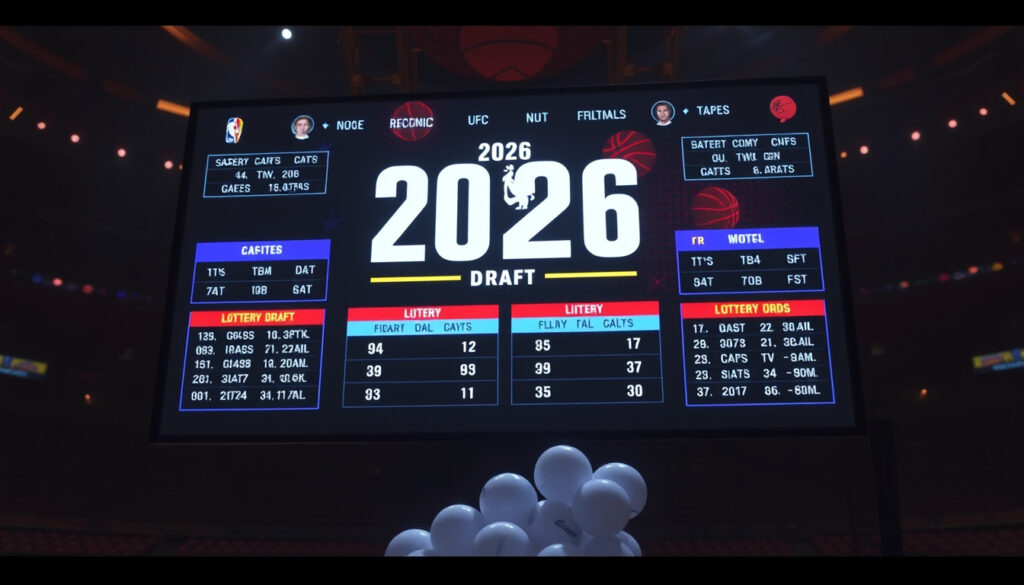
NBA Mock Draft 2026: Simulator, Projections & Lottery Odds
If you’ve spent any time watching NBA draft coverage lately, you’ve probably noticed two names at the top of every big board: AJ Dybantsa and Darryn Peterson. The interesting part? Nobody knows exactly where either will land on draft night. With the lottery set for May 10, 2026 and the main event at Barclays Center less than two months away, the gap between what scouts project and what the ping-pong balls decide creates genuine chaos at the top of the board.
Projected #1 Pick: AJ Dybantsa (BYU F) · Projected #2 Pick: Darryn Peterson (Kansas G) · Projected #3 Pick: Cameron Boozer (Duke F) · Key Simulator: Tankathon Lottery Simulator
Quick snapshot
- AJ Dybantsa ranks No. 1 on consensus board (Rookie Scale)
- 2026 NBA Draft Lottery scheduled for May 10, 2026 (ESPN)
- Darryn Peterson ranks No. 2 across multiple projections (Rookie Scale)
- Final lottery order remains undetermined
- Peterson vs Dybantsa debate for top spot ongoing
- Which teams will actually land in top 4 positions
- May 10, 2026 — NBA Draft Lottery (ESPN)
- June 23-24, 2026 — NBA Draft at Barclays Center (Bleacher Report)
- Pre-lottery mocks will continue updating weekly
- Final big boards expected post-lottery in May
- Team needs analysis intensifies after positions set
Eight key facts anchor the current landscape of 2026 NBA draft projections, drawing from multiple consensus boards and pre-lottery odds.
| Label | Value |
|---|---|
| Top Prospect | AJ Dybantsa (BYU) |
| #2 Prospect | Darryn Peterson (Kansas) |
| Key Simulator Site | Tankathon.com |
| Recent Mock Date | 1 day ago (Yahoo Sports) |
| Lottery Date | May 10, 2026 |
| Draft Dates | June 23-24, 2026 |
| Consensus Update | April 22, 2026 (Rookie Scale) |
| Top Lottery Odds | Washington Wizards & Indiana Pacers (14% each) |
NBA Mock Draft 2026 Simulator
Online simulators have become essential tools for fans who want more than static projections. The ESPN Draft Simulator lets users run lottery presentations with fast and slow spin options, seeing how different outcomes shift the entire board. This matters because the lottery isn’t just ceremonial—it can move a team from the fourth pick to first, completely reshaping roster-building plans.
Lottery Odds Impact
Teams like the Washington Wizards and Indiana Pacers currently sit at the bottom of the standings with equal 14% odds at the No. 1 pick. According to ESPN’s pre-lottery order, the difference between landing a superstar like Dybantsa or falling to the fourth pick could reshape either franchise’s timeline by years.
The lottery odds mean three teams with identical records compete for the same pick. For Wizards fans hoping for Peterson, the 14% chance creates real anxiety—ESPN’s draft machine shows scenarios where Washington falls all the way to sixth depending on how the lottery lands.
What this means: simulator users should understand that even the best pre-lottery projections represent one possible outcome among dozens. Running the Tankathon lottery multiple times reveals how dramatically position expectations can shift.
NBA Mock Draft 2026 Tankathon
Tankathon has carved out a specific niche in the mock draft ecosystem—it’s the go-to tool for lottery randomization. Unlike static mocks that assume a fixed order, Tankathon simulates the actual lottery ping-pong ball process, giving users a sense of the chaos built into draft night.
Top Projections
Bleacher Report ran a fresh lottery simulation via Tankathon and produced notably different results than consensus boards. In that simulation, the Memphis Grizzlies won the No. 1 pick and selected AJ Dybantsa, while the Utah Jazz landed Darryn Peterson at No. 2.
Draft Order Details
The contrast between different simulations reveals how much randomness affects the top of the board. NBADraft.net’s July 2025 mock had Utah selecting Dybantsa at No. 1 with the Wizards taking Peterson second. That same site’s earlier iteration flipped the order. The implication: without the lottery settling positions, even the top two picks remain genuinely uncertain.
Jeremy Woo of ESPN noted that the probability has been tilting toward Dybantsa as the most likely choice as the No. 1 pick—but “most likely” still means roughly 30-40% depending on which team wins the lottery. That gap between projection and certainty is where draft night drama lives.
The pattern: most mocks agree on the top three prospects, but lottery randomization creates a dozen plausible landing spots for each. For teams drafting fourth or lower, this uncertainty multiplies.
NBA Draft 2026 Order
The current pre-lottery order runs based on inverse win-loss records. According to ESPN’s complete order breakdown, teams with 17-65 records occupy the lottery slots, with the worst records receiving the highest odds.
Current Standings Basis
Pre-lottery projections typically use standings through mid-April. The Ringer’s first 2026 mock by J. Kyle Mann uses standings through April 5, 2026, with the actual lottery still a month away. This lag means the order you see in April mocks won’t match the actual lottery positions until May 10.
Traded Picks
Draft order gets complicated when picks have been traded. NBADraft.net’s full mock includes international players like Karim Lopez from Mexico at No. 12 and Hannes Steinbach at No. 20, reflecting how traded picks affect which teams select at specific positions. The catch: fans tracking their team’s pick need to verify whether picks are owned, owed, or locked by other teams first.
NBA Mock Draft 2026 ESPN
ESPN’s March 2026 mock highlighted Sacramento Kings at No. 1, Washington Wizards at No. 2, and Indiana Pacers at No. 3—projections that already look different as the season has closed. ESPN’s Jeremy Woo and the draft team’s current consensus places AJ Dybantsa at the top of most boards.
Best Available Players
ESPN’s top 2026 prospects list includes Darryn Peterson, AJ Dybantsa, Cameron Boozer, and Caleb Wilson. These four names appear consistently across tier 1 and tier 2 sources, though their exact ordering varies by evaluator. The 2026 draft class has been described by ESPN as historically deep, with quality rotation players potentially available through pick 20 and beyond.
Prospect Rankings
Rookie Scale’s consensus big board, updated April 22, 2026, aggregates rankings from ESPN, The Athletic, Bleacher Report, and others. The board shows Dybantsa at No. 1 (6’9 ¼” Wing, BYU, 19.4 years old), Peterson at No. 2 (6’5 ½” Combo Guard, Kansas, 19.4 years old), and Boozer at No. 3 (6’9″ Forward, Duke, 18.9 years old). This cross-publisher consensus gives those rankings additional credibility.
Consensus rankings don’t guarantee lottery position. CBS Sports’ 2026 mock remained unchanged in top 5 picks from prior updates, but that stability exists only because the mocks haven’t yet incorporated post-lottery positioning. The rankings are stable; the picks are not.
The implication: when the lottery shuffles actual positions, expect significant movement in who goes where even if the prospect rankings stay fixed.
NBA Mock Draft 2026 with Comparisons
Player comparisons help scouts communicate what a prospect might become at the NBA level. CBS Sports’ analysis emphasizes team fit alongside prospect talent, noting that a player like Darius Acuff Jr. at No. 6 makes sense only for certain franchises with specific roster needs.
Top Prospects vs NBA Stars
Darryn Peterson, the Kansas combo guard, has drawn comparisons to NBA backcourt players based on his playmaking and defensive versatility. AJ Dybantsa, the BYU wing, projects as a modern positionless player with size that allows switching across multiple defensive assignments. These comparisons aren’t perfect—prospects rarely perfectly replicate their comps—but they provide frameworks for team decision-making.
Risings and Fallers
Bleacher Report’s simulation noted that Dybantsa has picked up steam over Peterson in recent weeks, with ESPN’s Jeremy Woo reporting that “the probability has been tilting toward Dybantsa as the most likely choice as the No. 1 pick.” Isaiah Evans, meanwhile, appears in CBS analysis as one of the best shooters in the draft class with 35.8% from three-point range—a skill that could elevate his stock as teams value shooting more than ever.
Team fit matters differently depending on organizational context. A team like the Wizards, rebuilding around youth, might prioritize raw talent over immediate fit. A contender like the Pacers might prefer a ready-made role player like Evans over a project prospect. The same player—viewed through different team lenses—can be both overvalued and undervalued simultaneously.
What this means: mock drafts that ignore team context miss roughly half the story. The best mocks pair prospect talent with specific team needs and cap situations.
This multi-source comparison table shows how different projections land prospects on different teams depending on lottery outcomes.
| Source | #1 Projection | #2 Projection | #3 Projection |
|---|---|---|---|
| Rookie Scale Consensus (April 22) | AJ Dybantsa | Darryn Peterson | Cam Boozer |
| NBADraft.net (July 2025) | Utah Jazz → Dybantsa | Washington → Peterson | Various |
| Bleacher Report Tankathon Sim | Memphis → Dybantsa | Utah → Peterson | Various |
| ESPN March 2026 Mock | Sacramento → Peterson | Washington → Dybantsa | Pacers → Boozer |
| CBS Sports | Dybantsa | Peterson | Boozer |
Jeremy Woo, ESPN NBA Draft Analyst
“The probability has been tilting toward Dybantsa as the most likely choice as the No. 1 pick.”
ESPN Draft Staff
“This is shaping up to be an exceptionally talented draft class.”
Bleacher Report NBA Draft Analyst
“Congrats to the Memphis Grizzlies and condolences to the Indiana Pacers.”
Related reading: WNBA 2025 Playoffs Guide · World Series Schedule 2025
Frequently asked questions
What factors influence the 2026 NBA draft order?
The draft order derives from regular-season records with inverse placement—the worst teams pick highest. The top four picks are then determined by the lottery drawing on May 10, 2026, where teams with equal records have equal odds. Picks can be traded, affecting which teams select at specific positions.
How often do mock drafts update?
Major mocks typically update weekly during the pre-draft season, with larger updates after significant events like the NBA Draft Lottery in May. NBADraft.net last updated its 2026 mock on July 26, 2025, while Rookie Scale’s consensus board refreshes as individual outlets update their rankings.
Which sites offer the best 2026 NBA draft simulators?
ESPN Analytics offers the primary lottery simulator with fast and slow spin options. Tankathon provides lottery randomization and team need assessments. Both tools allow users to explore different scenarios as the actual lottery order remains unknown until May 10, 2026.
Who are the dark horse prospects for 2026 NBA draft?
Isaiah Evans (35.8% three-point shooter per CBS Sports analysis) represents a potential riser given modern NBA demand for shooting. International players like Karim Lopez (Mexico, No. 12 per NBADraft.net) also fall into dark horse territory, as team fit and development time can shift their draft stock significantly.
What team needs drive 2026 mock draft picks?
Team needs vary by roster composition. CBS Sports emphasizes team fit, placing Darius Acuff Jr. at No. 6 based on specific franchise needs rather than pure talent rankings. Rebuilding teams prioritize upside; contenders look for role-ready skills. The same prospect can rank differently across mocks depending on which teams’ needs are prioritized.
How do college commitments affect mock drafts?
College performance during the season directly impacts prospect rankings. AJ Dybantsa’s emergence at BYU, Darryn Peterson’s play at Kansas, and Cam Boozer’s contributions at Duke all solidified their top-three status. Mid-season injuries or disciplinary issues can drop prospects, while breakthrough performances can elevate them.
What is the role of traded picks in 2026 mocks?
Traded picks complicate draft order significantly. Teams may owe picks to other franchises or have received picks from other organizations. NBADraft.net’s full mock accounts for these trades, showing international prospects like Hannes Steinbach at No. 20 partly because the Washington pick at that position belonged to another organization. Fans tracking their team’s selections must verify pick ownership before assuming draft position.
For fans of bottom-feeding teams, the choice between hope and anxiety is obvious: root for the ping-pong balls to bounce your way on May 10, or prepare for disappointment when Dybantsa goes to someone else. The mock drafts will keep projecting until then—just don’t mistake their confidence for certainty.
More related posts
 21 Jump Street 2012 Cast: Full List of Actors
 Exhaust Shop Near Me: Costs, DIY Repairs, and Top Dublin Shops
 How to Draw a Fish: Easy Step-by-Step Guide
 Ready Player One Cast: Full List of Actors and Their Avatars
 What Does the Fox Say? Meaning, Real Sounds, and Origin
 Something in the Orange Meaning: Zach Bryan’s Story & Versions
 Full Moon May 2025: Flower Moon Date & Meaning
 PSG vs Bayern Munich Stats: Head-to-Head & 2026 Results
