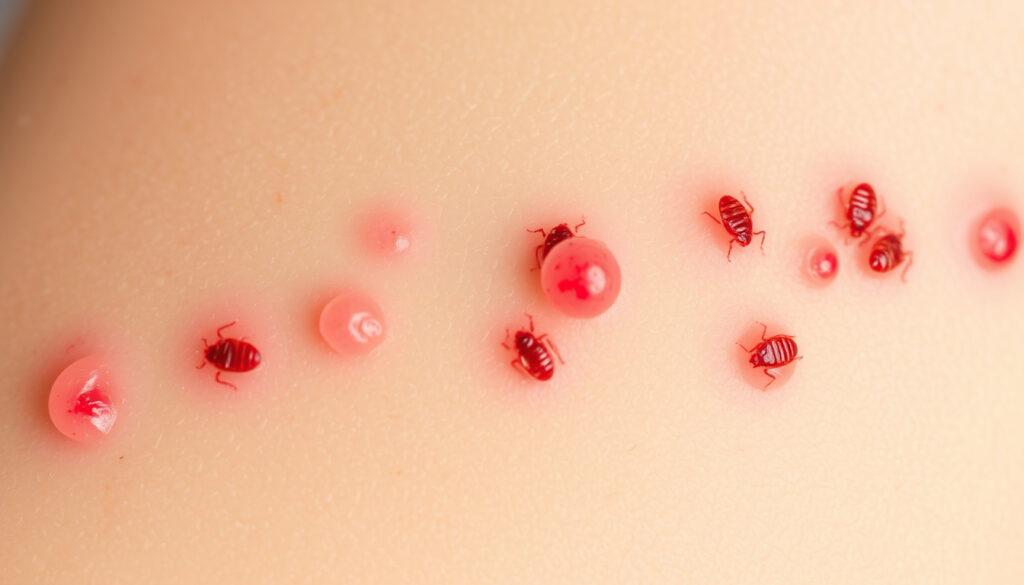
What Do Bed Bug Bites Look Like? Signs & Patterns
You wake up with a line of three red bumps on your arm and a single spot on your neck — and you’re not sure if it’s mosquitoes, fleas, or something else. Bed bug bites have a signature pattern that sets them apart, but only if you know what to look for. This guide walks through the visual clues, the common lookalikes, and practical steps to stop bites before they start.
People who develop visible welts: 70% according to dermatologists (WeDerm, 2023) ·
Typical number of bites in one feeding session: around 10 (NHS, 2024) ·
Appearance on lighter skin: raised red bumps (Healthline, 2024) ·
Appearance on darker skin: brown, red, or purple bumps, often harder to see (NHS, 2024)
Quick snapshot
- Raised red or purple bumps on lighter skin; brown, red, or purple on darker skin (CDC (U.S. public health agency))
- Often appear in lines or clusters of three to five (Harvard Health Publishing (medical school affiliate))
- May include a small dark spot at the center (Healthline (medical review team))
- Exposed skin: arms, neck, face, legs (Prevention (health magazine))
- Seldom on palms or soles (Prevention (health magazine))
- Around waist if sleeping without covering (Prevention (health magazine))
- Itching, sometimes intense (CDC (U.S. public health agency))
- Burning or stinging feeling (CDC (U.S. public health agency))
- Pain is rare; typically mild (Orkin (pest control provider))
- Bites may appear days after the bite (Healthline (medical review team))
- Reaction peaks 24–48 hours later (Healthline (medical review team))
- Heals in 1–2 weeks with care (Healthline (medical review team))
Five key facts, one takeaway: bed bug bites follow a predictable pattern of linear clusters on exposed skin, but the reaction varies widely from person to person.
| Key Fact | Details |
|---|---|
| Visual Pattern | Linear clusters or zigzag lines of bites, often three in a row (Harvard Health Publishing (medical school affiliate)) |
| Skin Reaction Prevalence | About 70% of people develop raised, itchy welts (Harvard Health Publishing (medical school affiliate)) |
| On Dark Skin | Bites may look brown, red, or purple and can be harder to see (CDC (U.S. public health agency)) |
| Bite Count Per Feeding | Around 10 spots per session |
| Pain Level | Most people report no pain at the time of bite (Orkin (pest control provider)) |
How do you tell if a bite is from a bed bug?
Appearance and pattern of bed bug bites
- Bed bug bites often appear in lines or clusters on exposed skin (Prevention (health magazine))
- They may form straight lines, zigzag patterns, or groups of three to five (Harvard Health Publishing (medical school affiliate))
- Each bite appears as a slightly swollen, red area that may include a dark spot at the center (Healthline (medical review team))
The linear pattern is the single strongest visual clue — mosquitoes don’t line up in rows, and fleas don’t march in straight lines across your arm.
Location on the body
- Bed bugs bite areas of skin exposed during sleep: arms, neck, face, and trunk (Prevention (health magazine))
- They tend to avoid areas covered by clothing: the Mayo Clinic (nonprofit medical center) notes that covering up with pajamas may reduce bites
- Bites rarely appear on palms, soles, or under tight clothing
If the bites are scattered across covered areas too, you’re likely dealing with something else — like an allergic rash or hives.
Reaction variability between people
- About 70% of people develop raised, itchy welts (Harvard Health Publishing (medical school affiliate))
- The same bite may cause no visible reaction in one person and a raised welt in another (CDC (U.S. public health agency))
- Reaction timing varies: some people see bumps in hours, others not for days (Healthline (medical review team))
The implication: if you share a bed with someone who has no bites, that doesn’t mean you’re bite-free — you may just react differently.
What are the first signs of bedbugs?
Visual signs: rust-colored stains, shed skins, eggs
- Small blood spots on sheets are often the earliest sign (CDC (U.S. public health agency))
- Look for live bugs, shed skins, or tiny eggs in mattress seams (Mayo Clinic (nonprofit medical center))
- Bed bugs are about 5 mm long and reddish-brown (CDC (U.S. public health agency))
Bite marks as early indicators
- Bite marks can appear days after the actual bite (Healthline (medical review team))
- New bites appearing every morning suggest an ongoing infestation
- Unexplained bites with no other insect sightings point toward bed bugs
How to inspect your mattress and furniture (US EPA method)
- Check mattress seams, box springs, and headboards for dark fecal spots (California Department of Public Health (state health agency))
- Use a flashlight and credit card to scrape seams — bed bugs hide in tight crevices
- Inspect behind picture frames, electrical outlets, and furniture joints
Bite marks alone don’t confirm bed bugs. You need physical evidence — rust-colored stains, shed skins, or a live bug — before calling an exterminator.
What could be mistaken for bed bug bites?
Mosquito bites vs. bed bug bites
- Mosquito bites are single and random; bed bug bites are often in rows (Harvard Health Publishing (medical school affiliate))
- Mosquito bites may have a distinct white halo around the red bump (MedlinePlus (U.S. National Library of Medicine))
- Mosquito bites typically appear soon after the bite and fade quickly
Flea bites vs. bed bug bites
- Flea bites are usually around the ankles and lower legs (CDC (U.S. public health agency))
- Flea bites appear as tiny red dots, often with a small halo
- Bed bug bites appear higher on the body (arms, neck, face) (Prevention (health magazine))
Spider bites vs. bed bug bites
- Spider bites often show two distinct fang marks (UnityPoint Health (healthcare network))
- Spider bites swell more circularly and tend to be solitary
- Bed bug bites have no central puncture point (CDC (U.S. public health agency))
Allergic reactions and hives
- Hives appear as raised welts that change shape and move across the body
- Bed bug bites stay in the same location once they appear
- Hives typically disappear within 24 hours; bed bug bites last several days (Harvard Health Publishing (medical school affiliate))
A quick visual comparison table helps settle the question fast:
| Bite Type | Pattern | Location | Key Visual Clue |
|---|---|---|---|
| Bed bug | Lines or clusters of 3–5 | Exposed skin (arms, neck, face) | No central puncture; red or purple bump |
| Mosquito | Single, random spots | Any exposed area | White halo; appears fast |
| Flea | Groups of tiny dots | Ankles, lower legs | Small red dot with halo |
| Spider | Solitary, uneven | Anywhere | Two fang marks; circular swelling |
| Hives | Large, mobile welts | Variable | Changes shape over hours; fades in 24 hours |
What stops bed bugs from biting you?
Protective barriers and encasements
- Encasing the mattress and box spring prevents bed bugs from reaching you (Mayo Clinic (nonprofit medical center))
- Use a bed bug-proof mattress encasement that fully zips closed
- Keep the bed away from walls and furniture (California Department of Public Health (state health agency))
Repellent methods (not highly effective)
- No repellent applied to skin is scientifically proven to stop bed bugs (Harvard Health Publishing (medical school affiliate))
- Physical barriers work better than chemical repellents (Mayo Clinic (nonprofit medical center))
- Wearing long pajamas that cover most of the skin may reduce bites
Prevention while sleeping (GoodRx strategy)
- Place bed legs in interceptors (special plastic cups that trap bed bugs)
- Reduce clutter around the bed to eliminate hiding spots (California Department of Public Health (state health agency))
- Wash bedding in hot water and dry on the hottest setting (California Department of Public Health (state health agency))
For travelers, the most effective prevention is inspecting the hotel room before unpacking: check mattress seams, keep luggage on a hard surface (not the bed or floor), and wash all clothing in hot water after returning home.
How to prevent bedbug bites while sleeping?
Using mattress encasements
- Select a bed bug-proof encasement that covers the entire mattress and box spring (Mayo Clinic (nonprofit medical center))
- Ensure the encasement has a zipper and no tears or holes
- Leave the encasement on for at least a year to starve any trapped bugs
Placing bed legs in interceptors
- Interceptors create a moat barrier that bed bugs cannot cross
- Check interceptors weekly for trapped bugs
- Move the bed away from walls so interceptors work effectively
Changing and washing bedding frequently
- Wash sheets and bedding in hot water (at least 120°F/49°C) (California Department of Public Health (state health agency))
- Dry on the hottest setting for at least 30 minutes
- Vacuum the mattress surface and seams regularly, then dispose of the vacuum bag outside (California Department of Public Health (state health agency))
Inspecting hotel rooms when traveling
- Keep luggage in the bathtub while inspecting the room (Harvard Health Publishing (medical school affiliate))
- Check mattress seams for dark fecal spots and live bugs (Mayo Clinic (nonprofit medical center))
- Place luggage on a luggage rack or hard surface, not on the bed or floor
The pattern: prevention is a combination of physical barriers (encasements, interceptors) and cleanliness (hot washing, vacuuming). There’s no magic spray — but these steps, used together, are highly effective.
Common lookalikes: how the bites differ
“Bed bug bites may appear in lines or clusters on exposed areas of the body.”
— Healthline Medical Review Team
“On black or brown skin, bedbug bites may look brown, red or purple and may be harder to see.”
— NHS (National Health Service, UK)
“About 70% of people develop raised bumps (welts) that are red in lighter skin tones and purple in darker skin tones.”
— WeDerm (dermatology practice)
mayoclinic.org, prevention.com, newsnetwork.mayoclinic.org, medicinecontact.com
Frequently asked questions
Can bed bug bites cause an allergic reaction?
Yes. Some people develop a more severe reaction, including large, painful welts or blisters. In rare cases, a widespread allergic response called papular urticaria can occur (CDC (U.S. public health agency)).
How long after exposure do bed bug bites appear?
Reaction time varies widely — from within minutes to up to 14 days after the bite. Most people notice bumps within 24 to 48 hours (Healthline (medical review team)).
Should I pop a bed bug bite blister?
No. Popping a blister increases the risk of infection and delays healing. Leave it intact and apply a cool compress or hydrocortisone cream for itching instead (Harvard Health Publishing (medical school affiliate)).
Do all people react to bed bug bites?
No. Approximately 30% of people have no visible reaction to bed bug bites at all. That means someone sharing a bed might have bites while their partner shows nothing (CDC (U.S. public health agency)).
What is the best treatment for bed bug bite itching?
Apply a topical corticosteroid (hydrocortisone 1%) or calamine lotion. Oral antihistamines like loratadine or cetirizine can also reduce itching. If the bite becomes infected, see a doctor (Harvard Health Publishing (medical school affiliate)).
Can bed bug bites make you sick?
Bed bug bites are not known to transmit disease to humans. However, excessive scratching can lead to secondary skin infections, and some people experience insomnia or anxiety from the stress of an infestation (CDC (U.S. public health agency)).
How can I tell if I have bed bugs or just bites from something else?
Look for the signs beyond bites: small blood spots on sheets, dark fecal stains on mattress seams, and shed bed bug skins. If you find any of these, you likely have bed bugs. If there are no other signs, the bites could be from mosquitoes, fleas, or an allergic reaction (CDC (U.S. public health agency)).
Related reading
For anyone waking up with unexplained lines of bites, the path forward is clear: check your mattress for physical signs of bed bugs, compare the pattern to mosquito, flea, and spider bites using the table above, and take preventive steps like encasing the mattress and washing bedding in hot water. If you suspect an infestation after finding evidence, contact a licensed pest control professional (U.S. EPA guidance) rather than trying DIY solutions that often fail to eliminate the colony.
More related posts
 AL All-Stars vs NL All-Stars Player Stats: 2026 Recap
 Mamie Van Doren 2024: New Music, Book, TikTok at 93
 How Many Cups in a Quart? – Quick Conversion Guide
 Mercedes-AMG GT 63: Price, Variants, Comparisons (2025 Guide)
 University of Arizona Global Campus – Complete Overview and Analysis
 Citizen Eco Drive Watch: Longevity, Value & Buying Guide
 Doc (2025 TV Series) Season 1: Streaming & Episode Guide
 Home Depot Black Friday 2025: Deals & Spring Sale Guide
