Where Was Jesus Crucified – Golgotha Sites and Bible Evidence
For centuries, pilgrims and scholars have sought to pinpoint the exact location where one of history’s most significant events occurred. The crucifixion of Jesus, as recorded in the New Testament, took place at a site known as Golgotha or Calvary. Yet despite extensive research and archaeological investigation, the precise geographical location remains a subject of scholarly debate. Understanding where this event occurred requires examining biblical accounts alongside historical and archaeological evidence, each contributing pieces to an incomplete puzzle.
The question of Golgotha’s location involves more than mere historical curiosity. It touches on scriptural interpretation, religious tradition, and the physical geography of ancient Jerusalem. Four Gospel writers consistently mention this site, providing details that have shaped both Christian pilgrimage and academic inquiry for two millennia.
Where Was Jesus Crucified?
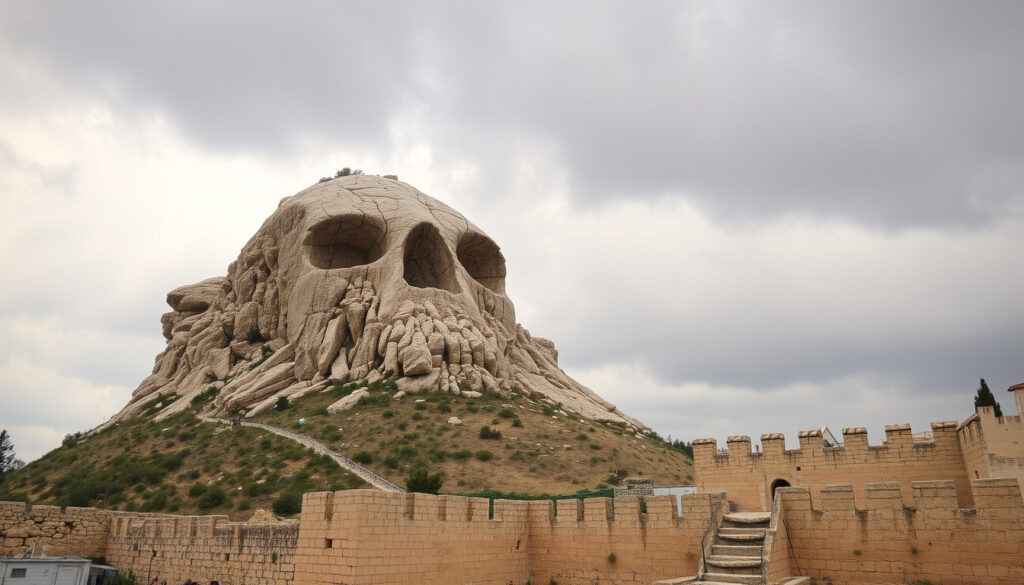
The biblical accounts converge on several key details about the crucifixion site. All four Gospels identify it as a place outside the city walls yet visible from within Jerusalem, accessible to passersby on a major road. The name Golgotha itself derives from Aramaic, translating to “place of the skull,” while the Latin equivalent Calvary carries the same meaning.
Golgotha (Aramaic)
Calvary (Latin)
Place of the Skull
Matthew 27:33, Mark 15:22, John 19:17
Church of the Holy Sepulchre
Key Facts About the Location
- Biblical accounts consistently describe the site as located outside Jerusalem’s city gates, a requirement under both Jewish and Roman customs for executions
- The location sat near a public road, allowing passersby to observe the crucifixion and mock the condemned, as recorded in Matthew 27:39 and Mark 15:29-30
- John 19:20 specifies the site was “near the city” to accommodate the large number of Jewish observers who could read the inscription above Jesus
- The presence of a garden tomb nearby, mentioned in John 19:41, provides an additional identifying detail consistent with first-century burial practices
- Archaeological evidence points to former quarry sites in the vicinity, where limestone outcrops could resemble a skull when viewed from certain angles
- Two locations have emerged as primary candidates: the traditional Church of the Holy Sepulchre and the alternative Garden Tomb site north of the Old City
| Attribute | Details |
|---|---|
| Primary Name | Golgotha (Aramaic) / Calvary (Latin) |
| Meaning | Place of the Skull |
| Key Bible Verses | Matthew 27:33, Mark 15:22, Luke 23:33, John 19:17 |
| Physical Description | Hill or elevation outside ancient city walls |
| Proximity Requirements | Near city, visible from within, adjacent to road |
| Nearby Feature | Garden with tomb (John 19:41) |
| Modern Designation | Contested between two primary sites |
What Is Golgotha and What Does It Mean?
The name Golgotha appears in three of the four Gospel accounts, always with the parenthetical explanation that it means “place of the skull.” This Aramaic term, pronounced something like gol-gul-tha, connected the physical geography of the site to a recognizable feature visible to those who encountered it.
Scholars generally accept that the name described a topographical characteristic rather than a generic designation. The limestone geology of the Jerusalem region includes numerous ancient quarries, where extraction operations left behind irregular rock faces and outcrops. When viewed from certain perspectives, these formations could suggest the appearance of a human skull.
The Aramaic word “Golgotha” and Latin “Calvary” both translate to “place of the skull,” describing a geographical feature rather than a proper name. Luke’s Gospel uses the simpler designation “the Skull” without the Aramaic term.
The Significance of “Outside the Gate”
The writer of Hebrews connects the location to an important theological concept, stating that Jesus “suffered outside the gate” (Hebrews 13:12). This detail served multiple purposes in early Christian interpretation. Roman and Jewish custom required executions to occur outside city limits, lending historical plausibility to the accounts while simultaneously fulfilling prophetic imagery of sanctification through bearing suffering beyond sacred spaces.
The placement also served practical purposes. Roman authorities typically positioned crucifixions along major roads approaching cities, maximizing visibility as a deterrent. The road connecting Jerusalem to surrounding regions would have carried significant traffic during pilgrimage festivals like Passover, when the population of the city swelled considerably.
What Does the Bible Say About the Crucifixion Location?
The Gospel writers provide remarkably consistent geographical details while remaining vague about precise coordinates. This combination of specificity regarding certain features and deliberate imprecision regarding exact location has shaped two millennia of scholarly inquiry.
Gospel Accounts of the Site
Matthew records that upon arriving at Golgotha, the soldiers offered Jesus wine mixed with gall before the crucifixion proceeded. Mark similarly identifies the location by name and notes the time of day when crucifixion began. Luke’s account emphasizes the crowds that gathered, with observers returning home “beating their breasts” in sorrow. John’s Gospel provides the most geographical context, explaining that the site was near the city and that a garden containing a tomb lay nearby.
“Bearing his own cross, he went out to what is called The Place of a Skull, which in Aramaic is called Golgotha. Many of the Jews read this title, because the place where Jesus was crucified was near the city.”
— John 19:17, 20
The specific clues embedded in these accounts have proven invaluable for location studies. The requirement that the site be outside the city walls but visible from within narrows the possibilities considerably. The proximity to a garden tomb rules out locations where such features could not exist. The visibility from a major road explains why passersby could mock Jesus and why the inscription above his head could be read by gathered crowds.
Why Outside the City Walls?
Both Jewish law and Roman practice governed where executions could take place. Jewish tradition considered executions and their associated impurity incompatible with sacred city spaces. Roman authorities similarly preferred external locations for public punishments, allowing authorities to control access while ensuring maximum visibility to those entering and leaving the city.
The book of Numbers specifies that hanged bodies could not remain on display overnight, and Deuteronomy required burial before sunset for executed individuals. These requirements necessitated locations where family members could access the condemned and where proper burial customs could be observed without violating sacred spaces.
Is the Church of the Holy Sepulchre the Crucifixion Site?
The Church of the Holy Sepulchre stands today within Jerusalem’s Christian Quarter, housing what tradition identifies as both the Rock of Calvary and the tomb from which Jesus rose. This site has received continuous Christian veneration longer than any other location associated with Jesus’s life and ministry.
The discovery and identification of this site traces to 326 CE, when Helena, mother of the Roman Emperor Constantine, traveled to Jerusalem seeking places sanctified by biblical events. According to tradition, she located the tomb beneath a temple to Venus that had been built by Emperor Hadrian, along with a rocky outcrop bearing resemblance to a skull.
Evidence Supporting the Holy Sepulchre
Multiple factors have contributed to the enduring credibility of this site as the location of Golgotha. Early Christian writers including Eusebius and Melito of Sardis, writing in the second century, described locations near city gates and along major roads consistent with the church’s position. The fourth-century Madaba Map, a Byzantine mosaic depicting Jerusalem, marks the Sepulchre location with particular prominence.
Archaeological investigations have revealed that the site was indeed a quarry during the first century, with extraction activities leaving behind irregular rock formations. The rock of Calvary visible within the church today represents a remnant of these ancient quarry operations. Excavations beneath the church have uncovered pre-Constantinian evidence of Christian veneration, suggesting continuous awareness of the site’s significance even during periods when overt worship was discouraged.
Despite destruction and reconstruction over centuries, the Church of the Holy Sepulchre has maintained an unbroken tradition of Christian worship since the fourth century, longer than any other site associated with Jesus’s crucifixion.
Challenges to This Identification
The primary objection to the Holy Sepulchre concerns its position relative to ancient city walls. Biblical accounts and historical custom suggest the site should have been outside Jerusalem’s boundaries at the time of the crucifixion, yet the church now lies within the modern Old City.
Archaeological research has partially addressed this concern by identifying Jerusalem’s “first wall” from Herod’s time. Excavations indicate this wall ran north of the traditional site, meaning that during Jesus’s lifetime, the Holy Sepulchre location would have been outside the city limits. Subsequent wall constructions over the following centuries eventually incorporated this area within the city boundaries.
Topographical studies have further supported this reconstruction, with scholars noting that consensus favors a location north of the first wall and west of the second. The placement of major roads through ancient Jerusalem, including what became the Decumanus Maximus during Roman reconstruction under Aelia Capitolina, aligns with the archaeological evidence.
Is the Garden Tomb the Real Calvary?
North of Jerusalem’s Old City, across from the traditional site, lies an alternative location that has attracted considerable interest since the nineteenth century. The Garden Tomb, discovered and promoted by British army officer Charles Gordon in 1883, offers a different candidate for Golgotha’s location based primarily on topographical observations.
The Gordon Proposal
Gordon noticed a skull-like formation in the limestone cliff face now known as Gordon’s Calvary. The resemblance to a skull, visible from certain vantage points, combined with the presence of an ancient tomb carved into the rock within a nearby garden, seemed to match the biblical description with remarkable precision.
The site’s location outside the current city walls also addresses the primary objection raised against the Church of the Holy Sepulchre. From this position, the hill would have been visible from Jerusalem during the first century, and a major road passing nearby would have accommodated the public nature of the execution.
Limitations of This Candidate
Despite its visual appeal and alignment with certain biblical details, the Garden Tomb lacks the strong scholarly support that accompanies the traditional site. Archaeological dating of the tomb itself suggests construction during the Iron Age or later, inconsistent with first-century burial practices if the tomb had been newly cut for Joseph of Arimathea.
The skull-like appearance that inspired Gordon’s identification has also changed over time due to natural erosion and quarrying activities. What Gordon observed in the nineteenth century may have differed significantly from the formation that existed during the first century.
While the Garden Tomb remains popular among some Protestant communities and continues to welcome visitors, most archaeologists and biblical scholars consider the Church of the Holy Sepulchre the more probable location based on historical attestation and archaeological evidence.
How Do We Identify Golgotha Today?
Modern identification efforts combine biblical criticism, archaeological evidence, and topographical analysis. No definitive artifacts, inscriptions, or scientific tests have resolved the debate conclusively, leaving researchers to weigh probabilities based on available evidence.
Methodological Approaches
Scholars employ several approaches when evaluating potential sites. Scriptural analysis examines all geographical references across the four Gospels, identifying details that must be satisfied regardless of which site ultimately proves correct. Archaeological investigation searches for physical evidence consistent with first-century Jerusalem, including tombs, roads, and quarry sites.
Historical attestation carries particular weight in these discussions. The Church of the Holy Sepulchre benefits from continuous identification since the fourth century, with earlier second-century references providing additional support. The Garden Tomb’s nineteenth-century proposal, while intriguing, lacks comparable historical documentation.
The Role of Jerusalem’s Changing Geography
Reconstructing ancient Jerusalem presents significant challenges due to the city’s complex history of destruction and reconstruction. The siege of 70 CE, subsequent Roman rebuilding, Byzantine development, medieval construction, and modern urban planning have all altered the landscape considerably.
Archaeological surveys continue to refine understanding of ancient wall placements and road systems. The discovery of a possible “Second Wall” route in 1893, along with ongoing excavations throughout the Old City, gradually provide more data for reconstructing the first-century urban landscape with greater precision.
The Day of the Crucifixion: Timeline of Events
The Gospel accounts provide a sequence of events that, when combined, offer a detailed timeline of the crucifixion day. While exact chronology remains debated among scholars, the basic framework appears consistently across the four narratives.
- Pilate delivers Jesus to be crucified, handing him over to Roman soldiers who compel Simon of Cyrene to carry the crossbeam (John 19:16, Matthew 27:32)
- Jesus bears his own cross to the place called Golgotha, arriving at approximately the third hour (John 19:17, Mark 15:25)
- The crucifixion begins at the third hour (9 AM), with soldiers dividing Jesus’s garments and casting lots for his clothing (Mark 15:24-25)
- Passersby, religious leaders, and those crucified alongside Jesus mock him throughout the morning hours (Matthew 27:39-44)
- Darkness falls over the land from the sixth to the ninth hour (noon to 3 PM) (Matthew 27:45, Luke 23:44)
- Jesus cries out at the ninth hour (3 PM) and breathes his last (Matthew 27:46-50, Mark 15:34-37)
- Joseph of Arimathea requests permission to bury Jesus, and the body is placed in a nearby tomb before sunset (Matthew 27:57-60, John 19:38-42)
What We Know and What Remains Uncertain
| Established Information | Unresolved Questions |
|---|---|
| The crucifixion occurred at a place called Golgotha or Calvary, meaning “place of the skull” | The precise GPS coordinates of the actual site |
| The site was located outside Jerusalem’s city walls but near enough for public viewing | Whether the skull resemblance was the primary identifying feature or a secondary characteristic |
| A garden containing a tomb stood nearby, where Jesus was buried | Which first-century tomb, if either currently identified site, served as the burial location |
| The location sat adjacent to a major road visible from within the city | The exact extent of first-century Jerusalem’s walls and their precise relationship to current sites |
| All four Gospels describe the same location despite using slightly different terminology | Whether additional archaeological discoveries might definitively resolve the debate |
| Roman executions typically occurred on hills outside urban areas as a matter of policy | The extent to which tradition should influence scholarly judgment versus archaeological evidence alone |
The Theological Significance of Location
The placement of Golgotha outside the city gates carried meaning that early Christian writers explicitly developed theologically. The author of Hebrews connects Jesus’s death “outside the gate” to the concept of sanctification through participation in his suffering. This imagery drew on Old Testament precedents where things set apart for God existed outside common spaces.
The visibility of the site also served important purposes in the Gospel narratives. The public nature of the execution, witnessed by crowds from Jerusalem and surrounding regions, fulfilled the purpose of Roman punishment while simultaneously allowing the inscription above Jesus to be read by “many of the Jews” who had gathered for Passover.
The proximity of the tomb addressed practical concerns while also carrying symbolic weight. A nearby burial location allowed for swift compliance with Jewish customs regarding executed criminals while simultaneously making the resurrection narrative physically plausible. A garden setting for such a significant event also resonated with Genesis imagery of Paradise and new creation.
Sources and Historical References
“They came to a place called Golgotha (which means the place of the skull).” Matthew 27:33
The four Gospel accounts constitute the primary historical sources for understanding the location of Golgotha. These texts, written within decades of the events they describe, provide internally consistent geographical information that has guided identification efforts for two thousand years.
“Then they brought Jesus to the place called Golgotha (which means the place of a skull).” Mark 15:22
Early church historians including Eusebius of Caesarea documented the tradition connecting Constantine’s building project to specific biblical locations. Eusebius’s fourth-century account describes Helena’s discovery of the sacred sites and the subsequent construction of churches that established the traditional identification.
Second-century writers Melito of Sardis and other early Christian authors described locations near city gates and along major roads, providing independent attestation to the geographical understanding that existed before Constantine’s building projects. These early references support the general accuracy of later tradition even as specific identification details remained subject to scholarly debate.
Summary
The question of where Jesus was crucified continues to engage believers and scholars alike. The biblical testimony consistently identifies the site as Golgotha, the place of the skull, located outside Jerusalem’s walls yet visible from within the city, adjacent to a major road and near a garden tomb. Two locations have emerged as primary candidates: the traditional Church of the Holy Sepulchre, venerated since the fourth century, and the Garden Tomb, proposed in the nineteenth century based on topographical observations.
While the Church of the Holy Sepulchre enjoys broader scholarly support due to its historical attestation and archaeological evidence, neither site can claim definitive identification. The changing geography of Jerusalem over two millennia, combined with the absence of written inscriptions or artifacts directly naming the site, ensures that some uncertainty will persist. What remains clear is that the theological significance of the location—outside the gate, visible to all, and adjacent to the tomb—holds meaning that transcends the specific geographical coordinates that may never be known with certainty.
Frequently Asked Questions
What does the name Golgotha mean?
Golgotha is an Aramaic word meaning “place of the skull.” The Latin equivalent, Calvary, carries the same meaning. The name likely referred to a geographical feature of the landscape, possibly a quarry formation resembling a skull.
How far was Golgotha from Jerusalem?
The biblical accounts describe Golgotha as being outside the city walls but near Jerusalem, close enough that crowds could gather and observers could read the inscription above Jesus. The traditional site at the Church of the Holy Sepulchre lies within what are now the Old City walls, though archaeological evidence suggests it was outside the first-century boundaries.
What archaeological evidence exists for Golgotha?
Archaeological investigations have found evidence of first-century quarries near both candidate sites. Excavations at the Church of the Holy Sepulchre have revealed pre-Constantinian Christian veneration and quarry formations consistent with the skull description. No definitive artifacts directly naming Golgotha have been discovered.
Why does the Church of the Holy Sepulchre lie inside modern walls?
Jerusalem’s walls have changed significantly over the centuries. Archaeological evidence suggests the Holy Sepulchre was outside the “first wall” during Jesus’s time but was incorporated within subsequent wall constructions. The city was substantially rebuilt under Roman Emperor Hadrian following the Bar Kokhba revolt in the second century.
What is the significance of Jesus being crucified outside the city?
Both Jewish law and Roman custom required executions to occur outside city boundaries. The author of Hebrews connects this placement to sanctification imagery, suggesting that Jesus’s suffering outside the sacred space of the city carried theological meaning for early Christian readers.
Can we know the exact location of Golgotha today?
No consensus exists regarding the exact location. The Church of the Holy Sepulchre has the strongest historical support with continuous veneration since the fourth century, while the Garden Tomb offers an alternative based on topographical matching. Neither site has been definitively confirmed through archaeological evidence.
More related posts
 iPhone 13 Release Date – Announcement, Preorder and Launch Timeline
 Amazon Prime Day Deals 2025: Ireland Savings Guide
 Anna Maria Island Florida: Cost, Safety, Location & Demographics
 The Boy Who Harnessed the Wind: True Story & Facts
 How Long Do Dogs Live? Average Lifespan, Breed Facts & Human Years
 Death from Boric Acid Suppo itorie : Safety Fact
 Which of the Following Statements Is True? Guide & Examples
 Tell Me Lies Cast: Real-Life Partners, Mental Health & Finale
