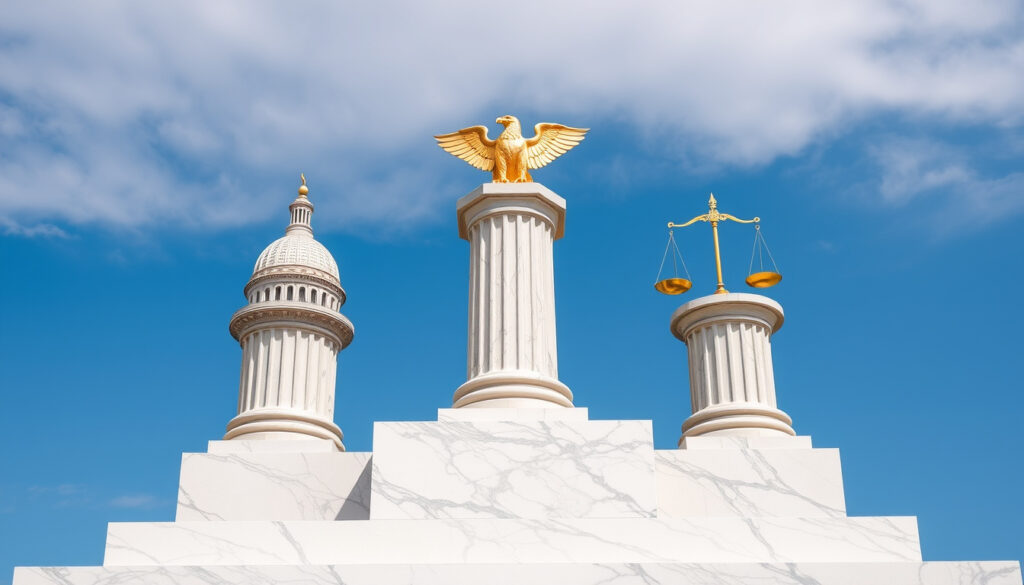
3 Branches of Government – Roles Powers Checks Explained
The United States federal government operates through a system established over two centuries ago to distribute power and prevent any single authority from dominating the nation. This structure divides governmental responsibilities among three distinct branches, each with its own powers, leadership, and constitutional foundation. The framework remains central to how American democracy functions today.
Understanding how these three branches work together—and how they check one another—provides essential insight into the mechanics of U.S. governance. The arrangement reflects deliberate choices made by the founding generation, choices that continue to shape political debates and institutional relationships in the modern era.
What Are the Three Branches of Government?
The American system distributes federal authority across three branches: legislative, executive, and judicial. This division stems directly from Articles I, II, and III of the Constitution, which took effect in 1789. Each branch holds specific powers granted by the Constitution, operates through distinct institutions, and answers to different constituencies or appointment processes.
| Branch | Main Function | Leader | Key Power |
|---|---|---|---|
| Legislative | Makes laws | Congress (Senate & House) | Legislate, declare war, confirm nominees |
| Executive | Enforces laws | President | Veto legislation, command military |
| Judicial | Interprets laws | Supreme Court | Judicial review, constitutional interpretation |
| Balance | Checks & Balances | All three branches | Limit each other’s powers |
Key Insights
- The separation of powers concept was influenced by Enlightenment philosopher Montesquieu, who argued against concentrating authority in one body
- The system ensures no individual or group gains excessive power through mutual checks
- Each branch can limit the actions of the others while performing its own constitutional functions
- The framers designed this structure to prevent the tyranny they had experienced under British rule
- State governments mirror the federal structure, with their own legislative, executive, and judicial branches
- Congressional term lengths vary: House members serve two years, senators six years, while Supreme Court justices serve for life
| Branch | Constitutional Article | Structure | Leadership Term |
|---|---|---|---|
| Legislative | Article I | Congress: 100 Senators, 435 Representatives | 2-6 years (elected) |
| Executive | Article II | President, Vice President, Cabinet (15 departments) | 4 years (max 2 terms) |
| Judicial | Article III | Supreme Court (9 Justices), lower federal courts | Lifetime appointment |
What Does the Legislative Branch Do?
Powers Granted by Article I
Article I of the Constitution establishes Congress as the legislative branch, vesting all lawmaking authority in this two-chambered body. The Senate and House of Representatives share responsibilities while maintaining distinct powers unique to each chamber. This bicameral structure was a deliberate compromise between large and small states during the Constitutional Convention.
Congress holds broad powers including the ability to levy taxes, regulate interstate and foreign commerce, coin money, declare war, raise and support armies, and establish federal courts below the Supreme Court. The chamber also possesses oversight authority over the executive branch and can impeach federal officials, including the president.
Leadership Structure
The Senate comprises 100 members—two from each state—serving six-year terms, with one-third of seats contested every two years. The Vice President of the United States serves as President of the Senate, though this role is largely ceremonial. Senators confirm presidential nominations for executive and judicial positions and ratify treaties with a two-thirds majority.
The House of Representatives consists of 435 members apportioned by population, serving two-year terms. The Speaker of the House, elected by the majority party, serves as the presiding officer and holds significant institutional power. The House holds exclusive authority to originate revenue bills and to impeach federal officials, with impeachment trials then conducted by the Senate.
The Federalist Papers—a collection of 85 essays written by Alexander Hamilton, James Madison, and John Jay between 1787 and 1788—played a crucial role in securing ratification of the Constitution. Federalist No. 51, authored by Madison, explained the logic behind separated powers: “Ambition must be made to counteract ambition.”
What Is the Role of the Executive Branch?
Powers of the President
Article II vests executive power in the president, who serves as head of state, chief executive, and commander-in-chief of the armed forces. The president enforces laws passed by Congress, conducts foreign policy, and nominates judges and agency heads subject to Senate confirmation. The executive branch employs approximately 2.3 million civilians across federal agencies, with an additional 1.3 million active-duty military personnel.
The president may veto legislation passed by Congress, though lawmakers can override a veto with a two-thirds vote in both chambers. Executive orders allow the president to direct executive branch operations and policies, though such orders remain subject to judicial review. The president also grants pardons and reprieves for federal offenses, with the exception of cases involving impeachment.
The Cabinet and Executive Agencies
The Cabinet consists of 15 department heads nominated by the president and confirmed by the Senate. These departments—ranging from State and Defense to Education and Health and Human Services—implement federal policies and manage government operations. The Vice President serves alongside the president and may assume duties as directed or succeed the president in case of death, resignation, or incapacity.
The executive branch operates through numerous federal agencies including the FBI, CIA, EPA, and FDA, each carrying out specific regulatory or operational functions. Federal acts establish these agencies and courts, creating the bureaucratic infrastructure that implements and enforces federal law across the nation.
How Does the Judicial Branch Function?
The Supreme Court and Federal Courts
Article III establishes the judicial branch, headed by the Supreme Court and extending to lower federal courts established by Congress. The judicial branch’s fundamental purpose is to interpret laws, evaluate the constitutionality of government actions, and resolve disputes involving federal law. Federal judges—including Supreme Court justices—are nominated by the president and confirmed by the Senate, serving what the Constitution describes as “during good Behaviour,” effectively lifetime appointments.
The Supreme Court consists of nine justices: a chief justice and eight associate justices. The Court hears cases on appeal from lower federal courts and state courts involving federal questions. Most cases reach the Supreme Court through a writ of certiorari, where the Court decides whether to review a lower court’s decision. The Court issues written opinions explaining its rulings, establishing precedent for future cases.
Judicial Review
The power of judicial review—the authority to declare laws or executive actions unconstitutional—was established in the landmark 1803 case Marbury v. Madison. While not explicitly mentioned in the Constitution, Chief Justice John Marshall’s opinion established this principle, giving the judiciary an essential check on the other branches. This power allows courts to invalidate federal statutes, executive orders, and state laws that conflict with the Constitution.
The judicial power extends to all cases arising under the Constitution, federal laws, and treaties; controversies involving ambassadors and admiralty jurisdiction; and disputes between states or between a state and the federal government. This broad grant of jurisdiction ensures federal courts can address the full range of constitutional questions.
Why Three Branches and How Do They Check Each Other?
The founders deliberately created a system where each branch possesses the means to limit the others’ powers. This structure, known as checks and balances, prevents any single branch from accumulating dangerous levels of authority. The system reflects Enlightenment philosophy and the founders’ determination to avoid the monarchical tyranny they had experienced under British rule.
The System of Mutual Restraint
Congress can override presidential vetoes with two-thirds votes in both chambers, confirm or reject executive nominations, impeach and remove federal officials, and control federal spending. The president nominates federal judges and can issue executive orders directing agency operations, while the judiciary can strike down congressional statutes and executive actions as unconstitutional.
These checks operate daily in American government. Presidential nominees face Senate scrutiny and rejection. Congressional investigations examine executive branch activities. Court rulings constrain both Congress and the president. The system creates a continuous negotiation among branches, each protecting its prerogatives while respecting the legitimate functions of the others.
Modern Examples of Checks and Balances
Recent decades have demonstrated these checks in action. Presidents from both parties have issued executive orders on significant policy matters, only to see courts invalidate portions of those orders. Congress has overridden presidential vetoes on budget and foreign policy matters. The Senate has rejected judicial nominees, leading to extended vacancies on federal benches.
Impeachment proceedings provide the most dramatic check. The House has impeached three presidents—Andrew Johnson in 1868, Bill Clinton in 1998, and Donald Trump twice in 2019 and 2021—while the Senate has convicted none. These proceedings demonstrate both the gravity of the check and the difficulty of successfully invoking it, requiring supermajority support in the Senate.
Timeline: Evolution of the Three-Branch System
- 1787: The Constitutional Convention drafts the separation of powers framework, influenced by Enlightenment ideas including Montesquieu’s writings on political liberty
- 1788: The Constitution is ratified by the required nine states; the Federalist Papers (85 essays by Hamilton, Madison, and Jay) make the case for the new framework
- 1789: The Constitution takes effect; George Washington becomes the first president and the first Congress convenes
- 1803: Marbury v. Madison establishes judicial review, strengthening the judiciary’s role as a check on the other branches
- 1935: The Supreme Court building opens, physically completing the separation of the three branches
- Modern era: Ongoing tensions between branches continue as each interprets and exercises its constitutional powers
While the constitutional structure has remained fixed since 1789, interpretations of specific powers continue to evolve. Debates persist over the scope of executive orders, the extent of congressional oversight authority, and the boundaries of judicial review. These interpretive questions ensure the separation of powers remains a living, contested framework.
Understanding the Separation of Powers
| Established Information | Information Subject to Ongoing Interpretation |
|---|---|
|
|
Historical and Constitutional Context
The three-branch structure emerged from the founders’ study of history and political philosophy. Montesquieu’s Spirit of the Laws (1748) argued that liberty depends on the separation of legislative, executive, and judicial powers. The American colonists, having experienced rule by a distant monarch, sought to prevent any similar concentration of authority in their new government.
The Constitutional Convention debated various proposals before settling on the tripartite structure. Smaller states advocated for equal representation in a unicameral legislature, while larger states pushed for representation based on population. The Great Compromise created the bicameral Congress we have today, with the Senate providing equal state representation and the House reflecting population.
Unlike parliamentary systems where the executive derives its authority from the legislature, the American system establishes independent branches with separate sources of legitimacy. The president is elected independently of Congress; federal judges hold office during good behavior. This independence, the founders believed, would allow each branch to resist encroachments by the others without being beholden to them.
Primary Sources on Government Structure
“Ambition must be made to counteract ambition. The interest of the man must be connected with the constitutional rights of the place.”
— James Madison, Federalist No. 51, 1788
“All legislative Powers herein granted shall be vested in a Congress of the United States, which shall consist of a Senate and House of Representatives.”
— United States Constitution, Article I, Section 1
“The executive Power shall be vested in a President of the United States of America.”
— United States Constitution, Article II, Section 1
Summary
The United States government’s three-branch structure represents one of the foundational compromises of American constitutionalism. Legislative, executive, and judicial branches each hold distinct powers, maintain separate leadership structures, and possess constitutional means to check the others. This system, designed to prevent tyranny and protect liberty, has endured for over two centuries while adapting to contemporary challenges.
Understanding these institutions provides essential context for engaging with American government and civic life. The tensions between branches—what the founders viewed as ambition counteracting ambition—continue to shape political debates and policy outcomes. For those seeking to understand how federal power operates, the separation of powers remains the essential starting point.
Readers exploring related topics may find the 401k 2024 Contribution Limit IRS guide useful for understanding how federal agencies implement tax policy, while the Best Buy Credit Card Review offers insight into federal regulatory oversight of consumer financial products.
Frequently Asked Questions
What are the three branches of the U.S. government?
The three branches are the legislative branch (Congress, which makes laws), the executive branch (led by the president, which enforces laws), and the judicial branch (headed by the Supreme Court, which interprets laws). Each branch has distinct powers under the Constitution.
What is separation of powers?
Separation of powers is the constitutional division of government authority into three distinct branches. The legislative branch makes laws, the executive branch enforces them, and the judicial branch interprets them. This structure prevents any single branch from gaining too much power.
What are checks and balances?
Checks and balances are mechanisms that allow each branch to limit the powers of the others. Congress can override vetoes and impeach officials; the president nominates judges and can veto legislation; the judiciary can declare laws unconstitutional.
What powers does each branch have?
Congress can make laws, declare war, regulate commerce, tax, spend, and confirm nominees. The president enforces laws, conducts foreign policy, commands the military, and can veto legislation. The Supreme Court interprets laws and can exercise judicial review over statutes and executive actions.
Who leads each branch?
The legislative branch is led by Congress, with the Senate President (Vice President) and House Speaker presiding over each chamber. The executive branch is led by the president, elected every four years. The judicial branch is led by the Chief Justice of the Supreme Court, with eight associate justices.
How did the three-branch system originate?
The system was created at the Constitutional Convention in 1787, influenced by Enlightenment philosopher Montesquieu. It was further explained in the Federalist Papers, particularly Federalist No. 51 by James Madison, and formally established when the Constitution took effect in 1789.
Can the Supreme Court be overruled?
While no branch has direct power to overrule the Supreme Court, Congress can propose constitutional amendments that supersede court decisions, and the Court’s membership changes over time through appointments. The president enforces court decisions, and Congress can also limit the Court’s jurisdiction in certain cases.
How do state governments fit into this structure?
State governments mirror the federal structure with their own legislative, executive, and judicial branches. Governors serve as chief executives, state legislatures make laws, and state courts interpret state laws. Federalism divides power between national and state governments while maintaining the separation of powers within each level.
More related posts
 Best Guiso de Lentejas Near Me
 Ashley St. Clair: Age, Relationship with Elon Musk & More
 Zahara Jolie-Pitt – Spelman College and Name Change Facts
 72 Hours From Now: Exact Time, Date, and Calculator Guide
 Simpsons Marge Death: Non-Canonical Flash-Forward Return
 How to Delete Search History on iPhone, Google & Chrome
 On Cloud Running Shoes: Reviews vs HOKA, Nike & Top Picks
