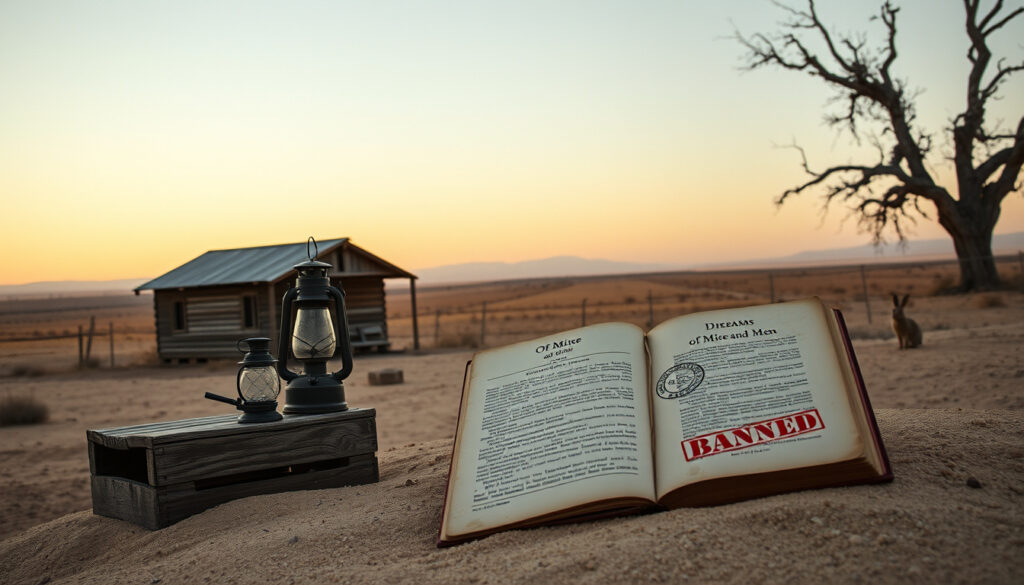
Of Mice and Men Guide: Themes, Banned Status & Worth Reading
There are books you get assigned in school, and then there are books you keep thinking about long after the final page. John Steinbeck’s Of Mice and Men, published in 1937, is the second kind: a novella about two Depression-era ranch hands whose friendship gets tested against a cruel world, and it keeps raising fresh questions about banned books, the American Dream, and what the story does and doesn’t say about love.
Author: John Steinbeck · Published: 1937 · Pages: 107 · Genre: Novella · Setting: Great Depression-era California · Known for: Tragic ending and American Dream theme
Quick snapshot
- Published in 1937 by Covici Friede Wikipedia (open encyclopedia)
- Follows George Milton and Lennie Small, migrant ranch workers Britannica Kids (student encyclopedia)
- Whether the George-Lennie bond carries intentional LGBTQ subtext — the text never labels it Britannica Kids (student encyclopedia)
- Where the line on age-appropriateness should sit for younger students Steinbeck in the Schools (educational reading guide)
- A short, scene-based structure that compresses the action and rewards close reading of foreshadowing and pacing English Association (literary teaching guide)
- Readers can finish the novella in a single sitting, then decide what the ending means for them Wikipedia (open encyclopedia)
- Teachers and parents keep renegotiating whether it belongs in classrooms VOBS Steinbeck resource (teaching guide)
Eight facts, one pattern: everything about Of Mice and Men — its length, its setting, its characters — is arranged to make a short story hit with the force of a much longer one.
| Detail | Value |
|---|---|
| Author | John Steinbeck |
| Publisher | Covici Friede |
| Publication year | 1937 |
| Pages | 107 |
| Genre | Novella |
| Setting | Great Depression-era California ranch |
| Main characters | George Milton and Lennie Small |
| Core theme | Friendship and the American Dream |
| Recognition | Part of school curricula broadly |
What Is the Description of Of Mice and Men?
Ask people why the book stuck with them, and you usually hear some version of the same answer: it’s a small story with heavy luggage. The setup is deceptively simple.
George Milton and Lennie Small are migrant ranch workers moving through Depression-era California in search of work (Britannica Kids (student encyclopedia)). Lennie is large, strong, and developmentally disabled; George is small, quick, and fiercely protective. Their partnership is unusual in a world where most ranch hands travel alone.
The Plot Skeleton
- The pair share one big dream: a small farm where Lennie can tend rabbits and they can answer to no one
- Lennie’s cognitive disability is central to the plot and raises questions about responsibility, care, vulnerability, and social protection (VOBS Steinbeck resource (teaching guide))
- The novella ends in a sudden tragic death that destroys the dream before it can begin
That compression is the point. The plot covers only a short stretch of working life, but every scene adds weight.
Setting and Symbols
- The action takes place on a ranch near Soledad, a name that has been interpreted as a nod to solitude
- Friendship stands out as the emotional center in a world where migrant laborers are frequently isolated
- Animals carry symbolic weight, from the soft creatures Lennie loves to the dog that gets put down
What this means: the description is intentionally modest — two men, one ranch, a few days — and that economy is exactly what makes the ending so hard to shake.
Are There Any Inappropriate Scenes in Of Mice and Men?
Short answer: yes, by most modern classroom standards. The dialogue is full of profanity and racial language, and the plot includes violence and a shooting. Whether that adds up to “inappropriate” depends on who is reading and why.
What Objectors Point To
- Candy’s old dog is shot by a coworker because it has outlived its usefulness — a scene that connects aging, dependence, and fear of abandonment (Wikipedia (open encyclopedia))
- Crooks, the Black stable hand, is excluded from the bunkhouse, reflecting racial segregation and the vulnerability of Black workers in the ranch community (VOBS Steinbeck resource (teaching guide))
- Steinbeck renders the speech of ranch workers without cleaning it up, so profanity and racial language appear throughout
The harder scene to talk about is the ending. Lennie’s disability means he cannot control his own strength, and the plot turns on the harm he causes without meaning to.
The Ending Everyone Argues About
- In the final scene, George shoots Lennie — an act framed as mercy but read by many as something closer to tragedy
- The killing echoes the earlier loss of Candy’s dog: both are judged, in the end, by their usefulness
The debate is the point. Some readers see the shooting as the only humane option available; others see it as the final failure of a world that had no place for Lennie.
The same unflinching scenes that make the book powerful are the ones that keep it off some shelves — the grit is the price of the honesty.
Banned and Taught, at the Same Time
- The novella is broadly part of school curricula, yet objections to its language and violence have followed it for decades
- Some parents and districts set an age or maturity threshold; others argue the book belongs in exactly the conversations it provokes
What this means: “inappropriate” is a moving target. The scenes are real, and so is the book’s staying power. Teachers, parents, and students are left to weigh one against the other.
What Is the American Dream in Of Mice and Men?
If you ask what the book is about, the American Dream is the most useful answer. But Steinbeck does not treat the dream as an inspiring goal. He treats it as a fragile story that two men tell themselves to survive.
The Farm Is the Dream
- The dream of owning a small farm functions as a version of the American Dream (English Association (literary teaching guide))
- The farm plan gives George and Lennie’s relationship purpose and provides emotional relief from economic insecurity (Steinbeck in the Schools (educational reading guide))
- George and Lennie retell the farm narrative like a consoling story, not just a financial plan (English Association (literary teaching guide))
Why the Dream Fails
- The novella presents the American Dream as vulnerable to economic forces, social exclusion, chance, and violence (Steinbeck in the Schools (educational reading guide))
- Poverty and rootlessness shape the characters’ lives and reflect the wider insecurity of the Depression era (VOBS Steinbeck resource (teaching guide))
The Symbolic Takeaway
The American Dream in this book is not wealth or status — it is a small patch of land, a few animals, and the right to be left alone. That is how far the dream has to shrink before it feels reachable.
The implication: Steinbeck is not anti-dream; he is anti-fantasy. The book shows hope surviving inside people who have almost nothing, and then shows how economic pressure, exclusion, chance, and violence keep it out of reach.
Is Of Mice and Men Worth Reading?
Few 107-page books generate this much debate. Steinbeck’s novella does something unusual: it makes you care deeply about two characters, then asks you to sit with an ending that is hard to defend and harder to forget.
What It Does Brilliantly
- Friendship is a central theme, especially through George and Lennie’s unusual companionship in a world where migrant laborers are frequently isolated
- The tight, scene-based structure means every element can be traced: setup, foreshadowing, payoff
- It provokes empathy and heated discussion — a book that works on an emotional level and an intellectual one
What It Asks of You
- The ending is emotionally heavy; readers looking for resolution should prepare for ambiguity
- The dialogue reflects 1930s ranch speech, including profanity and racial language that can be hard to read
- Its treatment of disability, race, and gender reflects a 1937 perspective — part of the historical value, part of the challenge
Who Should Pick It Up
- New readers who want a short, serious entry point into American classics
- Teachers and students who want a text that rewards rereading and debate
- Anyone who can handle a tragic ending — the sadness is not a flaw, it’s the engine
Why this matters: a book that can make an 8th-grader and a college senior argue about the same scene is doing something most novels can’t. That’s the strongest reason to read it.
Is Of Mice and Men LGBTQ?
It’s a question readers keep asking, and the honest answer is: possibly, if you choose to read it that way — but nothing in the text makes it official.
What the Text Actually Shows
- George and Lennie share a bond closer than the usual worker-to-worker connection; they travel, eat, and plan a shared future together
- The novella never labels the relationship as romantic or sexual, and no character identifies as LGBTQ
- The closeness reads as both emotional and practical: George needs someone to care for, and Lennie needs someone to care for him
Why the Question Keeps Coming Up
- A shared life, a shared dream, and a deep emotional dependence naturally invite a romantic reading
- Loneliness shapes every character, so the rare companionship between the two men becomes the emotional center of the book
- Some readers argue the intensity of the bond matters more than any label — the text simply never settles it
The Limits of This Reading
Reading George and Lennie as a romantic couple is an interpretation, not a finding. The book’s silence on sexuality is telling, but a silence is not a confirmation.
The safest description is also the most honest one: this may be one of American literature’s deepest friendships, and the book refuses to say what else it is.
Upsides
- Short enough to read in one sitting, with none of the sprawl of longer novels
- Explores friendship, loneliness, and the American Dream with unusual depth
- Teaches empathy by making readers sit with hard choices
- Rewards rereading with clear foreshadowing and layered symbols
Downsides
- The ending is tragic and emotionally difficult
- Profanity and racial language will bother some readers
- Violence and a mercy killing appear directly on the page
- The 1937 perspective on disability and race needs classroom context
What’s Confirmed, What’s Unclear
Confirmed facts
- Published in 1937 by Covici Friede (Wikipedia (open encyclopedia))
- Friendship is a central theme of the novella (Britannica Kids (student encyclopedia))
- The farm dream functions as a version of the American Dream
- George and Lennie are migrant ranch workers in Depression-era California
What’s unclear
- Whether the George-Lennie bond carries intentional LGBTQ subtext
- Whether the violence and language make the book inappropriate for younger students
- What the ending “means” — mercy, murder, or both
- Whether the farm dream could have succeeded if events had gone differently
The pattern: the table of knowns and unknowns reflects the book’s own structure — it gives you enough to debate, not enough to settle.
Voices on Of Mice and Men
Two framing sentences have shaped how readers talk about the book. One comes from Steinbeck himself; the other from the critical reception that followed it.
“A poem about man’s dreams and the brutal reality.”
— John Steinbeck, on the impulse behind the novella
“A masterpiece of American literature.”
— Critical reception, collected in Steinbeck in the Schools (educational reading guide)
The Verdict on Of Mice and Men
The verdict is not “read it” or “skip it.” Of Mice and Men rewards readers who can tolerate discomfort: it turns 107 pages into a lasting question about how much protection we owe the people we love. For anyone deciding whether to teach it, assign it, or finally read it, the choice comes down to appetite for honesty — accept the tragedy and the hard language as part of the story, or let it sit on the shelf, still packed with the questions it was built to ask.
online.salempress.com, www2.vobs.at, www2.vobs.at, research.gfcmsu.edu
Frequently asked questions
What are the main themes of Of Mice and Men?
Loneliness, friendship, the American Dream, cruelty, and the gap between hope and reality — all packed into a short, scene-based story.
Who are the main characters of Of Mice and Men?
George Milton and Lennie Small, two migrant ranch workers, with supporting characters including Candy, Crooks, Curley’s wife, and Curley.
Why is Of Mice and Men banned in some places?
Objections usually point to profanity, racial language, violence, and the mercy killing at the end. Different school districts have handled those objections differently.
What does the title Of Mice and Men mean?
The title is usually read as a nod to a Robert Burns poem about well-laid plans going wrong — a fitting warning for a story about a dream that collapses.
How does Of Mice and Men end?
After Lennie accidentally causes a tragedy, George shoots him in a scene framed as mercy. The ending has been debated ever since.
Is Of Mice and Men appropriate for high school students?
It is widely taught, but the language and violence make it a frequent subject of parent and district review. Context and discussion usually decide the outcome.
What is the relationship between George and Lennie?
They are friends and traveling companions in a world where loneliness is the norm. George protects Lennie; Lennie gives George a sense of purpose. The bond is the heart of the book.
Where is Of Mice and Men set?
On a ranch near Soledad, California, during the Great Depression — a setting that reinforces the characters’ isolation.
More related posts
 Texas Rangers vs Seattle Mariners Match Player Stats – 2024 Series Breakdown
 USD to Mexican Peso: $100 Example & Best Places to Convert
 What Is a Woman? Dictionary, Medical, and Legal Definitions
 Fear the Walking Dead Cast: Full Actor List by Season
 Elon Musk Net Worth 2025: $726 Billion, Surpassing $600B
 When Do Babies Start Walking? Average Age, Signs & Red Flags
 3I/ATLAS Interstellar Object: Facts, Risk & NASA Updates
