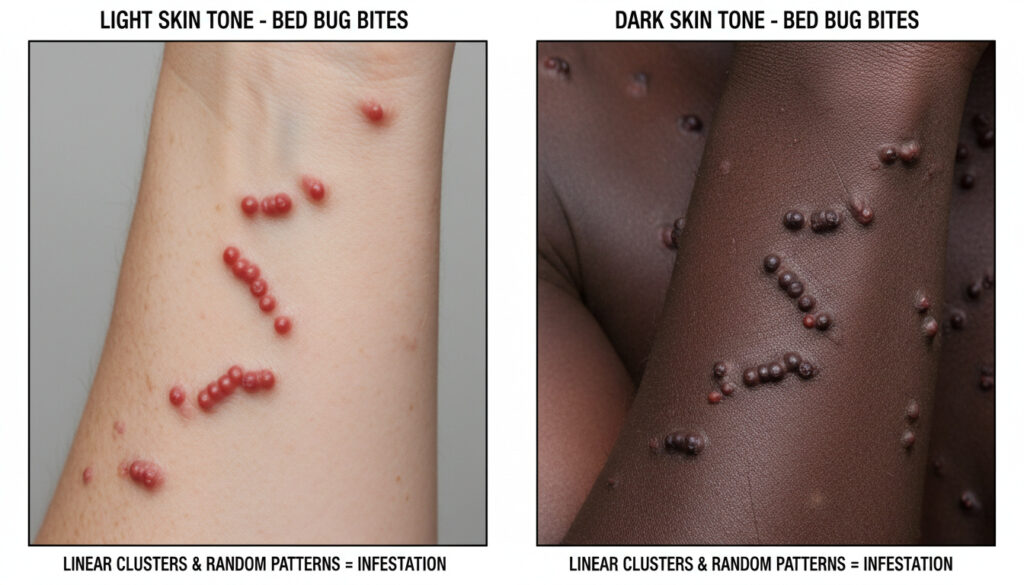
What Do Bed Bug Bites Look Like – Patterns on Light & Dark Skin
Bed bug bites appear as small, raised welts that trigger intense itching, though their look changes significantly based on skin tone and individual immune response. On lighter skin, these lesions usually show up as pink or bright red bumps, sometimes with a darker central puncture mark, while darker skin tones may develop purplish, violet, or deep brown discoloration that can linger as post-inflammatory hyperpigmentation long after the initial bite heals.
Identifying these bites requires careful observation of pattern and location. Unlike random insect bites, bed bug feeding often produces distinctive linear arrangements or clusters of three to five welts, commonly described as the “breakfast, lunch, and dinner” pattern, resulting from the insect’s movement across exposed skin during feeding. These bites concentrate on areas left uncovered during sleep—arms, legs, neck, face, hands, and shoulders—appearing anywhere from seconds to weeks after the actual exposure.
Distinguishing bed bug bites from mosquito or flea bites proves challenging because reactions vary significantly between individuals. While approximately 70 percent of people develop visible welts, the remaining 30 percent show no physical signs despite being bitten, complicating early detection and intervention efforts.
What Do Bed Bug Bites Look Like?
Small, raised, itchy welts; red or pink on light skin, purplish-brown on dark skin
Clusters, straight lines, or zigzag formations reflecting feeding movement
Exposed skin areas during sleep: arms, legs, neck, face, hands, shoulders
Active inflammation lasts 1-2 weeks; hyperpigmentation may persist for months on dark skin
- Seventy percent of bite victims develop visible welts, while 30 percent remain asymptomatic despite exposure
- The characteristic “breakfast, lunch, dinner” pattern appears as lines or clusters of three to five bites
- Coloration varies significantly: bright red on light skin versus purple, brown, or violet on darker complexions
- Itching typically begins hours to days after the bite, unlike the immediate reaction to mosquito bites
- No dark puncture center distinguishes bed bug bites from flea bites
- Severe reactions may produce papular eruptions or fluid-filled blisters
- Presence of blood stains or black fecal dots on bedding confirms infestation beyond skin symptoms
| Feature | Bed Bug Bites | Mosquito Bites | Flea Bites |
|---|---|---|---|
| Pattern | Linear clusters, zigzags, lines | Random, isolated | Random clusters, often on ankles |
| Color on Light Skin | Pink to bright red | Pink/red with dark center | Red with dark center |
| Color on Dark Skin | Purplish, brown, violet | Red center visible | Red bumps |
| Onset of Symptoms | Delayed (hours to days) | Immediate itching | Immediate itching |
| Primary Location | Exposed skin during sleep | Any exposed area | Lower legs, ankles |
| Secondary Signs | Blood stains, fecal dots on sheets | None specific | None specific |
How Do Bed Bug Bites Differ from Mosquito or Flea Bites?
Mosquito Bites
Mosquito bites present as isolated, randomly placed bumps with a distinct dark red center dot. They trigger immediate, intense itching and tend to swell before flattening. Unlike bed bug bites, mosquitoes can attack any exposed area regardless of whether the victim is sleeping, and they do not produce linear patterns. Research indicates that mosquito bites may form open sores if scratched excessively, whereas bed bug lesions rarely break the skin surface immediately.
Flea Bites
Flea bites closely resemble mosquito bites in appearance—small red bumps with a dark center—but concentrate primarily on the lower legs and ankles where fleas access hosts from the floor. The itching begins immediately upon biting. According to entomological studies, flea bites lack the organized linear or zigzag patterns characteristic of bed bugs, appearing instead in random clusters.
Bed bug bites lack the dark red center visible in flea and mosquito bites. The linear or zigzag pattern on exposed sleep areas provides the most reliable distinguishing feature, along with the delayed onset of itching.
Where Do Bed Bugs Bite Most and What Patterns to Spot?
Common Bite Locations
Bed bugs target skin left exposed during sleep, avoiding areas covered by clothing or bedding. Clinical documentation shows bites concentrate on the arms, legs, neck, face, hands, and shoulders. The insects cannot bite through most fabrics, making exposed skin the primary feeding surface. This location specificity helps differentiate bed bug bites from flea bites, which favor the ankles and lower legs.
Pattern Recognition
The feeding behavior of bed bugs creates distinctive visual patterns. As the insect moves across the skin surface, it bites multiple times, creating clusters of three to five welts, straight lines, or zigzag formations. Dermatological observations confirm these patterns reflect the bug’s movement while feeding, unlike the random placement of other insect bites. Images described in clinical libraries show these clusters on legs with accompanying hyperpigmentation on darker skin tones.
What Do Bed Bug Bites Look Like on Dark Skin?
On Black and brown skin, bed bug bites present unique diagnostic challenges. Rather than the bright red welts visible on light skin, bites appear purplish, deeper brown, violet, or even skin-colored, making them less noticeable during initial examination. Specialized dermatological resources note that post-inflammatory hyperpigmentation—dark marks remaining after the initial inflammation subsides—represents a significant concern for darker skin tones, potentially lasting months after the bites heal.
The same pattern rules apply across all skin tones: clusters, lines, or zigzags on exposed areas. However, the delayed visibility on darker skin often leads to later detection of infestations. Medical literature emphasizes that the burning sensation and papular eruptions occur regardless of skin color, though the visual presentation differs markedly.
On dark skin, bed bug bites frequently leave persistent dark marks that remain visible for months, unlike the fleeting redness seen on lighter complexions. Early treatment of inflammation may reduce long-term discoloration.
How Long Do Bed Bug Bites Last?
The timeline from bite to resolution follows a predictable pattern, though individual variation exists based on immune response and skin tone. Clinical studies document the progression from initial feeding to final healing.
- Immediate: Bite occurs during sleep; anticoagulant saliva injected without immediate pain
- Hours to days later: Red or purple marks appear; delayed itching and burning sensations begin
- Day 1-2: Itch intensity peaks; swelling increases; papular eruptions may develop
- Day 3-7: Inflammation subsides; bites begin healing; blistering possible in hypersensitive individuals
- Week 2: Most bites resolve completely; skin returns to normal texture on light skin
- Months later: Hyperpigmentation may remain visible on dark skin tones long after healing
What Is Certain and Uncertain About Bed Bug Bite Reactions?
| Established Information | Information That Remains Unclear |
|---|---|
| Bites cause itchy welts in approximately 70% of exposed individuals | Why 30% of the population shows no visible reaction to bites |
| Patterns consistently form lines or clusters on exposed skin | Individual determinants of severe allergic vs. minimal reaction |
| Dark skin exhibits purple, brown, or violet discoloration | Long-term dermatological effects across all populations |
| Secondary signs include blood stains and fecal dots on bedding | Exact timeline for hypersensitivity development in repeat exposures |
Why Do Bed Bug Bites Form Distinctive Patterns?
The linear and clustered patterns characteristic of bed bug bites result from the insect’s feeding biology. Bed bugs inject saliva containing anticoagulants and anesthetics during feeding, allowing them to remain undetected while moving across the host’s skin. As the insect searches for a suitable capillary, it bites multiple times in succession, creating the “breakfast, lunch, dinner” lines or zigzag formations. This nocturnal feeding behavior concentrates bites on areas exposed during sleep, as the insects cannot penetrate clothing.
The delayed immune response—itching appearing hours to days after feeding—occurs because the saliva proteins trigger a localized allergic reaction that takes time to manifest. Educational resources confirm that this delay, combined with the specific patterning, distinguishes bed bug activity from other household pests.
Expert Perspectives on Identification
Bed bug bites resemble bites from other insects, making visual identification challenging without considering pattern and environmental signs.
— Centers for Disease Control and Prevention
On darker skin tones, the bites may appear as hyperpigmented macules or papules, often leading to delayed diagnosis compared to the erythematous presentation on lighter skin.
— Black Skin Directory
Key Takeaways for Identifying Bed Bug Bites
Bed bug bites present as itchy, raised welts arranged in lines or clusters on exposed sleep areas, with coloration ranging from bright red on light skin to purple and brown on darker complexions. The delayed onset of symptoms, combined with secondary evidence such as blood stains or fecal dots on bedding, provides the most reliable identification method. While the bites cause significant discomfort and potential secondary infections from scratching, they do not transmit disease. Proper identification remains crucial for effective treatment and eradication. For those managing household concerns, understanding financial details like the 401k 2024 Contribution Limit IRS requires similar attention to specific numerical details and regulations.
Frequently Asked Questions
Are bed bug bites dangerous?
Bed bugs do not transmit diseases, though bites cause intense itching and potential secondary infections from scratching. Severe allergic reactions require medical attention.
Do bed bugs bite through clothing?
No, bed bugs typically feed on exposed skin and cannot bite through most fabrics. They target areas left uncovered during sleep.
Can bed bug bites appear immediately?
Some individuals notice marks within hours, but most experience delayed reactions appearing days after exposure. Thirty percent of people show no visible signs.
How can I differentiate bed bug bites from hives?
Bed bug bites follow linear patterns on exposed skin and coincide with sleep periods. Hives appear randomly, change shape rapidly, and lack the characteristic three-bite cluster.
Why do some people not react to bed bugs?
Approximately 30 percent of the population does not develop visible welts due to minimal immune response to the insect’s saliva, despite receiving bites.
Do bed bugs only bite at night?
Bed bugs are nocturnal and prefer feeding during sleep, but they will bite during the day in heavily infested environments or when hosts sleep during daylight hours.
What should I do if I suspect bed bug bites?
Inspect mattress seams for black fecal dots or shed skins. Wash linens in hot water and contact a pest control professional for confirmation and treatment.
More related posts
 24 7 Plumber Near Me: Emergency Costs & How to Choose
 What Internet Is Available at My Address? | Broadband Checker
 Orlando Magic vs Charlotte Hornets Match Player Stats – Box Scores
 When Does Baseball Season Start in 2026? MLB Dates
 Translate Turkish to English – Best Free Tools and Services
 How Tall Is Wemby? Official Height, Shoe Height, More
 Weather in New York City: Daily, 10-Day & Monthly Forecast
 Death from Boric Acid Suppo itorie : Safety Fact
