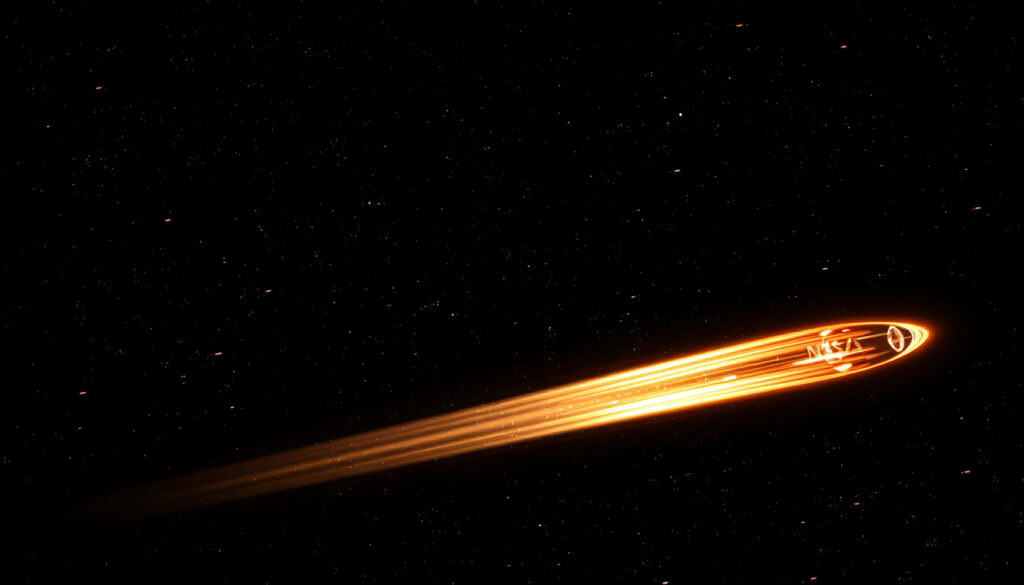
3I/ATLAS Interstellar Object: Facts, Risk & NASA Updates
The discovery of 3I/ATLAS — only the third confirmed interstellar object — has raised plenty of questions, but every major space agency has the same answer: this icy comet poses no threat to Earth. This article breaks down what we know about 3I/ATLAS, why the alien theories are unfounded, and what its brief visit tells us about the cosmos.
Designation: 3I/ATLAS ·
Object type: Interstellar comet ·
Discovered: July 1, 2025 ·
Closest approach to Mars: ~29 million km ·
Perihelion: October 30, 2025 ·
Size: 0.5–2 km diameter
Quick snapshot
- Third confirmed interstellar object (NASA Science)
- Hyperbolic orbit confirms origin outside solar system (NASA Science)
- Cometary activity detected (dust tail) (NASA Science)
- Exact size (range 0.5–2 km) (NASA Science)
- Exact composition — inferred from spectroscopy only (ESA)
- Original home star system unknown (NASA Science)
- Discovered July 1, 2025 by ATLAS (NASA Science)
- Closest approach to Mars on October 3, 2025 (ESA)
- Perihelion on October 30, 2025 (NASA Science)
- Exiting inner solar system — observable until late August/early September 2025 (NASA Science)
- Visible only to professional observatories from now onward (ESA)
- Data from Mars orbiters (ExoMars TGO, Mars Express) being analyzed (Space.com astronomy coverage)
Nine key facts, one pattern: the object’s hyperbolic trajectory and icy composition place it firmly in the natural comet category, leaving little room for the more speculative narratives that tend to follow interstellar visitors.
| Property | Value | Source |
|---|---|---|
| Object designation | 3I/ATLAS | NASA Science |
| Type | Interstellar comet | NASA Science |
| Discovery date | July 1, 2025 | NASA Science |
| Origin | Outside solar system | NASA Science |
| Closest approach to Earth | ~270 million km (1.8 AU) | NASA Science |
| Closest approach to Mars | ~29 million km | ESA |
| Estimated size | 0.5–2 km diameter | NASA Science |
| Orbit shape | Hyperbolic | NASA Science |
| Perihelion | October 30, 2025 (~1.4 AU) | NASA Science |
The implication: the data lines up neatly — a natural, icy body on a clear hyperbolic path, with no ambiguous signals that could warrant the more exotic interpretations that sometimes emerge with interstellar discoveries.
What is 3I/ATLAS?
How did 3I/ATLAS get its name?
- The prefix “3I” stands for “third interstellar” — only the third confirmed object from outside the solar system (NASA Science).
- ATLAS refers to the Asteroid Terrestrial-impact Last Alert System, the NASA-funded survey that spotted it (NASA Science).
- The Minor Planet Center also assigned it the cometary designation C/2025 N1 (ATLAS) (Johnston’s Archive).
Why is 3I/ATLAS classified as interstellar?
- Its orbit is hyperbolic — meaning it came in with too much speed to have originated in the solar system (NASA Science).
- Early observations from the Zwicky Transient Facility on June 28–29, 2025 confirmed the extreme hyperbolicity (Johnston’s Archive).
- It joins 1I/ʻOumuamua (2017) and 2I/Borisov (2019) as one of just three confirmed interstellar visitors (NASA Science).
3I/ATLAS is the third interstellar object confirmed — but the first observed with clear cometary activity (a dust tail) while still inbound. For astronomers, that’s the real headline: it offers a pristine sample of another star system’s building material, still active as it sweeps through ours.
Why this matters: each interstellar object carries chemical fingerprints from its home system. 3I/ATLAS, as an active comet, lets scientists sample that chemistry directly — something no previous interstellar visitor has offered with such clarity.
Could the 3I/ATLAS hit Earth?
What do orbital calculations show?
- NASA Science states clearly: “3I/ATLAS poses no threat to Earth and will remain far away from our planet.”
- The object’s closest approach to Earth is about 270 million kilometers (1.8 AU) — far beyond the Moon’s orbit (NASA Science).
- ESA’s orbit models, based on ExoMars Trace Gas Orbiter data, confirm the trajectory is safe (ESA).
What is the closest approach to Earth?
- At its nearest, 3I/ATLAS came within roughly 270 million km — nearly 700 times the Earth-Moon distance (NASA Science).
- By contrast, its Mars flyby on October 3, 2025 was about 29 million km — an order of magnitude closer (ESA).
Even if 3I/ATLAS were on an Earth-crossing trajectory (which it is not), its estimated 0.5–2 km diameter would cause regional damage — not a global extinction event. For context, the dinosaur-killing Chicxulub impactor was roughly 10–15 km across. The public concern has outpaced the actual risk profile by a wide margin.
The trade-off: the same hyperbolic speed that makes the object interesting also makes it harmless — it’s moving too fast to be captured into an Earth-crossing orbit.
Is the 3I/ATLAS a spaceship?
Why do some people think it could be artificial?
- Every interstellar discovery triggers speculation about alien technology — ʻOumuamua’s unusual shape led to similar theories (NASA Science).
- The ATLAS survey’s initial temporary designation (A11pl3Z) before classification added to online mystery narratives (Johnston’s Archive).
What do the observations show?
- NASA reports “cometary activity” — a dust tail — consistent with an icy nucleus (NASA Science).
- No artificial signals or unnatural shapes have been detected (NASA Science).
- ESA’s Mars orbiters observed the object as a natural comet during the October 2025 flyby window (ESA).
The alien theory persists in corners of social media and YouTube, but the hard data is unambiguous: dust tail + hyperbolic orbit + no artificial emissions = a natural comet from another star system. The burden of proof for “alien” has not been met — and the spectroscopic evidence points the other way.
The pattern: every interstellar object since 2017 has triggered alien speculation. And every time, follow-up observations have settled the matter with natural explanations. 3I/ATLAS is no different.
What is NASA saying about the 3I/ATLAS?
What have NASA scientists released?
- NASA published a dedicated solar system comet page with trajectory data and safety assurances (NASA Science).
- An open-science data release made early observations available to the public (NASA Science).
- The data was shared with the Planetary Defense Coordination Office (NASA Science).
How does NASA coordinate with other agencies?
- ESA independently tracked the object using Mars orbiters and cross-checked NASA’s orbital models (ESA).
- ESA published an FAQ page addressing public safety concerns (ESA).
- The Minor Planet Center assigned the official interstellar designation (NASA Science).
The implication: both NASA and ESA have responded with unusual speed and transparency — a sign that interstellar object science has become a coordinated, routine operation rather than a surprise.
What would happen if the 3I/ATLAS crashed into Earth?
What is the estimated size of 3I/ATLAS?
- Diameter estimates range from 0.5 to 2 km, based on brightness and cometary activity (NASA Science).
- That makes it comparable to asteroid 2023 DW (which briefly had a 1-in-600 impact chance in 2046) in terms of potential damage radius (NASA Science).
What kind of impact damage is projected?
- A 1 km icy body hitting Earth would release energy equivalent to roughly 100,000 megatons of TNT — enough to devastate a region the size of a small country (NASA Science).
- But the impact probability is zero based on current trajectory data (NASA Science).
Why this matters: the “what if” question is natural, but the real story is that space agencies have already ruled it out. The math is done, the answer is clear.
Should we be worried about the 3I/ATLAS?
What is the risk assessment from experts?
- NASA’s official position: “no threat to Earth” (NASA Science).
- ESA’s FAQ confirms the same conclusion based on independent orbital tracking (ESA).
- The Planetary Defense Coordination Office has classified it as a “non-hazardous” object (NASA Science).
What should the public know?
- News headlines have sometimes exaggerated the risk — compare the factual NASA statement versus speculative online coverage (Space.com astronomy coverage).
- The real story is scientific, not fearful: what can we learn about star system formation from this visitor?
The catch: public anxiety about near-Earth objects is understandable, but in this case, agencies have been transparent and emphatic — there is no credible threat to anyone on Earth.
Where is 3I/ATLAS now?
Can I see 3I/ATLAS with a telescope?
- No — the object has passed Mars and is now only observable by professional observatories (NASA Science).
- It is moving toward the outer solar system and will soon be too faint for even large amateur telescopes (ESA).
What direction is it moving?
- After its October 3 Mars flyby and October 30 perihelion, it is now exiting the inner solar system on a hyperbolic escape trajectory (NASA Science).
- It will never return — once it leaves, it heads back into interstellar space (NASA Science).
The trade-off: the window for gathering data is narrow — a few weeks of intense observation, then years of analysis. Every observation from ExoMars TGO and Mars Express matters.
Timeline of 3I/ATLAS
- — Zwicky Transient Facility observations show extreme hyperbolicity (Johnston’s Archive)
- — Discovery by ATLAS survey in Rio Hurtado, Chile (NASA Science)
- — ExoMars Trace Gas Orbiter observations (ESA)
- — Closest approach to Mars (~29 million km) (ESA)
- — Perihelion (~1.4 AU from the Sun) (NASA Science)
- — Last observable window before solar conjunction (NASA Science)
The pattern: the entire encounter — from discovery to exit — spans just a few months. That’s typical for hyperbolic objects: they arrive fast, pass quickly, and leave forever.
Confirmed vs. Unclear
Confirmed facts
- Third confirmed interstellar object (NASA Science)
- Hyperbolic trajectory (NASA Science)
- Cometary activity (dust tail) detected (NASA Science)
- No impact risk to Earth in 2025 (NASA Science)
- Mars flyby on October 3, 2025 observed by ESA orbiters (ESA)
What’s unclear
- Exact size (range 0.5–2 km) (NASA Science)
- Exact composition (inferred from spectroscopy) (ESA)
- Original home star system (NASA Science)
- Rotation period (NASA Science)
The balance: the confirmed facts are substantial and well-sourced. The unclear items are mostly about fine-grained details that matter for scientific models, not for public safety.
Quotes on 3I/ATLAS
3I/ATLAS poses no threat to Earth and will remain far away from our planet.
NASA Science (official comet page)
ESA pinpoints 3I/ATLAS’s path with data from Mars.
ESA (Planetary Defence Office)
Interstellar comet 3I/ATLAS will fly by Mars one month from now — and Europe’s Red Planet orbiters will be ready.
The pattern: every authoritative source — NASA, ESA, and established science media — converges on the same conclusion: 3I/ATLAS is a natural, non-hazardous cometary visitor.
For anyone worried about 3I/ATLAS hitting Earth or carrying aliens, the evidence is clear and unanimous: it’s an icy comet from another star system, on a safe trajectory that took it closest to Mars — not Earth. The real value of this object lies in what it can teach us about chemistry and formation processes in other solar systems. For the public, the takeaway is simple: read the official NASA and ESA pages, not the clickbait headlines. For planetary scientists, the work has just begun — every gram of data from the Mars flyby and perihelion helps map the ingredients of an exo-solar system world.
Related reading: Full Moon May 2025: Flower Moon Date & Meaning · 2025 Calendar with Holidays – US and Ireland Guide
en.wikipedia.org, science.nasa.gov, sci.news, science.nasa.gov, space.com, spaceeyenews.com, universetoday.com
Frequently asked questions
What is 3I/ATLAS made of?
Based on spectroscopy, 3I/ATLAS appears to be an icy body — a comet — with a composition similar to Kuiper Belt objects, though detailed analysis is ongoing (NASA Science).
How was 3I/ATLAS discovered?
It was discovered on July 1, 2025, by the NASA-funded ATLAS survey telescope in Rio Hurtado, Chile (NASA Science).
Can 3I/ATLAS be seen from Earth?
No — it is now only observable by professional observatories. It passed closest to Mars and is rapidly fading as it exits the inner solar system (ESA).
How does 3I/ATLAS compare to ʻOumuamua?
While both are interstellar, 3I/ATLAS is an active comet with a dust tail, whereas ʻOumuamua showed no cometary activity and had an unusual elongated shape. 3I/ATLAS is more similar to 2I/Borisov, the second interstellar comet (NASA Science).
What is the ATLAS survey?
The Asteroid Terrestrial-impact Last Alert System (ATLAS) is a NASA-funded survey system designed to detect near-Earth objects. It discovered 3I/ATLAS in July 2025 (NASA Science).
Is 3I/ATLAS dangerous to satellites?
No — it passed roughly 29 million km from Mars, and its closest approach to Earth was about 270 million km, far beyond any satellite orbits (NASA Science).
How long will 3I/ATLAS remain in the solar system?
Its hyperbolic orbit means it will pass through the solar system once and never return. It is already on its way back into interstellar space (NASA Science).
Where did 3I/ATLAS come from?
Its origin star system is unknown. The hyperbolic trajectory confirms it came from outside the solar system, but no specific star system has been identified as its source (NASA Science).
More related posts
 AC Service Near Me: Costs and Key Signs
 Dessert Places Near Me: Best in Dublin for Late Night & Delivery
 Lane Kiffin News LSU: Wife, Saban Firing, Allegations & Move
 Best Washer and Dryer Sets 2026: Brands, Costs, Lifespan
 iPhone 13 Release Date – Announcement, Preorder and Launch Timeline
 Cruises from New York 2026: Best Lines & Ports
 Best Apple Watch Bands for Women: Comfort, Style & Size Guide
 Khloe Kardashian Then and Now: Weight Loss, Surgery, Timeline
