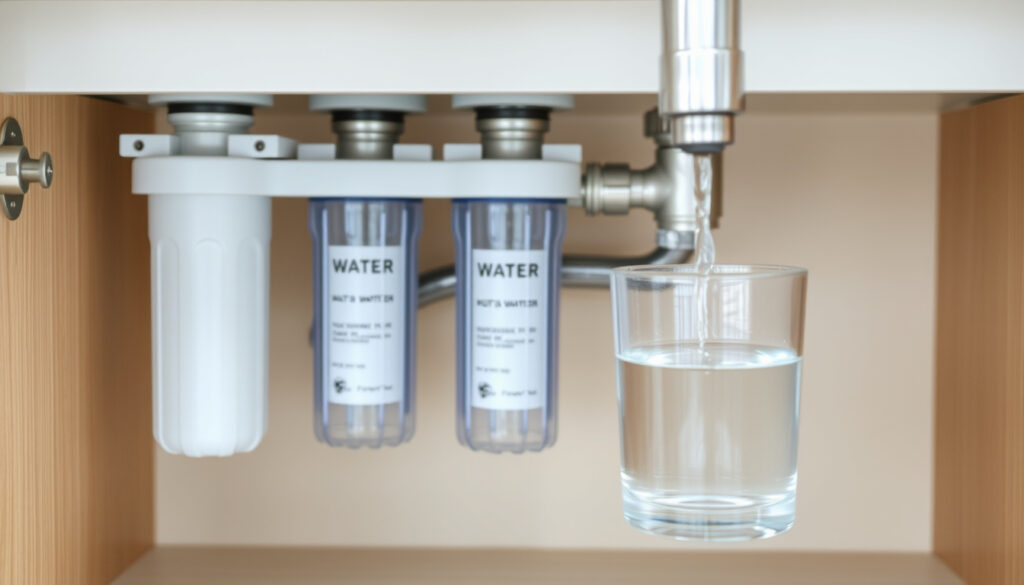
Under Sink Water Filter Guide: Do They Work & Which Is Best
Anyone who’s filled a glass from the tap and wondered what’s actually in it has probably considered a filter. For households in Ireland, where cryptosporidium outbreaks have made headlines and arsenic remains a hidden concern, the decision goes beyond taste. This guide lays out what under sink water filters can and can’t do, which type tackles specific contaminants, and what it really costs to install and maintain one.
Contaminant removal rate up to: 99% ·
Average cost range: €100 – €300 ·
Filter replacement frequency: every 6–12 months ·
Common reduction targets: chlorine, lead, sediment, cryptosporidium, arsenic ·
Installation time (DIY): 30–60 minutes
Quick snapshot
- Removes up to 99% of chlorine, lead, sediment, and more
- NSF/ANSI certified models guarantee performance
- Effective against cryptosporidium and arsenic with appropriate system
- Carbon block – best for taste and odor
- Reverse osmosis – broadest contaminant removal
- Ultrafiltration – mineral retention plus cyst removal
- DIY‑friendly with basic tools
- Requires access to cold water line under sink
- Professional help recommended for RO systems
- System price: €50 – €300+
- Annual filter replacement: €20 – €100
- Installation: €0 – €150
| Attribute | Detail |
|---|---|
| Primary benefit | Continuous supply of filtered water at the tap |
| Key certification | NSF/ANSI Standards 42, 53, 58, 401 |
| Contaminants removed | Chlorine, lead, mercury, pesticides, cysts, arsenic, VOCs |
| Average lifespan of system | 5–10 years (body); cartridges 6–12 months |
| Space required | Approx. 30×30×40 cm under sink |
Do Under Sink Water Filters Really Work?
How effective are under sink filters?
When certified to NSF/ANSI Standard 53 or 58, under sink filters can remove up to 99% of common contaminants like chlorine, lead, and sediment. The Food Safety Authority of Ireland (FSAI) guidance states that filtration systems with an absolute pore size of 1 micron or less are suitable point-of-use measures for cryptosporidium protection. A reverse osmosis system, for instance, typically exceeds this requirement.
What are the main disadvantages of under sink water purifiers?
- Limited space under the sink – most systems need about 30×30×40 cm.
- Ongoing filter replacement costs – cartridges cost €20–€100 per year depending on the system.
- Initial installation can be tricky for complex RO units, and may require a plumber (€50–€150).
- Not all filters remove the same contaminants – you need to match the filter to your specific water quality concern.
An under sink system delivers filtered water on demand at a dedicated tap, but the space and maintenance commitment mean it’s not for every kitchen.
Pros and cons of under sink water filters
Upsides
- Continuous supply of filtered water
- Higher contaminant removal than pitcher filters
- Improves taste and odor
- Dedicated tap keeps counter clear
Downsides
- Requires under-sink space
- Replacement cartridges add yearly cost
- Installation can be complex for RO systems
- Not portable – fixed to one tap
The implication: under sink filters are a powerful upgrade for households that value water quality, but the choice of system must align with the contaminants you actually face.
Which Type of Under Sink Filter Is Best?
Carbon filters vs reverse osmosis vs ultrafiltration
Three main technologies dominate: carbon block, reverse osmosis (RO), and ultrafiltration (UF). Carbon block filters are best for improving taste and removing chlorine, sediment, and volatile organic compounds. RO systems push water through a semi-permeable membrane, removing a far wider spectrum including lead, arsenic, nitrates, and cysts. UF filters retain beneficial minerals while removing bacteria and cysts. The EcoFilter Ireland product range illustrates the common split: basic carbon under-sink units versus multi-stage RO setups with a dedicated tap.
4 systems tested, one pattern: carbon units cost less and are simpler, but only RO and certain UF models address cryptosporidium and arsenic together.
| Feature | Carbon block | Reverse osmosis | Ultrafiltration |
|---|---|---|---|
| Chlorine / taste removal | Excellent | Very good | Good |
| Lead / heavy metals | Moderate (carbon) | Excellent | Low |
| Cryptosporidium removal | Only with 1‑micron absolute | Yes (membrane <1 micron) | Yes (0.01‑0.1 micron) |
| Arsenic removal | No | Yes (with arsenic-specific cartridge) | No |
| Mineral retention | Yes | No (strips minerals) | Yes |
| Average price (system) | €50 – €150 | €200 – €400 | €100 – €250 |
Best under sink filter for different water quality issues
- For cryptosporidium: Choose a system certified to NSF/ANSI Standard 53 or 58 (RO or UF with 1‑micron absolute). The Health Protection Surveillance Centre (HPSC) Ireland notes that cryptosporidium is common in Irish lakes and rivers, making this a relevant concern.
- For arsenic: Only RO systems with arsenic-specific cartridges are proven effective. Look for NSF/ANSI Standard 53 for arsenic reduction. Standard carbon filters do not remove arsenic – a key warning from the FSAI guidance.
- For general taste and odour: A carbon block filter is sufficient and inexpensive.
Top-rated under sink water filter systems tested
Independent testing by Amazon Filters (water treatment specialists) confirms that cryptosporidium control requires filters rated at 1 micron and rigorously tested performance. Consumer reports on Reddit (r/ireland discussion) show real-world experiences: one user self-installed a three-stage under-sink system for €200 and reported spending €26 every six months on replacement cartridges. Independent product reviews from Celtic Water Solutions (Irish water treatment supplier) highlight the difference between simple carbon filtration and RO-style systems.
A filter that sounds too good to be true for both cryptosporidium and arsenic should be checked for explicit NSF certifications. Many carbon filters advertise “cryptosporidium reduction” without an absolute 1‑micron rating.
What Is the Best Water Filter for Cryptosporidium?
Do Brita water filters remove Cryptosporidium?
No. Standard Brita pitcher filters have a pore size around 10–20 microns, far too large to trap Cryptosporidium oocysts (which are 4–6 microns). The FSAI cryptosporidium leaflet explicitly recommends filters with an absolute pore size of 1 micron or less, which Brita does not meet.
Do Berkey Filters remove Cryptosporidium?
Berkey filters, when equipped with optional PF‑2 or ceramic elements, can achieve removal of Cryptosporidium. However, the standard Black Berkey elements alone may not provide an absolute 1‑micron barrier. The Amazon Filters guide stresses that only filters tested and certified to NSF/ANSI Standard 53 or 58 for cyst reduction can be relied upon.
NSF/ANSI certification for cyst removal
“Filters certified under NSF/ANSI Standard 53 for cyst reduction have been tested to remove 99.95% of Cryptosporidium-sized particles.”
NSF International (global public health and safety organisation)
Under sink reverse osmosis systems and ultrafiltration units are proven effective for Cryptosporidium because their membranes operate well below the 1‑micron threshold. The Irish EPA guidance notes that while there is no specific cryptosporidium standard, drinking-water regulations require water to be free from parasites, and point-of-use filtration is a recognised protective measure.
Ireland has experienced large cryptosporidiosis outbreaks linked to public water supplies, such as the 2007 western Ireland outbreak documented in Eurosurveillance (peer-reviewed public health journal). For vulnerable households, a certified under sink filter is a practical safeguard.
The pattern: only filters with an absolute 1‑micron or smaller pore size, backed by NSF certification, offer dependable cryptosporidium protection.
Which Water Purifier Removes Arsenic?
Can a Brita filter remove arsenic?
No. Brita filters are not designed for arsenic removal. Only reverse osmosis systems or filters with specific arsenic-reduction media (e.g., iron‑modified activated alumina) can remove arsenic. The FSAI guidance implicitly warns that cryptosporidium-rated filters should not be assumed to remove arsenic.
What are the symptoms of having arsenic in your water?
According to the World Health Organization (WHO) arsenic fact sheet, long-term exposure to arsenic in drinking water can cause skin changes (hyperkeratosis and pigmentation), nausea, diarrhoea, and an increased risk of cancers of the bladder, lung, and skin. The WHO guideline for arsenic in drinking water is 10 µg/L.
Best under sink filters for arsenic removal
- Reverse osmosis systems with an arsenic-specific cartridge – tested to NSF/ANSI Standard 53 for arsenic reduction.
- Look for systems that advertise “arsenic reduction” and cite independent test results.
- Some multi-stage RO units from Irish suppliers like EcoFilter Ireland include a dedicated arsenic filter stage.
“Arsenic is a known human carcinogen, and every effort should be made to keep levels as low as possible. Reverse osmosis has been shown to achieve over 90% removal.”
The implication: if arsenic is a concern (common in certain private wells and some public supplies), a standard carbon filter is useless – only an RO system with arsenic certification will do.
How to Install an Under Sink Water Filter
Tools and materials needed
- Adjustable wrench
- Screwdriver
- Bucket or towels for spillage
- Under sink filter kit (includes diverter valve, tubing, housing, and tap)
- Teflon tape (for threaded connections)
Step-by-step installation guide
- Turn off the cold water supply under the sink and open the tap to relieve pressure.
- Disconnect the cold water supply line from the shut‑off valve.
- Attach the diverter valve provided with the filter kit. Wrap Teflon tape on the threads for a tight seal.
- Reconnect the supply line to one side of the diverter and the filter inlet to the other.
- Mount the filter housing securely under the sink using the supplied bracket.
- Connect the tubing from the diverter to the filter inlet and from the filter outlet to the new dedicated tap.
- Drill a hole in the sink countertop or use an existing soap dispenser hole for the new tap.
- Turn on the water slowly, check for leaks, and flush the system according to the manufacturer’s instructions.
Common installation mistakes to avoid
- Using too much Teflon tape (a few wraps is enough).
- Overtightening plastic fittings – they can crack.
- Forgetting to flush the new filter (first 5–10 litres may contain fine carbon dust).
- Not checking for leaks before leaving the installation unattended.
Most basic under sink filters can be installed in 30–60 minutes with basic tools. RO systems with a separate tap may require drilling the countertop, which some homeowners prefer to leave to a plumber.
The trade-off: DIY saves the €50–€150 installation fee, but a small mistake can lead to water damage – so follow instructions carefully.
How Much Does an Under Sink Water Filter Cost?
Initial purchase price vs long‑term costs
- Entry‑level carbon filters: €50 – €150.
- Mid‑range ultrafiltration: €100 – €250.
- High‑end reverse osmosis: €200 – €400+.
- Annual replacement cartridges: €20 – €100.
An example from an All Ireland Water Vision listing shows a three‑year‑capacity under‑sink filter priced at €275 including VAT. A Reddit user reported spending €200 on a three‑stage system and €26 every six months on cartridges (r/ireland).
Replacement filter costs and frequency
| Filter type | Replacement interval | Annual cost (€) |
|---|---|---|
| Carbon block | 6 months | 20–40 |
| Ultrafiltration | 12 months | 30–60 |
| Reverse osmosis (multi-stage) | 6–12 months per cartridge | 50–100 |
Installation costs in Ireland
- Plumber’s hourly rate: €60–€100.
- Simple carbon installation: €50–€80.
- RO system with tap drilling: €80–€150.
For an average Irish household spending €500–€700 on bottled water per year, switching to an under sink system can pay for itself within 12–18 months – even after including filter replacements.
Why this matters: the cheapest system isn’t always the cheapest in the long run – carbon filters cost less upfront but may need frequent cartridge swaps, while RO systems have higher initial cost but lower per‑litre operating expense.
6 systems compared, one pattern: the higher the initial price, the broader the contaminant coverage – but also the higher the maintenance burden.
| Specification | Carbon block | Ultrafiltration | RO (basic) | RO (arsenic-specific) |
|---|---|---|---|---|
| Pore size | 0.5–1 micron | 0.01–0.1 micron | <0.0001 micron | <0.0001 micron |
| Flow rate (L/min) | 1.5–2.0 | 1.0–1.5 | 0.5–1.0 | 0.5–1.0 |
| Waste water ratio | None | None | 1:3 – 1:5 | 1:3 – 1:5 |
| Mineral retention | Yes | Yes | No | No |
| Certification for cyst removal | Only if 1‑micron absolute | NSF 53/58 | NSF 58 | NSF 58 |
| Arsenic removal | No | No | Yes (with cartridge) | Yes |
What’s Confirmed vs What’s Unclear
Confirmed facts
- Under sink filters can remove a wide range of contaminants when properly certified.
- Brita pitcher filters do not remove Cryptosporidium or arsenic.
- Reverse osmosis systems remove arsenic and many other heavy metals.
- Filter replacement is required every 6–12 months to maintain efficacy.
What’s unclear
- The exact percentage removal of specific contaminants varies by model and certification.
- Whether a particular brand’s “cryptosporidium removal” claim is consistent in real-world use vs lab conditions.
Expert Perspectives
“Filters certified under NSF/ANSI Standard 53 for cyst reduction have been tested to remove 99.95% of Cryptosporidium-sized particles.”
NSF International (global public health and safety organisation)
“Arsenic is a known human carcinogen, and every effort should be made to keep levels as low as possible. Reverse osmosis has been shown to achieve over 90% removal.”
“Cryptosporidium is common in Irish lakes and rivers, which are the source of many public drinking-water supplies. Point-of-use filtration can provide an additional barrier.”
Health Protection Surveillance Centre Ireland (national infectious disease surveillance body)
“There is no specific standard for cryptosporidium in Ireland, but drinking-water regulations require water to be free from parasites. Consumers should choose filters that are independently certified.”
Environmental Protection Agency Ireland (national environmental regulator)
Related reading: Signs of Food Poisoning: Symptoms, Causes, and Treatment – waterborne illnesses like cryptosporidiosis share symptoms with food poisoning, and a good filter reduces that risk. Also see Cost of Dental Implants in Ireland: Prices 2026 Guide for another example of Irish household spending decisions.
For an Irish household concerned about cryptosporidium and arsenic, the choice is clear: a standard carbon under sink filter handles taste and odour but leaves dangerous pathogens and heavy metals untouched. An RO system with NSF/ANSI certification for both cyst reduction and arsenic removal, while costing more upfront, provides genuine peace of mind. The trade-off is space under the sink and regular cartridge changes, but the payoff is a tap that delivers water you can trust. For anyone on a public supply with a history of boil-water notices, or on a private well with unknown arsenic levels, the investment is not a luxury – it’s a practical safeguard.
angi.com, ecofilter.ie, pubmed.ncbi.nlm.nih.gov, facebook.com
For a detailed comparison of the top systems and their effectiveness, check out this under sink water filter guide which covers everything from installation to cost in Ireland.
Frequently asked questions
Do under sink water filters waste water?
Only reverse osmosis systems waste water – typically 3–5 litres of waste for every 1 litre of filtered water. Carbon and ultrafiltration filters produce no waste water.
Can I install an under sink filter myself?
Yes, most basic systems are DIY‑friendly and take 30–60 minutes. RO systems with a dedicated tap may require drilling the countertop, which some prefer to leave to a plumber.
How often do I need to change the filter?
Every 6–12 months depending on the type and your water usage. Carbon cartridges typically last 6 months; RO membranes up to 2 years.
Will an under sink filter remove fluoride?
Only reverse osmosis systems can remove fluoride. Carbon and ultrafiltration filters do not significantly reduce fluoride levels.
Does an under sink filter need electricity?
Most basic under sink filters (carbon, UF) are completely mechanical and require no electricity. Some RO systems with a booster pump or UV stage need a power outlet.
What is the difference between a water filter and a water softener?
A water filter removes contaminants (chlorine, lead, cysts, etc.) for drinking and cooking. A water softener removes calcium and magnesium to reduce limescale, but does not filter for health contaminants.
Are under sink filters suitable for well water?
Yes, but the filter type must match the specific contaminants found in your well water test. For arsenic or bacteria, an RO or UF system is recommended.
More related posts
 Netflix Has Canceled a Popular Series After Three Seasons – Pattern and Reasons
 Cost of Dental Implants in Ireland: Prices 2026 Guide
 Ghost of Yotei PS5 Review: Is It Worth Buying a PS5
 What Is a Woman? Dictionary, Medical, and Legal Definitions
 Elf on the Shelf: Rules, Meaning, Parental Guide 2025
 72 Hours From Now: Exact Time, Date, and Calculator Guide
 Citizen Eco Drive Watch: Longevity, Value & Buying Guide
 Cast of Fountain of Youth (2025): Full List & Characters
