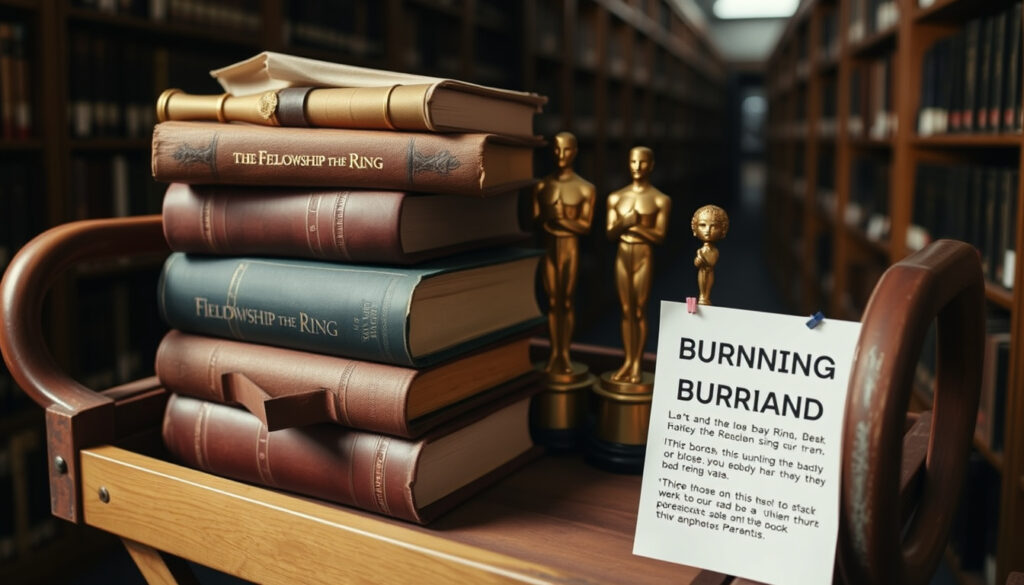
The Fellowship of the Ring: Banned Book, 17 Oscars, Viewing Order
Few stories have lived such a double life: The Fellowship of the Ring is both a treasured fantasy classic that launched a record-breaking film trilogy and a book so controversial it spent years as the most banned title on American library shelves. This guide connects those two sides — the Oscar-winning blockbuster and the fiercely debated novel — so you can decide whether that means reading first, watching first, or both.
Trilogy Academy Awards: 17 Oscars · Volume one publication year: 1954 · Film release year: 2001 · Theatrical runtime: 178 minutes · Banned book ranking: #1 most banned (ALA 1990-2000)
Quick snapshot
- The Fellowship of the Ring is volume one of The Lord of the Rings, first published in 1954 (Tolkien Gateway)
- Trilogy won a combined 17 Academy Awards (LOTR Fandom)
- Film released in US on December 19, 2001 (IMDb)
- Which specific edition of the book is most frequently cited as “#1 most banned” varies by reporting source (Sunday Report)
- 1937: The Hobbit published (Tolkien Gateway)
- 1954: Fellowship of the Ring published (Wikipedia)
- 1990s: Most banned book of decade (Sunday Report)
- 2001: Film premiere (IMDb)
- 2003: Return of the King wins 11 Oscars; trilogy totals 17 (Academy Awards)
- For viewers: decide between release order and chronological order (Collider)
- For readers: the story continues in The Two Towers (Tolkien Gateway)
Six key facts, one pattern: the Fellowship connects a 1954 book to a 2001 film that helped win a record 17 Oscars.
| Attribute | Value | Source |
|---|---|---|
| Full title | The Lord of the Rings: The Fellowship of the Ring | Wikipedia |
| Director | Peter Jackson | Wikipedia |
| Release date (film) | December 19, 2001 (USA) | Wikipedia |
| Book publication | July 29, 1954 (UK) | Wikipedia |
| Academy Awards (film) | 4 wins including Best Cinematography | Academy Awards |
| Trilogy total Oscars | 17 | Academy Awards Search |
Which trilogy has 17 Oscars?
How many Oscars did The Lord of the Rings trilogy win?
The Lord of the Rings film trilogy won a combined 17 Academy Awards, the most of any trilogy in Oscar history. The breakdown: The Fellowship of the Ring won 4, its two sequels earned 2, and The Return of the King — the final installment — swept 11 Oscars in 2004. The trilogy also collected 30 nominations total across all three films (LOTR Fandom).
Return of the King’s 11-for-11 sweep is a statistical anomaly — no film in the post-2000 era has matched that clean a ratio across so many categories.
The implication: Seventeen Oscars over three films isn’t just a win count; it’s a statement about sustained quality in a genre often overlooked by the Academy.
In what order should I watch LOTR?
Do I watch LOTR first or The Hobbit?
The standard recommendation for first-time viewers is release order: The Fellowship of the Ring (2001), The Two Towers (2002), The Return of the King (2003), followed by the Hobbit trilogy (An Unexpected Journey 2012, The Desolation of Smaug 2013, The Battle of the Five Armies 2014) (Good Housekeeping). A chronological story order would place the Hobbit films first, but that changes the pacing and reveals (Collider).
Three viewing approaches, one trade-off:
| Method | Films in sequence | Best for |
|---|---|---|
| Release order | Fellowship → Two Towers → Return → Hobbit trilogy | First-time viewers, preserving reveals |
| Chronological order | Hobbit trilogy → Fellowship → Two Towers → Return | Familiar readers wanting narrative continuity |
| LOTR only | Just the three LOTR films | Viewers short on time or who prefer the darker tone |
The pattern: Purists lean toward release, but chronological works for anyone who wants the full Middle‑earth arc in story sequence.
Why was the Fellowship of the Rings banned?
According to the American Library Association’s annual reports, The Lord of the Rings and The Hobbit were the most banned books of the 1990s in the United States (Sunday Report). Objections cited magic, anti‑Christian themes, violence, and references to drugs such as pipeweed. Some religious groups also challenged the books for their occult undertones (Sunday Report).
The same elements that drew censorship — magic, moral ambiguity, complex world‑building — also fueled the story’s cultural endurance and made it a textbook example of freedom to read debates.
The catch: The banning history is as much a reflection of the era’s cultural anxieties as of Tolkien’s writing. The books remain among the most frequently challenged, even today.
Who lost an Oscar 18 times?
What is the biggest Oscar snub of all time?
Composer John Williams holds the record for most Oscar nominations without a win, with 18 losses (Wikipedia). For The Fellowship of the Ring specifically, missing the Best Picture prize — the film won 4 Oscars in technical categories but not the top award — is a snub that fans still talk about today (Academy Awards).
The trade-off: 17 Oscars across the trilogy is a haul, but Fellowship’s lack of a Best Picture win means there’s always a “what if” for one of the most acclaimed fantasy films ever.
Why does Frodo wait 17 years?
In Tolkien’s timeline, Frodo inherits the Ring at age 33 (hobbit coming‑of‑age) and leaves the Shire at age 50 — a gap of 17 years (LOTR Fandom). The film compresses this dramatically; the novel explains the delay as careful planning on Frodo’s part and Gandalf’s delayed return from research.
Why this matters: The gap underscores Frodo’s reluctance and the slow, creeping corruption the Ring exerts — a detail many movie‑only fans miss.
Timeline signal
1937 — Tolkien publishes The Hobbit (Tolkien Gateway)
1954 — The Fellowship of the Ring first published in UK (Wikipedia)
1990s — Trilogy tops banned‑book lists (Sunday Report)
2001 — Film premieres; wins 4 Oscars (Academy Awards)
2003 — Return of the King wins 11 Oscars; trilogy total 17 (Academy Awards Search)
Confirmed facts
- The Fellowship of the Ring is volume one of The Lord of the Rings, first published in 1954 (Britannica)
- The film was released in 2001 (Wikipedia)
- The trilogy won 17 Oscars (Academy Awards Search)
What’s unclear
- Which edition of the book is considered “#1 most banned” varies by reporting source (Sunday Report)
- Whether the extended edition of the film is the definitive version is debated among fans
The pattern: A book once banned for magic became the backbone of the most decorated film trilogy in Academy history.
Quotes on a classic
The Lord of the Rings and The Hobbit were the most banned books of the 1990s in the United States.
— American Library Association (via Sunday Report)
The standard recommendation for first-time viewers is to follow release order to preserve the original reveals and pacing.
— Collider, Viewing Guide
The editorial take: Two different lenses — one warning, one guiding — both point to the same object’s outsized cultural footprint.
Frequently asked questions
What is the Fellowship of the Ring?
The Fellowship of the Ring is the first volume of J.R.R. Tolkien’s The Lord of the Rings fantasy novel series, and also the first film in Peter Jackson’s film trilogy based on that series.
Is the Fellowship of the Ring based on a book?
Yes, the film is an adaptation of the first volume of The Lord of the Rings, published in 1954.
Who are the members of the Fellowship?
The Fellowship of the Ring consists of nine members: four hobbits (Frodo, Sam, Merry, Pippin), two men (Aragorn, Boromir), one elf (Legolas), one dwarf (Gimli), and one wizard (Gandalf).
How long is the Fellowship of the Ring movie?
The theatrical version has a runtime of 178 minutes; the extended edition runs 208 minutes.
What is the extended edition of Fellowship of the Ring?
The extended edition includes additional footage and scenes not in the theatrical cut, totaling about 30 minutes more content.
Where can I watch the Fellowship of the Ring?
The film is available on major streaming platforms such as Amazon Prime Video and HBO Max, and is also sold on Blu‑ray and DVD (Amazon).
Who directed the Fellowship of the Ring?
The film was directed by Peter Jackson.
For fans approaching Middle‑earth for the first time, the choice between book and film is really a decision between two distinct experiences — one steeped in language and patience, the other in visual spectacle — and both are worth taking.
More related posts
 Proverbs 27:9 Explained: Friendship, Advice & Bible Verses
 Is McDonald’s Open on Christmas Day? 2025 Hours Guide
 How to Cancel Hulu: Step-by-Step Guide for All Devices
 Breakfast Burritos Near Me: Best Local & Fast Food
 Miami vs. Ohio State 2025 Cotton Bowl: How the Hurricanes Stunned the Buckeyes
 Restaurants Near Me Open Now: Maps, Apps & Lingo Tips
 Elf on the Shelf: Rules, Meaning, Parental Guide 2025
 How to Draw a Fish: Easy Step-by-Step Guide
