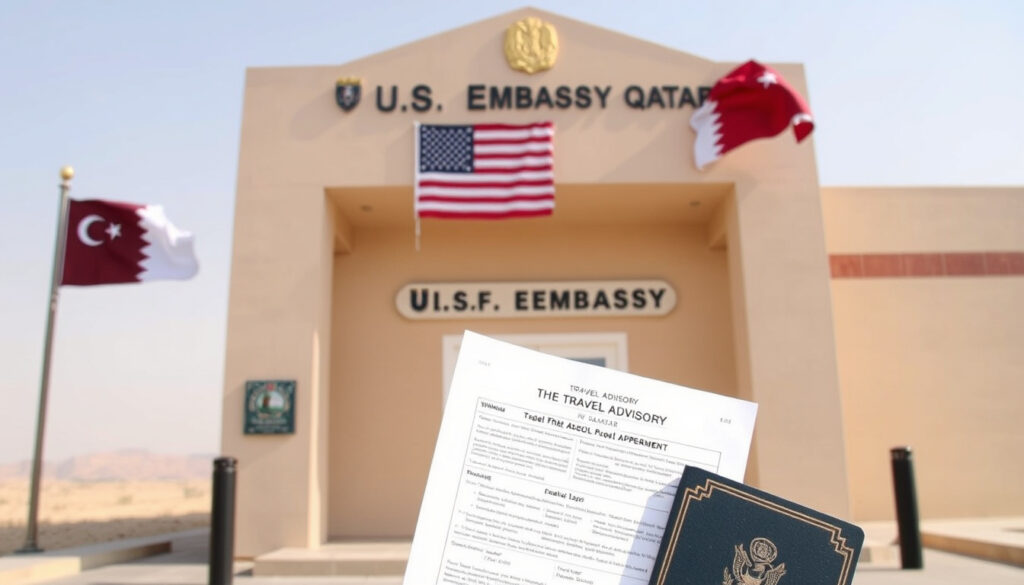
U.S. Embassy Qatar Warning: What Travelers Need to Know
When the U.S. Embassy in Doha tells its own staff to leave, it’s natural to wonder: should I cancel my trip? The ordered departure announced in July 2026 has left many Americans uncertain about safety in Qatar.
Latest U.S. Embassy Alert: July 24, 2026 ·
Ordered Departure Status: Active ·
Threat Level (Canada): Avoid non-essential travel ·
Largest U.S. Base in Region: Al-Udeid Air Base ·
Public Displays of Affection: Illegal ·
Comparative Safety (Dubai vs Qatar): Dubai considered more liberal
Quick snapshot
- Ordered departure active (U.S. Embassy Doha Security Alert)
- Latest alert: July 24, 2026 (U.S. Embassy Doha Security Alert)
- Avoid demonstrations (U.S. Embassy Doha Security Alert)
- Low crime rate (U.S. State Department Qatar Country Info)
- Regional tensions risk (U.S. State Department Travel Advisory)
- Monitor local media (U.S. Embassy Doha Security Alert)
- Modest dress recommended (U.S. State Department Qatar Country Info)
- Public affection illegal (U.S. State Department Qatar Country Info)
- Alcohol restricted (U.S. State Department Qatar Country Info)
- Al-Udeid Air Base (U.S. State Department Travel Advisory)
- Largest in region (U.S. State Department Travel Advisory)
- Bilateral agreement (U.S. State Department Travel Advisory)
Six key facts at a glance, pulling together the official warnings and practical realities.
| Category | Value |
|---|---|
| Latest Alert Date | July 24, 2026 (U.S. Embassy Doha) |
| Ordered Departure | Yes (U.S. State Department) |
| Threat Level (Canada) | Level 3: Avoid non-essential (Government of Canada) |
| Al-Udeid Base | Largest U.S. base in Middle East (U.S. State Department) |
| Public Affection | Illegal (U.S. State Department Qatari Laws) |
| Comparative Safety | Dubai more liberal (U.S. State Department) |
Is it safe to go to Qatar right now?
What does the U.S. Embassy warning say?
On July 24, 2026, the U.S. Embassy in Doha issued a security alert stating that the embassy remains on ordered departure status. Non-emergency U.S. government personnel have been relocated outside Qatar. The advisory strongly encourages Americans in Qatar to depart now using commercial transportation (U.S. State Department Travel Advisory).
What is the ordered departure status?
Ordered departure means the U.S. government has ordered its non-emergency employees and their family members to leave the country. It doesn’t compel private citizens to leave, but it signals a serious threat. The embassy advises remaining Americans to prepare contingency plans that do not rely on government assistance (U.S. State Department Travel Advisory).
When the U.S. government pulls its own staff, it’s a stronger signal than any travel advisory level. For American travelers in Qatar, the message is clear: leave if you can, or be ready to shelter in place.
What threat level is Qatar?
What is Canada’s travel advisory?
Canada’s travel advisory for Qatar is Level 3: Avoid non-essential travel (Government of Canada Travel Advisory). This places Qatar in the same tier as countries with active conflict or high instability.
What is the U.S. Department of State advisory?
The U.S. Department of State advises Americans worldwide to exercise increased caution, and the Qatar-specific advisory is at Level 4: Do Not Travel (U.S. State Department Travel Advisory). The agency notes that Qatar’s overall crime rate is low, but regional tensions can affect security (U.S. State Department Qatar Country Info).
Official warnings are at their highest level, even though day-to-day crime is low. The threat is geopolitical, not general lawlessness.
Why is there a U.S. base in Qatar?
Who pays for the base?
Al-Udeid Air Base is operated by the U.S. Air Force with support from the Qatar Emiri Air Force under a bilateral defense agreement (U.S. State Department Travel Advisory). The base is the largest U.S. military facility in the Middle East, hosting thousands of personnel and serving as a key hub for regional operations.
How large is Al-Udeid?
Al-Udeid Air Base is the largest U.S. military base in the Middle East (U.S. State Department Travel Advisory). It plays a critical role in U.S. Central Command operations, including air support for missions across the region.
The same base that protects U.S. interests also makes Qatar a target. The base’s presence is a strategic asset, but it’s also a reason the embassy is so cautious about personnel safety.
The implication: the military asset that protects American interests also elevates Qatar’s risk profile, creating a security tension few other Gulf destinations face.
Can females wear shorts in Qatar?
What is the dress code for women in Qatar?
Women can wear shorts in public, but it is respectful to cover knees and shoulders (U.S. State Department Qatar Country Info). In conservative areas, modest dress is expected. There are no specific laws against shorts, but public indecency laws apply.
Are there any legal penalties?
No specific statute prohibits shorts, but police can enforce public indecency laws if they deem attire offensive (U.S. State Department Qatar Country Info). You’re unlikely to be arrested for wearing shorts in tourist areas, but you may attract unwanted attention or be asked to change.
The pattern: Qatari dress norms are enforced through public indecency laws, not a written dress code, giving authorities broad discretion.
Can I kiss my wife in public in Qatar?
What are the rules on public displays of affection?
Public displays of affection, including kissing, are illegal in Qatar (U.S. State Department Qatar Country Info). Hand-holding is generally tolerated, but passionate kissing is strictly prohibited.
What are the penalties?
Penalties can include fines, imprisonment, or deportation (U.S. State Department Qatar Country Info). What’s normal in the West can land you in legal trouble in Qatar. Even married couples are expected to keep affection private.
The catch: what feels normal in the West can result in fines or deportation in Qatar, even for married couples.
Is Dubai or Qatar safer?
How does crime rate compare?
Both Dubai and Qatar have low crime rates (U.S. State Department Qatar Country Info). However, the U.S. Embassy warning currently applies to Qatar, not Dubai.
How does cultural tolerance compare?
Dubai is generally considered more liberal and tolerant of Western behaviors (U.S. State Department UAE Country Info). Qatar has stricter laws on public behavior and alcohol consumption.
The threat differential is not about petty crime—it’s about regional geopolitics. Dubai sits in a more stable part of the Gulf, while Qatar’s location and military base make it a higher-risk destination for now.
Three key differences, one takeaway: the safety gap is driven by political risk, not street crime.
| Factor | Dubai (UAE) | Qatar |
|---|---|---|
| U.S. Embassy Advisory | Level 2: Exercise increased caution | Level 4: Do Not Travel |
| Cultural Tolerance | High — public displays of affection tolerated | Low — public displays of affection illegal |
| Alcohol Availability | Widely available in hotels & bars | Restricted to licensed hotels & clubs |
| U.S. Military Presence | Minimal (naval base) | Major (Al-Udeid Air Base) |
| Current Travel Advisory (Canada) | Level 2 | Level 3 |
The pattern: the safety gap between Dubai and Qatar is driven by political risk, not street crime.
Timeline signal
- — U.S. Embassy Doha issues security alert warning against demonstrations and large gatherings (U.S. Embassy Doha Security Alert).
- — U.S. Embassy issues another security alert and announces ordered departure status for non-emergency personnel (U.S. Embassy Doha Security Alert).
Confirmed facts
- U.S. Embassy issued security alerts on June 4 and July 24, 2026 (U.S. Embassy Doha).
- Ordered departure status is in effect (U.S. State Department Travel Advisory).
- Qatar has a low crime rate (U.S. State Department Qatar Country Info).
- Public displays of affection are illegal (U.S. State Department Qatar Country Info).
What’s unclear
- Duration of the current warning — no end date has been announced.
- Specific nature of the threat prompting the ordered departure — the embassy cites “armed conflict” but gives no further details.
- Whether the warning will affect tourist visas — no official change to visa policy has been reported.
“Due to the threat of armed conflict, the U.S. Department of State ordered non-emergency U.S. government employees and their family members to leave Qatar.”
U.S. State Department Travel Advisory
“Americans should not travel to Qatar due to the risk of armed conflict.”
U.S. State Department Travel Advisory
“The Canadian government advises avoiding non-essential travel to Qatar due to the security situation.”
For American travelers currently in Qatar, the choice is clear: arrange commercial departure immediately, or be prepared to shelter in place without expectation of government evacuation. The warning is not a suggestion—it’s a directive backed by the highest advisory level. Those who ignore it risk being caught in a deteriorating situation with limited options.
osac.gov, instagram.com, osac.gov, travelwarningcheck.com, instagram.com, timesofisrael.com, hamiltonjournal.org
Travelers should also consult the U.S. Embassy Doha travel safety guide for updated information on suspended services and regional security.
Frequently asked questions
How do I sign up for the U.S. Embassy’s WhatsApp channel?
The U.S. Embassy in Doha offers a WhatsApp channel for alerts. Enroll by visiting the embassy’s website and following the instructions. The channel sends real-time security updates.
What is the STEP program and how do I enroll?
The Smart Traveler Enrollment Program (STEP) is a free service that allows U.S. citizens traveling abroad to register with the nearest embassy. Enroll at step.state.gov to receive updates and emergency contact.
Can non-U.S. citizens still travel to Qatar during the warning?
Yes, the warning is directed at U.S. citizens. Other nationalities are not affected by the U.S. ordered departure, but they should check their own country’s travel advisories. Canada and several European nations have also issued warnings.
What should I do if I am in Qatar during a security alert?
Follow the instructions in the embassy alert: stay indoors, avoid windows, monitor local media, and keep a low profile. If you feel unsafe, contact the embassy via the emergency number provided in the alert.
How often does the embassy update security alerts?
Alerts are issued as needed, usually when the threat level changes. During the current crisis, updates have been monthly (June, July 2026). Always check the embassy website for the latest.
Is Hamad International Airport considered safe?
As of the latest alerts, the airport remains operational and is considered safe for transit. However, given the ordered departure, travelers should minimize time in public areas and follow any security instructions at the airport.
Are there any U.S. travel restrictions to Qatar right now?
There are no U.S. restrictions on travel to Qatar itself, but the Level 4 “Do Not Travel” advisory strongly discourages it. Some airlines may alter schedules; check with your carrier before booking.
More related posts
 Under Sink Water Filter Guide: Do They Work & Which Is Best
 Tell Me Lies Cast: Real-Life Partners, Mental Health & Finale
 Ukraine War News Today – Key 2025 Developments
 A Big Bold Beautiful Journey (2025) Box Office Flop
 Where to Watch Landman TV Series Online in Ireland & UK
 Time in London Right Now – BST Status, UTC+1 and DST Dates
 Propane Gas Near Me – Refill Stations, Exchanges & Delivery
