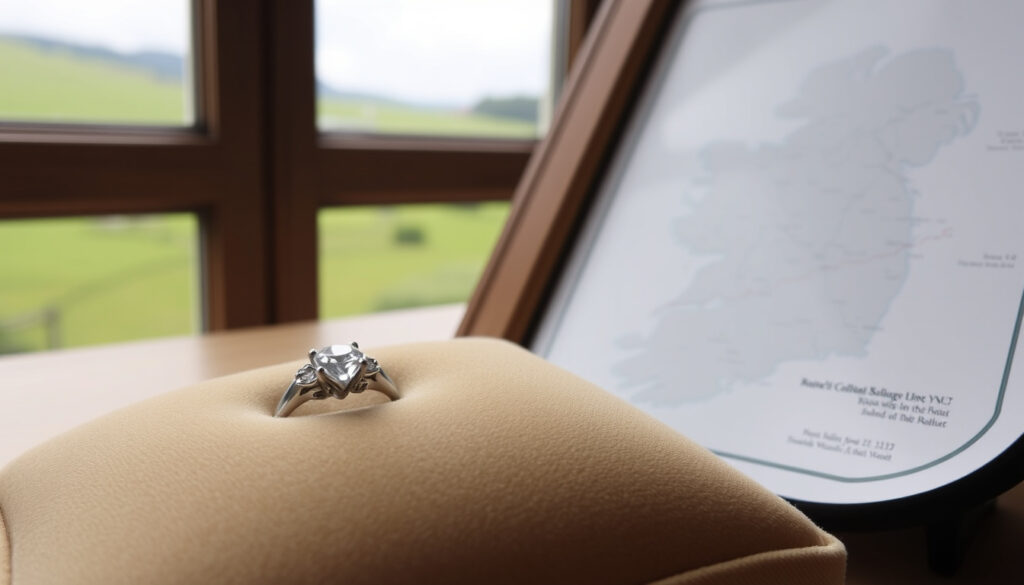
Engagement Rings for Women: Ireland Buying Guide (2025)
Choosing an engagement ring is one of those decisions where excitement meets real pressure. In Ireland, the average ring now costs around €3,840 according to Bespoke Diamonds (Irish jeweller), and that number can climb quickly depending on style and stone — this guide walks through budgets, sale timing, and local pricing so you can make a confident choice without the marketing fluff.
Average cost of an engagement ring in Ireland: €3,840 ·
3-month salary rule: Spend approximately 2–3 months’ gross income ·
1-carat diamond price range: €4,000–€6,000 ·
Best time to buy: November–December ·
Most popular diamond shape: Round brilliant
Engagement Rings for Women: Your Complete Buying Guide
Quick snapshot
- 3-month salary rule is a guideline, not a rule (Valentina Ireland)
- Average Irish ring cost €3,000–€5,000 (Appleby Ireland)
- 1-carat diamond pricing starts around €4,000 (TheJeweller.ie)
- Classic solitaire, halo, three-stone are top styles (Gear Jewellers)
- Most flattering cuts: round, princess, cushion (Bespoke Diamonds)
- 2026 trends: lab-grown diamonds, coloured gemstones, custom settings (Irish Tatler)
- 3-month rule: propose within 3 months of buying the ring (Valentina Ireland)
- Lead time for custom rings: 2–3 months advance ordering (Gear Jewellers)
- Best time to buy: November–December for sales (Appleby Ireland)
- Diamond pricing in Ireland varies by county (Wexford highest at €4,795 average) (TheJeweller.ie)
- Engagement rings under €1,000 possible with lab-grown or simpler settings (Gleeson Goldsmiths)
Consider these five key facts from Irish retailers and aggregators:
| Average engagement ring cost (Ireland) | €3,000–€5,000 (Bespoke Diamonds average: €3,840) (Bespoke Diamonds) |
|---|---|
| 1-carat diamond price (Ireland) | €4,000–€6,000 (natural round average €3,715) (TheJeweller.ie) |
| Most popular cut | Round brilliant (TheJeweller.ie) |
| 3-month rule | Propose within 3 months of buying the ring – a guideline, not law (Valentina Ireland) |
| Best time to buy | November–December (holiday sales) |
How Much Should You Spend on an Engagement Ring?
How much should I spend in Ireland?
The old “three months’ salary” rule still circulates, but Irish jewellers are more pragmatic. Valentina Ireland (Dublin jeweller) notes that budgets above €12,000 are now rare. A typical Irish shopper spends between €2,500 and €4,500 according to Irish Tatler (lifestyle publication). County averages vary: Wexford tops out at €4,795, while Kildare sits at €4,405 (Bespoke Diamonds).
The implication: ignore the salary rule and focus on what fits your finances and your partner’s expectations.
How much is a 1 carat diamond in Ireland?
The current market price for a 1-carat natural round diamond in Ireland is €3,715.36, based on 30,543 diamonds tracked by TheJeweller.ie (independent price aggregator). That figure jumps to €4,088 for round cuts – the most expensive shape – while asscher cuts average €2,852.46. At the top end, a D-colour, FL-clarity 1-carat round can cost €15,075.99; a J-colour, I3-clarity version runs as low as €1,721.43 (TheJeweller.ie).
The trade-off: you can spend less than €2,000 or more than €15,000 on the same size stone – quality is the real cost driver.
How much should I spend if I make $100,000 a year?
At a $100,000 income, the old 3-month rule would suggest a €20,000–€30,000 ring. But Irish realities are different. Appleby Ireland (established jeweller) says typical budgets sit between €3,000 and €7,000. A more realistic approach is to spend what you can comfortably afford without sacrificing other goals.
The pattern: a carefully chosen diamond within your budget always beats stretching for a larger stone you can’t comfortably afford.
What Are the Best Engagement Ring Styles?
What is the most flattering engagement ring?
The most flattering ring depends on hand shape, but three styles dominate across Irish retailers: solitaire (timeless, focuses on the stone), halo (extra sparkle, makes the centre stone appear larger), and three-stone (symbolic, with side stones). Gear Jewellers (ring buyer’s guide) recommends trying shapes against your finger – elongated cuts like oval or marquise can slim the finger visually.
What is the trendiest engagement ring right now?
As of 2025, round brilliant remains Ireland’s most popular cut (TheJeweller.ie). But lab-grown diamonds are surging: a 1-carat IGI-certified lab-grown solitaire from Valentina costs about €1,500 versus €6,000 for the natural equivalent. Coloured gemstones – especially sapphires and emeralds – are also gaining ground, particularly in bespoke designs from Dublin and Cork jewellers.
Lab-grown diamonds now offer identical visual quality at a fraction of natural prices. If resale value matters less, they free up budget for a larger stone or a custom setting.
What this means: personal taste and lifestyle should drive the decision, not fashion cycles.
What Is the Trend in Engagement Rings in 2026?
What is the trendiest engagement ring right now?
By 2026, the industry expects ethical materials and mixed metals to define the next wave. Irish Tatler highlights custom settings as the key differentiator – no two rings from a good independent jeweller need look the same. Coloured gemstone centres (emerald, sapphire) are moving from niche to mainstream, especially in Cork and Galway ateliers.
Are diamonds worth more now than 10 years ago?
Natural diamond prices have risen roughly 10 % over the past decade, according to industry indices, but the gain is uneven. Investment-grade stones (D colour, IF clarity) have appreciated more; commercial grades have been flat. Lab-grown diamonds, by contrast, have dropped in price as production scales up. For most buyers, diamonds are not an investment – they are a personal purchase with sentimental value.
The pattern: if you view the ring as a symbol, buy what you love. If you want a store of value, buy natural at top quality and keep the certificate.
When Is the Best Time to Buy an Engagement Ring?
What is the 3 month rule for rings?
The “3-month rule” is an old jewellery industry tradition: you should propose within three months of buying the ring. Irish jewellers like Bespoke Diamonds note it has no legal or financial basis – it’s a courtesy guideline. Plan your timeline around proposal logistics, not an artificial deadline.
How many months in advance should you buy an engagement ring?
For an off-the-shelf ring, buying two weeks ahead is fine. For a custom design, allow 8–12 weeks for production plus delivery. Valentina Ireland recommends starting the process at least three months before your proposal date if you want bespoke work from Irish craftspeople.
Why this matters: rushed custom orders often compromise on diamond selection. Time gives you access to better stones at better prices.
Buying in November–December holiday sales can save 15–25 % on marked prices, but inventory shrinks fast. Shop early in the month for the best choice.
The implication: plan your purchase timeline around both financial and practical considerations.
How Much Is a 1 Carat Diamond in Ireland?
How much should I spend on an engagement ring in Ireland?
Ireland offers a full price spectrum. At the low end, Gear Jewellers states diamonds start from €600. Appleby Ireland says most people spend between €3,000 and €7,000. For a 1-carat natural round solitaire, expect €4,000–€6,000; the identical ring in lab-grown costs about €1,500 (Valentina Ireland).
Are diamonds worth more now than 10 years ago?
As noted earlier, natural diamond prices have crept up ~10 % over ten years. But the gap between high and low quality has widened. A 1-carat round D/FL stone costs €15,076 today, while a J/I3 costs €1,721 (TheJeweller.ie). The real price growth is concentrated at the top.
Trend timeline: lab-grown diamonds rose during 2020–2023 (Gleeson Goldsmiths), coloured gemstones gained traction in 2024 (Irish Tatler), and 2025 saw bespoke settings dominate. 2026 is expected to focus on ethical materials.
“The 3-month rule is a guideline, but spend what you’re comfortable with. Many of our clients spend between €2,500 and €4,500 and end up with a ring they love.”
— Irish Tatler (lifestyle publication), quoting an unnamed jewellery expert
“Custom designs allow you to create a truly unique piece. We see more couples coming in with Pinterest boards and leaving with something that reflects their story.”
— Bespoke Diamonds (Irish jeweller)
The common thread: Irish jewellers prioritise personal budget and preference over industry formulas.
What’s unclear
- Whether diamond prices will continue to rise in the coming years
- Exact impact of lab-grown diamonds on natural diamond resale value
- Future trends beyond 2026
- Best time to buy may not apply to all retailers
- Budget calculators are available but their accuracy varies
For an Irish buyer, the choice is clearer than it first appears. Your budget buys either a smaller natural diamond or a larger lab-grown one; custom work from Dublin, Cork, or Galway jewellers adds personality without inflating cost. The smartest move: decide your comfort zone, check current prices on TheJeweller.ie, and start shopping three months before you plan to propose. The ring you choose will be worn every day – make it one that fits your life, not a marketing rule.
For more local shopping guides, visit Piercing Shops Near Me: Dublin Guide and Build-A-Bear Near Me: Irish Stores & Prices.
Frequently asked questions
Does the 3-month rule mean you must propose within 3 months of buying?
It’s an old tradition suggesting you propose within three months of buying the ring. Irish jewellers treat it as a guideline, not a rule.
What’s the recommended lead time for ordering a custom engagement ring?
Off-the-shelf: 2 weeks. Custom: at least 8–12 weeks. Start looking 3–4 months before your planned proposal.
Which engagement ring style suits shorter fingers best?
Solitaire, halo, and three-stone settings suit most hand shapes. Elongated cuts like oval or marquise can make fingers appear slimmer.
What’s a realistic engagement ring budget for a high earner in Ireland?
The 3-month rule would suggest €20,000+, but Irish buyers typically spend €3,000–€7,000. Spend what you’re comfortable with in cash.
Have diamond prices increased significantly over the past decade?
Natural diamond prices have risen roughly 10 % overall, but only top-quality stones have appreciated significantly. Lab-grown diamonds are much cheaper.
Which engagement ring styles are most popular in 2025?
Round brilliant is still most popular, but lab-grown diamonds, coloured gemstones, and custom settings are the fastest-growing trends.
What’s the average price of a 1-carat diamond in Ireland?
A natural 1-carat round diamond averages €3,715, with a range from €1,721 to €15,076 depending on cut, colour, and clarity. Lab-grown equivalents start around €1,500.
More related posts
 Orlando Magic vs Charlotte Hornets Match Player Stats – Box Scores
 J. Robert Oppenheimer: Life, Legacy, and Key Facts
 How Many Weeks Are Left in 2025? Current Week Number
 How to Pair Apple Watch to a New Phone: Step by Step Guide
 Caitlin Clark Indiana Fever: Gender, Relationship & Future
 Under Sink Water Filter Guide: Do They Work & Which Is Best
 Wizards Beyond Waverly Place Season 2: Guide
 Formal Dresses Near Me: Cost, Fit & 2026 Trends Guide
