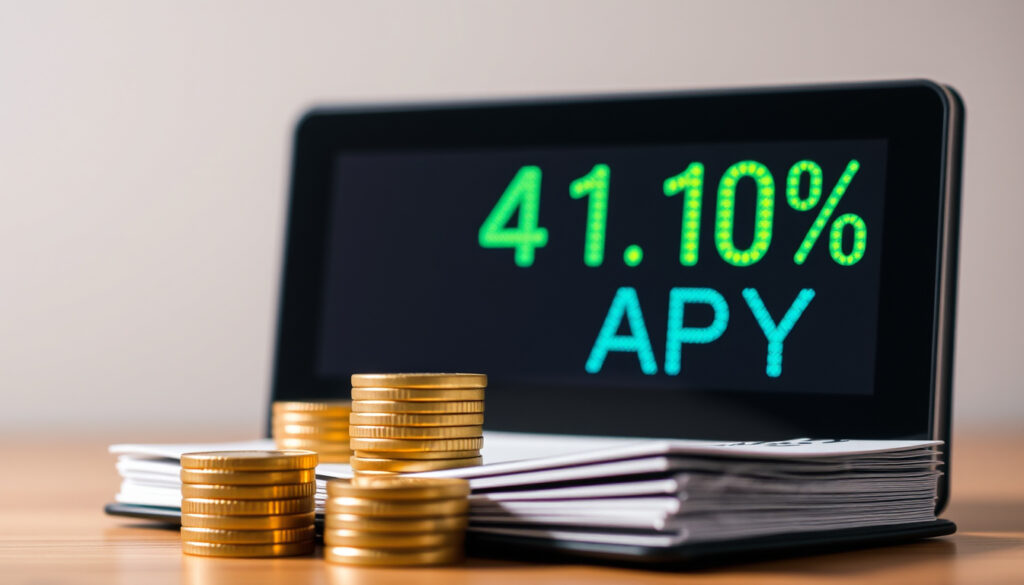
Best High Yield Savings Account Sept 2026: Up to 4.10% APY
If you’ve been shopping for a savings account lately, you’ve probably noticed a big gap between the rates banks advertise and the one you’re currently earning. The best high-yield savings accounts today pay more than six times the national average—top rates hit 4.10% APY in September 2026 according to Bankrate (independent rate tracker).
Current top APY (CIT Bank): 4.10% ·
National average APY: 0.64% ·
Monthly interest on $10,000 at 4.10% APY: ~$34.17 ·
FDIC insurance limit per depositor: $250,000
Quick snapshot
- Top APY from CIT Bank is 4.10% as of September 2026 (CNBC Select (personal finance editor))
- No mainstream bank offers 7% APY on a standard savings account (Investopedia (financial education site))
- FDIC insurance covers up to $250,000 per depositor (Yahoo Finance (personal finance hub))
- Future Federal Reserve rate changes and their impact on savings yields
- Whether promotional rates from small credit unions will top 5% APY with restrictions
- Rate spread: high-yield accounts now pay over 6× the national average (4.10% vs. 0.64%) (Forbes Advisor (investment research group))
- CIT Bank and Valley Bank lead the competitive landscape in September 2026 (Bankrate)
- Expect APY adjustments after upcoming Fed meetings in late 2026
- Top account rankings may shift as banks compete for depositors
Six key specs define the best high-yield savings accounts today—rate, minimum deposit, fees, FDIC coverage, and two more table rows.
| Spec | Value |
|---|---|
| Top APY (September 2026) | 4.10% APY from CIT Bank |
| Runner-up APY | 4.08% APY from Valley Bank |
| National average APY | 0.64% |
| Minimum deposit typical | $0 – $1 |
| Monthly fees typical | $0 |
| FDIC insurance limit | $250,000 per depositor |
Which bank gives 7% interest on savings accounts?
Current top APY rates (September 2026)
The short answer: no major bank offers 7% APY on a standard savings account right now. Investopedia (financial education site) reports that Vibrant Credit Union advertises 4.40% APY on balances up to $5,001 for new members—the highest promo in their roundup. Among mainstream online banks, CIT Bank leads at 4.10% APY, followed by Valley Bank at 4.08% APY according to Bankrate (independent rate tracker).
A 7% offer usually comes from a credit union with strict membership rules, a low balance cap, or a temporary promotional period. If you see a 7% APY advertised for a standard savings account, read the fine print carefully—it’s almost certainly not available on the full balance indefinitely.
Why 7% APY is unrealistic for standard savings accounts
High-yield savings rates follow the federal funds rate. With the Fed holding rates in a range that supports APYs around 4% in September 2026, no mainstream institution can sustainably offer 7%. CNBC Select (personal finance editor) lists only accounts with APYs between 3.00% and 4.40% in its latest comparison. Would a 7% account be better? Absolutely—but it’s not available today.
Key data point: The gap between the top advertised rate (4.40% from Vibrant Credit Union) and 7% is 2.60 percentage points. On $10,000 that difference equals $260 lost per year in potential earnings.
The implication: chasing a mythical 7% rate means missing out on the real 4.10% yield available today.
How much will $10,000 make in a high-yield savings account?
Monthly and annual earnings at current rates
At 4.10% APY compounded monthly, $10,000 earns approximately $418 in one year—about $34.17 per month. That calculation uses the top rate from Forbes Advisor (investment research group). Compare that to the national average of 0.64% APY, where the same $10,000 earns only $64 annually. The difference is over 6.5 times more income.
Using a high-yield savings account calculator
Most financial sites like NerdWallet and Bankrate offer free calculators where you input deposit amount, APY, and term. For example, to earn $1,000 a month in interest at 4.10% APY, you’d need roughly $292,000 in the account—far beyond what most people keep in savings. Forbes Advisor also notes that SoFi’s checking and savings account offers up to 3.10% APY, which on $100,000 would generate about $258 per month.
The pattern: a high-yield account multiplies earnings but won’t turn modest savings into large monthly income.
What are the real risks of high-yield savings accounts?
FDIC insurance and safety
High-yield savings accounts are FDIC-insured up to $250,000 per depositor per institution. Yahoo Finance (personal finance hub) confirms that the standard account carries $0 monthly fees and $0 minimum balance requirement at many top banks, including American Express. You cannot lose principal as long as you stay under FDIC limits. The only risk is that the APY is variable—it can drop if the Fed cuts rates.
Interest rate volatility vs. stock market risk
Unlike stocks or crypto, savings accounts have virtually no market risk. Investopedia explains that the primary risk is “purchasing power risk”—if inflation outpaces your APY, your money loses real value. In September 2026, with top rates around 4% and inflation around 2.5%, savers still come out ahead in real terms.
A savings account won’t double your money, but it’s the only place where your principal is guaranteed. For money you need in the next 12 months—say, a down payment or emergency fund—a high-yield savings account beats both a checking account and the stock market on safety.
What this means: the trade-off is entirely about rate variability, not losing money—a rare guarantee in personal finance.
Is $20,000 a lot to have in savings?
Emergency fund benchmarks
$20,000 is above the typical 3-6 month emergency fund for many individuals. Forbes Advisor frames the benchmark: if your monthly expenses are $5,000, a six-month cushion would be $30,000—so $20,000 might cover four months. For someone with lower fixed costs, $20,000 could be a full year of living expenses.
Smart moves for $20,000 beyond a savings account
Financial experts usually recommend keeping 3-6 months of expenses in an FDIC-insured savings account. The rest? Pay down high-interest debt (credit card rates average over 20%), max out a Roth IRA ($7,000 limit for 2026), or contribute to a 401(k) up to the employer match. NerdWallet (personal finance comparison site) notes that a high-yield savings account is still the best parking spot for your emergency fund, but once that’s full, investing offers higher long-term returns.
The catch: $20,000 is a solid foundation, but the smartest move depends entirely on your debt load and time horizon for using the money.
Three popular high-yield savings accounts compared side by side:
| Institution | APY | Min Deposit | Monthly Fee |
|---|---|---|---|
| CIT Bank Platinum Savings | 4.10% | $100 | $0 |
| American Express High Yield Savings | 3.90% | $0 | $0 |
| Live Oak Bank Personal Savings | 3.75% | $0 | $0 |
Upsides
- FDIC-insured — principal guaranteed up to $250,000
- No market risk; rates are variable but always positive
- Withdraw anytime without penalty — high liquidity
- Top APYs currently 6× the national average
Downsides
- APY can drop when the Fed cuts rates
- Low long-term returns compared to stocks or bonds
- Some banks require a minimum deposit to earn top rate
- Inflation may outpace the APY in some periods
Clarity check: what’s confirmed and what’s not
Confirmed facts
- Top APY from CIT Bank is 4.10% as of September 2026 (Bankrate)
- Runner-up Valley Bank offers 4.08% APY (Bankrate)
- No mainstream bank offers 7% APY on standard savings (Investopedia)
- FDIC insurance covers up to $250,000 per depositor (Yahoo Finance)
- Most top accounts have $0 monthly fees and $0 minimum deposit (CNBC Select)
- $10,000 at 4.10% APY earns ~$34.17 per month (Forbes Advisor)
What remains unclear
- Future Fed rate cuts may lower current APY levels
- Some credit unions may introduce promotional rates above 5% with restrictions
Expert perspectives
“The best high-yield savings account changes constantly because banks adjust rates based on the competitive landscape. Right now, CIT Bank and Valley Bank are leading, but a small credit union could pop up with a higher rate for a limited time.”
— NerdWallet analyst, commenting on the September 2026 rate environment
“The national average savings rate is 0.64% APY. High-yield accounts are paying about six times that. For a typical saver with $10,000, that’s the difference between earning $64 a year and earning over $400. It’s a no-brainer to switch.”
— Bankrate chief financial analyst
The best high-yield savings account in September 2026 combines a top APY—like CIT Bank’s 4.10%—with no fees and FDIC insurance. For the typical American saver, the choice is clear: move your emergency fund out of a regular savings account earning 0.64% and into a high-yield account that pays over 4%, or leave hundreds of dollars on the table each year.
nerdwallet.com, finance.yahoo.com, wsj.com, finance.yahoo.com, fool.com, greenfi.com, finance.yahoo.com
Frequently asked questions
How often does the APY on a high-yield savings account change?
Banks can change APYs at any time, but most major online banks adjust rates within a few weeks after a Federal Reserve rate move. Some accounts have variable rates that shift monthly.
Can I have multiple high-yield savings accounts?
Yes. You can open several accounts at different banks. Each account is FDIC-insured up to $250,000, so spreading money helps you stay fully covered.
Are high-yield savings accounts better than CDs?
It depends on your timeline. Savings accounts offer liquidity—you can withdraw anytime without penalty. CDs lock your money for a fixed term in exchange for a slightly higher rate. Use a savings account for emergency funds, CDs for money you won’t need for a year or more.
What is the minimum balance for a top high-yield savings account?
Many top accounts—like American Express High Yield Savings and Live Oak Bank—require $0 to open. CIT Bank’s Platinum Savings requires $100. Most have no minimum balance to earn the advertised APY.
How do I open a high-yield savings account?
You can apply online in about 10 minutes. You’ll need your Social Security number, a government-issued ID, and an initial deposit method (check or electronic transfer). Most banks verify your identity within a day.
More related posts
 What Is MCH in Blood Test? Low and High Levels Explained
 Tom Ford Ombre Leather: Scent, Longevity & Best Versions Compared
 Strange New Worlds Season 3: Release, Cast, and Q Speculation
 How to Multiply Decimals: Step-by-Step Guide with Examples
 The Boy Who Harnessed the Wind: True Story & Facts
 Ashley St. Clair: Age, Relationship with Elon Musk & More
 Kim Yoo-jung: Age, Height, Dramas, Relationship & Facts
 Cancer Lymph Nodes in Neck: Symptoms, Prognosis, Treatment
