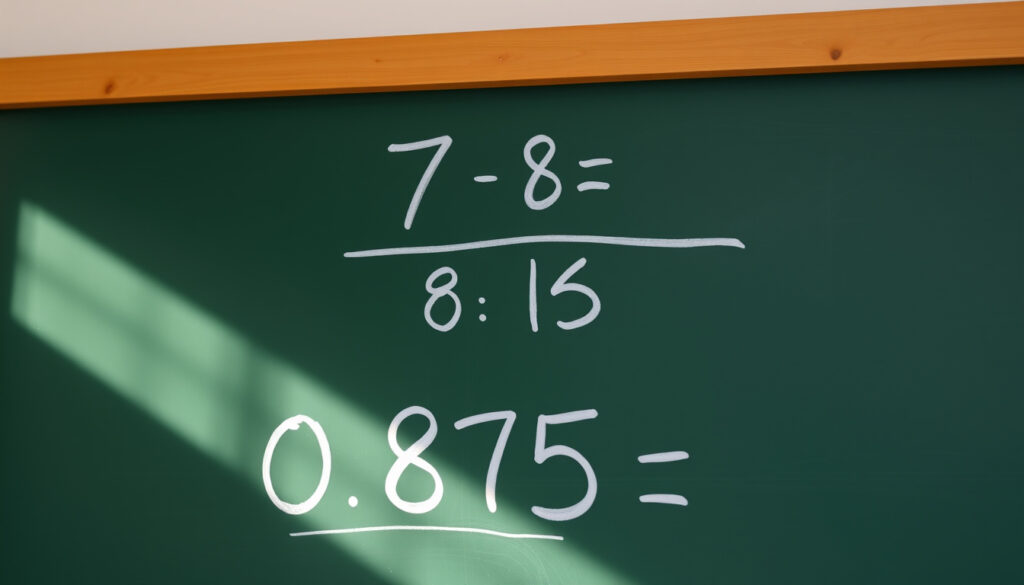
7/8 as a Decimal: Complete Guide with Long Division Steps
Few numbers cause as much head-scratching as fractions when you’re staring at a tape measure or a set of calipers. If you’ve ever wondered what 7/8 looks like as a decimal, the answer is straightforward: it’s 0.875.
Decimal value of 7/8: 0.875 · Percentage equivalent: 87.5% · Simplest fraction form: 7/8 (already in simplest form) · Meaning in measurement (inches): 0.875 inches
Quick snapshot
- 7/8 as a fraction = 0.875 as a decimal (Engineering ToolBox)
- 0.875 is a terminating decimal, meaning it has a finite number of digits (Engineering ToolBox)
- The conversion works because 8 × 125 = 1000, making 7/8 equivalent to 875/1000 (Engineering ToolBox)
- Why some prefer the long-division method over equivalent fractions when converting by hand
- Whether the inch value 0.875 is commonly misinterpreted as 7/16 or 13/16 due to ruler mark confusion
- Why the equivalent fraction method is less common in construction contexts
- Instant answer: 7/8 = 0.875 (the conversion is exact)
- Historical context: fractional inches predate decimal usage in many trades
- Use 0.875 in calculations for drilling, cutting, or measuring
- Convert to percent (87.5%) when working with discounts or statistics
Key facts at a glance
Here is a concise summary of the essential conversions for 7/8.
| Fraction | 7/8 |
|---|---|
| Decimal | 0.875 |
| Percent | 87.5% |
| Simplest Form | Yes (7 and 8 relatively prime) |
| Decimal Type | Terminating |
| Conversion Method | Divide 7 by 8 |
The table shows the core facts: 7/8 has a terminating decimal form, which makes it particularly easy to work with in precise measurements and calculations.
What is 7/8 as a decimal?
7/8 as a decimal is exactly 0.875. This is a terminating decimal, which means the division process comes to an end without any repeating digits. The conversion is a direct result of dividing 7 by 8: Inch Calculator confirms this, and the Engineering ToolBox lists 7/8 among its fractional-inch equivalents with the decimal 0.875.
How to convert 7/8 to decimal using long division
- Set up the long division problem: 7 ÷ 8
- Since 7 is less than 8, add a decimal point and a zero to the dividend, making it 70
- 8 goes into 70 eight times (8 × 8 = 64), leaving a remainder of 6
- Bring down another zero, making it 60; 8 goes into 60 seven times (8 × 7 = 56), leaving a remainder of 4
- Bring down another zero, making it 40; 8 goes into 40 exactly five times (8 × 5 = 40), leaving no remainder
“When you divide 7 by 8, you get exactly 0.875,” explains the Engineering ToolBox conversion chart.
The long division method works because it leverages the fact that any fraction is a division problem: the numerator divided by the denominator. As Inch Calculator explains, this method directly converts the fraction to a decimal by performing the division. When converting a fraction to a decimal by long division, you may add zeros after the decimal point if the dividend is smaller than the divisor, a technique confirmed by the same source.
How to convert 7/8 to decimal using equivalent fractions
- Find an equivalent fraction with a denominator that is a power of 10 (10, 100, 1000, etc.)
- Since 8 × 125 = 1000, multiply both the numerator and denominator of 7/8 by 125
- This gives 7 × 125 = 875 and 8 × 125 = 1000, resulting in the fraction 875/1000
- Convert to decimal: 875/1000 = 0.875
This method is often faster for fractions with denominators that are factors of 10 or 100. According to a Dummies conversion guide, fractions, decimals, and percents are simply different representations of the same quantity. The equivalent-fraction approach works because multiplying by 125/125 (which equals 1) doesn’t change the value of the fraction, only its form.
Long division works for any fraction but takes a few steps; the equivalent-fraction method is faster but only works when the denominator divides evenly into a power of 10. For 7/8, both paths arrive at the same 0.875.
The implication: Because 8 is a factor of 1000, the conversion is clean and exact, which is why you’ll see 0.875 listed on reference charts rather than rounded approximations.
What is 0.875 as a fraction?
0.875 as a fraction is 7/8 in its simplest form. The decimal 0.875 comes from the fraction 875/1000, which reduces by dividing both the numerator and denominator by their greatest common factor, 125. As Inch Calculator demonstrates, 875 ÷ 125 = 7 and 1000 ÷ 125 = 8, yielding the fraction 7/8.
Simplest fraction form of 0.875
- 0.875 has three decimal places, so it can be written as 875/1000
- The greatest common divisor (GCD) of 875 and 1000 is 125
- Dividing both by 125 yields 7/8
This is the reverse of the conversion process, and it’s equally important in trades and education. A MHCC Pressbooks guide notes that a measurement guide for fractional inches warns that marks must be interpreted by the subdivision size, such as fourths, eighths, or sixteenths. This means that recognizing 0.875 as 7/8 helps you read a ruler or tape measure correctly.
How to convert 0.875 to fraction
- Write 0.875 as 0.875/1
- Multiply both numerator and denominator by 1000 to remove the decimal: 875/1000
- Simplify by finding the GCD (125) and dividing: 875/125 = 7, 1000/125 = 8
The verification step is crucial: divide 7 by 8 to confirm you get 0.875. This round-trip check is a standard practice in measurement work, as referenced in Math for Trades Volume 1.
Why this matters: For anyone working in construction or machining, the ability to move between decimal and fraction form without a calculator is a practical skill. Misreading 7/8 as 3/4 (0.75) or 15/16 (0.9375) can lead to mismeasured cuts.
What is 7/8 as a percent and decimal?
7/8 as a percent is 87.5%, and as a decimal, it’s 0.875. The percent representation is derived directly from the decimal: multiply 0.875 by 100 to get 87.5%. The Inch Calculator lists this conversion, confirming that 7/8 equals 87.5%.
“The decimal and percent forms are directly related,” notes a Dummies conversion guide. “7/8 equals 87.5%.”
Converting fraction to percent
- First, convert the fraction to a decimal: divide 7 by 8 to get 0.875
- Multiply the decimal by 100: 0.875 × 100 = 87.5
- Add the percent sign: 87.5%
This process follows the general rule from Inch Calculator: converting a fraction to a percent requires first transforming it to a decimal, then multiplying by 100. The same source provides a step-by-step calculator that shows the intermediate decimal step.
Combined decimal and percent representation
- 7/8 = 0.875 (decimal)
- 7/8 = 87.5% (percent)
- Both are exact representations; no rounding is needed
The percent and decimal are equivalent representations of the same quantity. A Dummies conversion guide emphasizes that fractions, decimals, and percents are directly corresponding forms—knowing one lets you derive the others. In practical terms, this means if you know that a discount is 7/8 off, you know it’s 87.5% off, which helps you quickly calculate savings.
While 87.5% is the exact percent, many people default to rounding to 88% in conversation. For accurate financial calculations, keep the exact 87.5% to avoid slight errors that compound over multiple transactions.
The pattern: The decimal and percent are so tightly linked that the conversion method matters less than remembering the exact values, especially when 87.5% appears in discounts or data analysis.
What is 7/8 of an inch in decimal format?
7/8 of an inch is 0.875 inches in decimal format. This measurement is common in woodworking, construction, and machining, where fractional inches are the standard on rulers and measuring tapes but decimal inches are often required for calculations. The Engineering ToolBox provides a fractional-to-decimal conversion chart that lists 7/8 as 0.875 inches.
7/8 inch on a ruler
- On a standard ruler divided into eighths, 7/8 is the seventh mark from the left edge
- This is one mark short of the 1-inch line
- Each eighth of an inch equals 0.125 inches, so 7 × 0.125 = 0.875
Reading a ruler correctly requires knowing the subdivision marks, a point emphasized in the MHCC Pressbooks guide. For example, when the ruler is divided into eighths, the 7/8 mark is the second-longest mark after the 1/2-inch line, but the precise visual identification depends on the ruler’s scale.
Practical examples of using 7/8 inch in decimal
- Drill bit sizes: a 7/8-inch drill bit equals 0.875 inches, which in metric is 22.225 mm
- Pipe fitting: a 7/8-inch tube fitting needs a 0.875-inch hole for a proper fit
- Carpentry: when using a digital caliper, setting it to 0.875 inches is often easier than reading the fractional mark on a tape
The utility of knowing 0.875 inches becomes clear in mixed measurements. For instance, if a project specifies a 0.875-inch dowel, you know to use a 7/8-inch drill bit. According to a Math for Trades Volume 1 resource, converting fractions to decimals is a standard step in measurement work, making this skill essential for anyone regularly using both fractional and decimal tools.
Is 7/8 close to 1/2?
No, 7/8 is not close to 1/2. The difference is significant: 7/8 equals 0.875, while 1/2 equals 0.5, a gap of 0.375. To put it another way, 7/8 is 87.5% of one whole, while 1/2 is only 50%—a substantial difference by any measure.
Compare 7/8 to 1/2
- 7/8 = 0.875; 1/2 = 0.5; difference = 0.375
- 7/8 is 75% larger than 1/2 (calculated as (0.875 – 0.5) / 0.5 = 0.75)
- In measurement terms, 0.375 inches is the same as 3/8 of an inch
The 7/8 measurement is actually closer to 1 than to 1/2. On a number line, 0.875 sits much closer to 1.0 than to 0.5—the distance to 1 is only 0.125, while the distance to 0.5 is 0.375. This makes sense, as 7/8 is only one part away from the whole.
Compare 7/8 to 3/4 and 1
- 7/8 = 0.875, 3/4 = 0.75, 1 = 1.0
- 7/8 is 0.125 more than 3/4
- 7/8 is 0.125 less than 1
This comparison is critical in measurement contexts. For example, a 7/8-inch bolt is just 1/8 of an inch smaller than a 1-inch bolt but 1/8 of an inch larger than a 3/4-inch bolt. Both the Engineering ToolBox and Inch Calculator confirm these relationships, showing that 7/8 occupies a specific place in the fraction family between the more common 3/4 and 1.
Most people can visualize 3/4 of a pie, but very few can quickly estimate 7/8 of a pie. The gap between perception and calculation is where measurement errors happen—knowing the decimal form bridges that gap.
The implication: If you’re comparing 7/8 to 1/2, you’re making a two-fold error in your estimate. The precise decimal value should be your guide, not a mental approximation.
Practical conversion: 7/8 to decimal and percent
The following checklist summarizes the key methods for converting 7/8 into other formats, useful for quick reference in schoolwork or on the job.
Step-by-step conversion checklist
- Long division: 7 ÷ 8 = 0.875 (attach zeros to the dividend as needed)
- Equivalent fraction: Multiply 7/8 by 125/125 to get 875/1000 = 0.875
- Percent: Take the decimal (0.875) and multiply by 100 to get 87.5%
- Inch measurement: 7/8 inch = 0.875 inches, which is 22.225 mm
The methods converge on the same answer because they follow from the definition of a fraction as division. The Inch Calculator notes that if you prefer a calculator, the tool does the division for you, but understanding the long division method ensures you can always verify the answer.
Why this matters: For a DIY enthusiast or a professional, having these conversions memorized saves time and prevents costly mistakes—especially when working with materials where a 1/8-inch error spoils a cut.
For more measurement conversions, see our guide on How Many Cups in a Quart? – Quick Conversion Guide and Distance Between Two Points: Great Circle Formula Explained.
inchcalculator.com, engineeringtoolbox.com, samaterials.com, oreateai.com, calcmountain.com, discover.oreateai.com
Frequently asked questions
How do you write 7/8 as a decimal using a calculator?
To write 7/8 as a decimal using a calculator, enter 7, press the division key (÷), enter 8, and press equals. The calculator will display 0.875. This works because a fraction is simply a division problem: the numerator (7) divided by the denominator (8). Most calculators handle this directly, and the result is a terminating decimal with no rounding necessary.
What is 7/8 as a terminating or repeating decimal?
7/8 is a terminating decimal because it ends after a finite number of digits—specifically, it ends after three decimal places (0.875). The decimal terminates because the denominator 8 has prime factors of only 2 (8 = 2 × 2 × 2), which are factors of 10 and its powers. In contrast, a repeating decimal like 1/3 (0.333…) goes on forever because the denominator includes other prime factors.
What is the difference between 7/8 and 3/4 in decimal form?
The difference between 7/8 and 3/4 is 0.125 in decimal form. This is because 7/8 = 0.875 and 3/4 = 0.75. The gap is exactly one eighth of a whole. In practical terms, if you’re measuring wood and accidentally use a 3/4-inch drill bit instead of a 7/8-inch one, you’ll have a hole that’s 1/8 inch too small—enough to cause a tight fit or require rework.
Can 7/8 be expressed as a fraction with denominator 100?
Yes, 7/8 can be expressed as a fraction with denominator 1000, but not with exactly 100 as the denominator. To get a denominator of 1000, multiply both numerator and denominator by 125: 7 × 125 = 875 and 8 × 125 = 1000, giving 875/1000. You cannot get exactly 100 as a denominator because 8 does not divide evenly into 100. The nearest fraction with denominator 100 would be 88/100 (which equals 88%), but this is an approximation.
Why is 7/8 converted to 0.875 instead of another decimal?
7/8 converts to exactly 0.875 because, when you divide 7 by 8 using long division, the division terminates after the thousandths place. Specifically: 8 goes into 70 eight times (remainder 6), then into 60 seven times (remainder 4), then into 40 five times (remainder 0). The quotients in sequence (8, 7, 5) give you 0.875. There is no other decimal that represents 7/8 exactly because the decimal system is base-10 and 8 (which is 2³) divides evenly into 1000 (10³).
What is 7/8 as a decimal rounded to two decimal places?
7/8 as a decimal rounded to two decimal places is 0.88 (using standard rounding rules) or 0.87 (using truncation). The exact decimal is 0.875, so when rounding to two decimal places, you look at the third digit (5). Since the third digit is 5, you round the second digit up, making 0.88. However, if you truncate rather than round, you would keep 0.87. In most practical applications, 0.88 is the standard rounding.
More related posts
 The Fantastic Four: First Steps Disney+ Streaming Date
 Simpsons Marge Death: Non-Canonical Flash-Forward Return
 How Much Mortgage Can I Afford in Ireland? Calculator & Rules
 Green Noise for Sleep: Is It Good? What You Need to Know
 Cast of The Ministry of Ungentlemanly Warfare: Real vs Movie
 Pixar Movies in Order: Complete List (1995–2026)
 Can Dogs Eat Peas? Benefits, Risks, and Serving Tips
 Tell Me Lies Cast: Real-Life Partners, Mental Health & Finale
