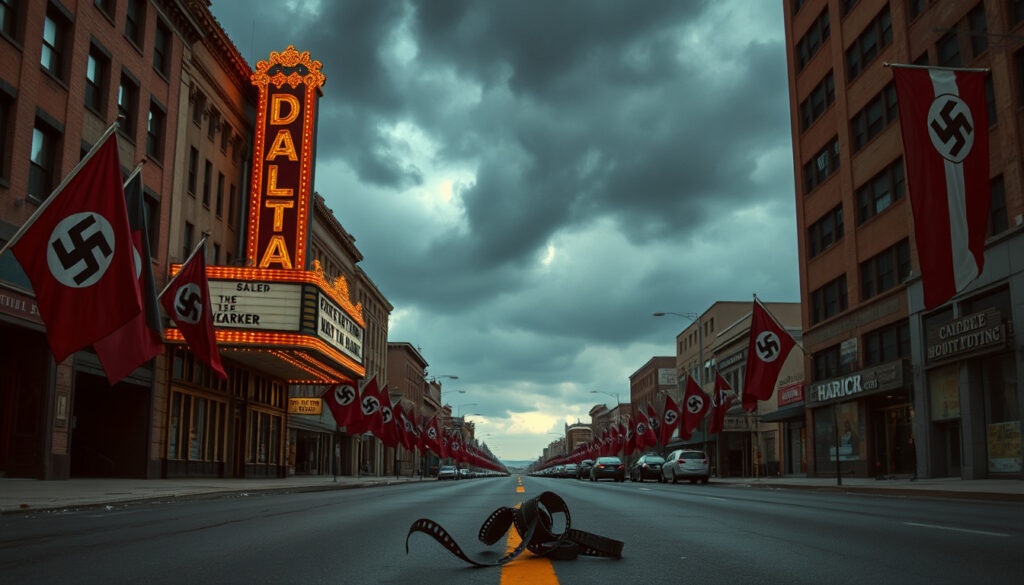
The Man in the High Castle: Cancellation & Ending Guide
There aren’t many series that ask you to sit inside a world where the Nazis won World War II and still make you care about the people living there, but The Man in the High Castle did exactly that, turning Philip K. Dick’s 1962 novel into a four-season Amazon series that ran from 2015 to 2019. This guide separates what we know about the cancellation and the final season from what the show deliberately leaves open, so you can decide whether it’s worth streaming.
Seasons: 4 (IMDb listing) ·
Rotten Tomatoes (Season 4): 93% critics / 59% audience (Rotten Tomatoes season page) ·
Based on: Philip K. Dick’s 1962 novel (Wikipedia entry) ·
Final season: November 2019 (Digital Spy analysis)
Quick snapshot
- The series ran from 2015 to 2019 (IMDb).
- It is based on Philip K. Dick’s 1962 novel.
- Who exactly emerges through the portal is never explained on screen (Looper’s breakdown).
- Whether the films are windows into real alternate realities remains a fan debate (Looper). (Looper’s breakdown)
- Amazon made the cancellation call before season 4 premiered (ComicBook.com’s report).
- Showrunner David Scarpa described the finale’s ambiguity as intentional (Amazon Adviser’s recap).
- No season 5 or continuation has been announced (ComicBook.com).
- For new viewers, the series remains available on streaming, with regional availability changing over time.
Here are the key production and reception details for the series.
| Label | Value |
|---|---|
| Creator | Frank Spotnitz (IMDb) |
| Network | Amazon Prime Video (Wikipedia) |
| Based on | The Man in the High Castle by Philip K. Dick (Wikipedia) |
| Final season | Season 4, November 2019 (Digital Spy) |
| Rotten Tomatoes (Season 4 critics) | 93% based on 14 reviews (Rotten Tomatoes) |
| Rotten Tomatoes (Season 4 audience) | 59% (Rotten Tomatoes) |
Can someone explain The Man in the High Castle?
The short pitch is that the Axis powers won World War II, and the United States has been carved up by the victors. The deeper story is about ordinary people who find films showing a different world — one where the Allies won — and who begin to realize that those films may be more than propaganda.
What is the premise of the series?
- Set in an alternate 1960s where the Allied powers lost World War II (Wikipedia).
- The former United States is divided into a Nazi-controlled East and a Japanese-controlled Pacific States (Wikipedia).
- The discovery of mysterious films turns the political drama into a philosophical puzzle about reality itself (Looper).
Dick’s novel posed that puzzle on the page. The series expands it into a full alternate-history world where the central artifact is no longer a book but a set of film reels that appear to show history running on a different track.
Who are the main characters?
- Juliana Crain — the protagonist from the Pacific States who first brings the films into the story.
- John Smith — a high-ranking Nazi official in New York whose family life complicates the regime’s cruelty.
- Tagomi — a Japanese trade minister who starts to question the system he serves.
- Joe Blake — a resistance figure with a dangerous, shifting allegiance.
The show is not a simple good-versus-evil story. Its most effective moments come from watching people inside the occupying regimes wrestle with their own moral compromises.
What is the alternate history setting?
- The Eastern United States is under Nazi control, with New York as a major center of power.
- The Western states are controlled by Imperial Japan, with San Francisco as a key city.
- Between them lies a neutral zone where much of the series’ underground activity takes place.
The setting matters because it makes the alternate history feel concrete. This is not a metaphor about fascism; it is a daily reality for the characters, and that is why the films hit so hard.
the show’s real subject is not just “what if history changed?” but “how would ordinary people keep their ethics inside a system that asks them to look away?”
The takeaway: the series is built on a question, not an answer.
Is Man in High Castle worth watching?
For most viewers, the answer is yes — with a caveat. The first two seasons are generally regarded as the strongest, while later seasons split opinion sharply as the story moves from political thriller into full multiverse territory.
What’s the best season of Man in the High Castle?
- Season 1 has the tightest introduction to the world and the strongest sense of discovery.
- Season 2 deepens John Smith’s story and is often treated as the creative peak.
- Season 4 is the most divisive, pushing the alternate-history concept into an explicitly open-ended finale.
If you want a self-contained taste of what the show can do, watch the first season. If you are drawn by the political intrigue, season 2 delivers on that promise. Later seasons reward viewers who care about the multiverse idea, but they also test your patience with loose threads.
How do critics rate the series?
- Rotten Tomatoes scores by season show a clear arc: strong start, mixed middle, divided final season (Rotten Tomatoes series page).
- Season 4’s 93% critic score is based on only 14 reviews, making it a thin sample (Rotten Tomatoes).
- The same season carries a 59% audience score, which better reflects the fan backlash (Rotten Tomatoes).
Season 4’s critic score is a small-sample warning, and the gap between critics and the audience is the show’s whole story. Count on that tension before you commit to the final season.
What this means: worth watching is a season-by-season question. Start with season 1, and let that decide whether the world earns your attention.
Why was The Man in the High Castle canceled?
The cancellation was not announced after a quiet final season. Amazon made the decision before season 4 premiered, and the story was compressed to fit the shortened runway (ComicBook.com).
Will there be a season 5 for Man in the High Castle?
- No. Amazon did not renew the show after season 4.
- Planned storylines for a fourth and fifth season were reportedly condensed into one shorter final run (ComicBook.com).
- The fourth season premiered in November 2019 as the series’ final point (Digital Spy).
Why did Man in the High Castle end so abruptly?
- The show was still expanding its multiverse when it had to start closing major arcs.
- The compressed plan shows up in a finale that moves quickly from character deaths to a portal reveal.
- Showrunner David Scarpa said the ambiguity was intentional, not an accident of cancellation (Amazon Adviser).
The pattern: Amazon treated The Man in the High Castle as a prestige experiment rather than an endless franchise. Once the story’s cost and complexity outweighed its cultural pull, the renewal stopped.
Why is season 4 of The Man in the High Castle so bad?
Most of the criticism points to pacing, unanswered questions, and a finale that refuses to explain itself. That does not make the season objectively bad; it makes it frustrating for viewers who wanted a cleaner ending.
Can you explain the ending of season 4 of The Man in the High Castle?
- The Resistance sabotages the train carrying John and Helen Smith; Helen dies in the crash (Digital Spy).
- John Smith survives, then dies by suicide after Juliana confronts him near the portal (Digital Spy).
- General Whitcroft removes his Nazi insignia and calls off the planned air strikes on San Francisco (Digital Spy).
- The portal opens, and Hawthorne Abendsen moves toward it, apparently hoping to find a version of his deceased wife (Looper).
- Juliana and Wyatt are present when the portal opens, but the political future of North America is never settled (Looper).
The final images are clearly meant to show that the alternate worlds are becoming connected. What the show refuses to answer is who the newcomers are and what they want.
What are the main criticisms of season 4?
- Digital Spy described the finale as “flawed and burdened by unanswered questions” (Digital Spy).
- Rotten Tomatoes’ critics’ consensus said the season “brings the story close to closure,” but that does not erase the rushed pacing (Rotten Tomatoes).
- Viewers often point to the compressed two-season plan as the reason major character exits feel abrupt (ComicBook.com).
“bad” means different things here. For some viewers it means morally unsettling; for others it means structurally messy. Season 4 is both, and the finale makes you choose how much ambiguity you can tolerate.
The takeaway: judgment depends on what you wanted the show to be.
Why was Joe Blake killed off in Man in the High Castle?
Joe Blake dies in season 3, and his death works as a turning point. Up to that moment, he represented the possibility that someone could move between the resistance and the Nazi system without being destroyed by it.
Why did the show remove him?
- His death raises the stakes for the resistance and removes a character who had one foot on each side of the conflict.
- It also signals that the multiverse will not protect central figures from the regime’s violence.
- Creatively, it clears the way for the final season’s focus on Juliana, Tagomi, and John Smith.
Joe’s death is not a mystery in the usual sense. It is a narrative consequence: the occupation has become too dangerous for anyone to survive on charm and double identity.
Why this matters: the show kills Joe to remind you that no one is safe. The same ruthlessness is what makes the final season feel emotionally heavy.
Why did Tagomi get killed off?
Tagomi’s death in season 4 lands harder because he was one of the few authority figures acting from conscience. He dies near the end of the series, and his absence is felt immediately.
Who killed Tagomi in Man in the High Castle?
- The Nazis are responsible, as the regime tightens its grip on the Pacific States.
- His death is treated as an emotional gut-punch rather than an off-screen convenience.
- His exit shifts the story’s moral center onto Juliana and John Smith.
Why is Tagomi not in season 4 of The Man in the High Castle?
- Because he dies partway through the final season.
- His removal is a creative choice meant to raise the stakes for the finale.
- For viewers, his death becomes a signal that the series is no longer protecting its most sympathetic characters.
The implication: Tagomi’s death is the show admitting that even the most thoughtful character cannot escape the system he chose to question.
Four seasons, one pattern: the critics kept rewarding the show even as the audience split over where the story was going.
| Season | Rotten Tomatoes score | What it tells you |
|---|---|---|
| Season 1 | 84% (Rotten Tomatoes series page) | Strongest world-building and pacing. |
| Season 2 | 89% (Rotten Tomatoes series page) | Deepens the political conflict and John Smith’s arc. |
| Season 3 | 67% (Rotten Tomatoes series page) | Mixed reviews as the multiverse expands. |
| Season 4 | 93% critics / 59% audience (Rotten Tomatoes season page) | Small critic sample, divided audience. |
Pros and cons at a glance
Upsides
- The premise gives the show a built-in philosophical hook: every film is a reminder that the world could have been different.
- The alternate-history setting rewards patient viewers with layered world-building.
- The first two seasons are tightly paced and often cited as the series’ creative peak.
Downsides
- The final season compresses a lot of story and loses momentum.
- The ambiguous portal finale divides viewers.
- Several major character exits, including Joe Blake and Tagomi, feel more functional than earned.
The trade-off: the show’s weaknesses are inseparable from its strengths.
Timeline signal
- 1962: Philip K. Dick publishes the novel (Wikipedia entry).
- 2015–2019: The series runs for four seasons (IMDb).
- November 2019: Season 4 premieres as the final season (Digital Spy).
- Before that season: Amazon decides not to renew, condensing the planned story (ComicBook.com).
The narrative: a compressed schedule defined the series’ conclusion.
Confirmed facts and what’s still unclear
Confirmed facts
- The series is based on Philip K. Dick’s 1962 novel (Wikipedia entry).
- Amazon ended the show after four seasons (ComicBook.com).
- Season 4 premiered in November 2019 as the finale (Digital Spy).
What’s unclear
- The exact meaning of the final scene’s open door to the multiverse is left ambiguous (Amazon Adviser).
- Whether the films are real windows to another reality or Abendsen’s invention remains a fan debate (Looper).
- Who the people emerging from the portal are is never answered on screen (Looper).
The separation: the line between what is known and what is open is a deliberate choice.
Voices on the finale
“The ambiguity was intentional,” showrunner David Scarpa told Entertainment Weekly, according to Amazon Adviser’s recap.
David Scarpa, showrunner, via Amazon Adviser
The final season “brings the story close to closure” and “makes major threads come full circle,” per Rotten Tomatoes’ season 4 page.
Rotten Tomatoes critics’ consensus
Digital Spy called the finale “flawed and burdened by unanswered questions,” even as it found the ending broadly coherent (Digital Spy).
Digital Spy’s review of the finale
The discourse: the differing opinions prove the finale is effective at generating debate.
The Man in the High Castle leaves you with two different shows: a disciplined alternate-history drama in seasons 1 and 2, and a riskier, messier multiverse story by season 4. The finale asks you to accept ambiguity as the point, not as a plot hole. For Amazon Prime Video subscribers, the decision is simple: start with season 1 and give the premise one episode to pull you in — and if the portal ending doesn’t land, the first two seasons still stand on their own.
Frequently asked questions
Is The Man in the High Castle based on a true story?
No. It is alternate history adapted from Philip K. Dick’s 1962 novel. Real historical settings are used as a backdrop, not as documentation.
How many episodes are in The Man in the High Castle?
The series runs 40 episodes across four seasons, according to IMDb’s episode guide.
Who is the Grasshopper Lies Heavy in the series?
In the novel, The Grasshopper Lies Heavy is a book-within-the-book. In the series, it is reimagined as films made by Hawthorne Abendsen that appear to show alternate realities (Looper).
What is the significance of the films in The Man in the High Castle?
The films show the Allies winning the war, and they become the proof that more than one reality exists.
How does the TV series differ from the book?
The show moves the action to the occupied United States, builds out John Smith’s family, and replaces the novel’s meta-book with actual film reels. The ending is also more explicit about the multiverse.
Can I watch The Man in the High Castle on Netflix?
Streaming availability changes by region. The series originally streamed on Amazon Prime Video; some markets later saw the series appear on Netflix, so check your local catalog (ComicBook.com).
What is the best order to watch the seasons?
Watch in release order: season 1, then 2, 3, and 4. The show’s bigger ideas build on each other, so skipping ahead costs context.
The function: these questions keep the conversation going long after the credits.
More related posts
 Rosuvastatin Side Effects: Common, Long-Term, What to Avoid
 1/4 Inch to mm: Exact Value, Formula & Common Mistakes
 Things to Do in New York: Budget, Safety & Local Laws
 Cast of Fountain of Youth (2025): Full List & Characters
 Average IQ in the USA: 98, State Rankings and Global Context
 New $100 Bill: Security Features, Old vs. New, How to Spot Fakes
 Astronomy Picture of the Day: NASA’s Daily Image and Archive
 Watch Love Island UK 2026: Where to Stream & How to Watch
