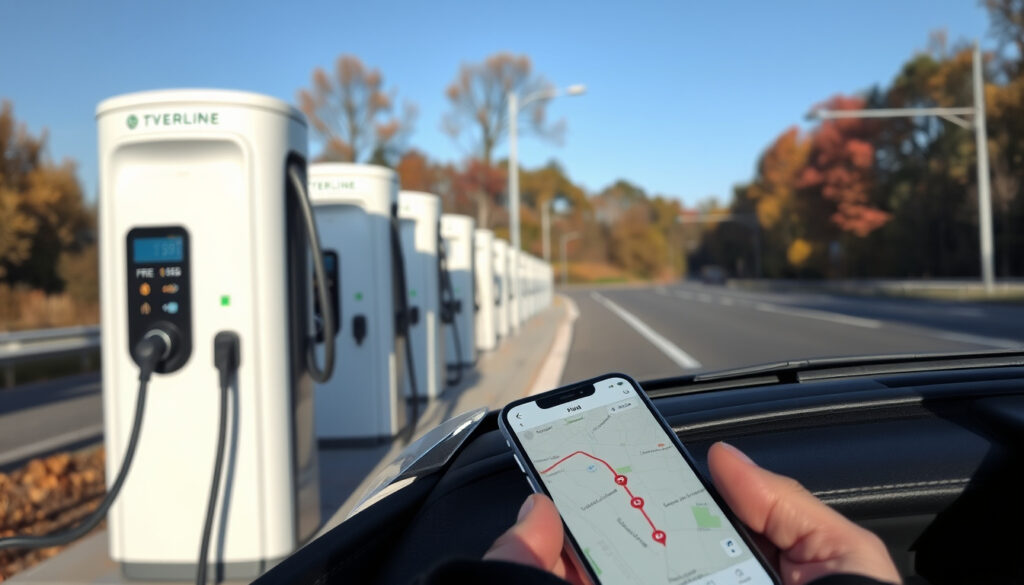
Charging Stations Near Me: Costs, Free Options & How to Find Them
If you’ve ever opened a charging app and wondered which nearby stations won’t sting your wallet, you’re not alone. Free and low-cost charging stations are hiding in plain sight — inside supermarkets, malls, and hotel lots — but most public chargers are paid, according to Kelley Blue Book (auto research site), and here’s what charging actually costs, which retailers still offer free Level 2 power, and how to track down the best spots near you.
Public charging stations in the US: 56,000+ ·
Average cost per kWh: $0.10–$0.30 ·
Charging 300 miles typical cost: $15–$45 ·
Free public chargers estimate: ~10% of Level 2 stations
Quick snapshot
- Most public EV charging is paid; free Level 2 is usually sponsored by retailers, employers, or local governments (Recharged (EV charging explainer)).
- National public averages cluster in the mid-30s per kWh: 34.2 cents (LendingTree (personal finance data)) and 36.5 cents (CNET (tech and EV coverage)).
- Home charging undercuts public Level 2 by at least $0.07 per kWh (Qmerit (EV charging installer)).
- Which “free” stations on the map are actually free, working, and open when you arrive (Kelley Blue Book (auto research site)).
- Whether retailers keep free Level 2 once paid fast chargers take over their lots (Recharged (EV charging explainer)).
- Whether a free session covers your whole visit or just the first hour (Recharged (EV charging explainer)).
- AAA’s national public average: 36.5 cents/kWh, as of Sept. 2, 2025 (CNET (tech and EV coverage)). (ElectricChoice (energy price comparison))
- LendingTree’s public/commercial average: 34.2 cents/kWh, as of Feb. 27, 2025 (LendingTree (personal finance data)). (ElectricChoice (energy price comparison))
- State-level data shows parking garages and malls around 30 cents/kWh (ElectricChoice (energy price comparison)).
- Free Level 2 looks likely to keep shrinking at retail as paid DC fast chargers multiply.
- Home charging stays the cheapest baseline — at least $0.07/kWh below public Level 2 (Qmerit (EV charging installer)).
- App-based check-ins will matter more as genuinely free spots get harder to find (Kelley Blue Book (auto research site)).
Eight data points, one pattern: the price you pay is decided less by the brand on the charger and more by where the charger sits and how fast it can push electrons.
| Metric | Current figure | Where it comes from |
|---|---|---|
| AAA national public average | 36.5¢/kWh (Sept. 2, 2025) | CNET (tech and EV coverage) |
| LendingTree public/commercial average | 34.2¢/kWh (Feb. 27, 2025) | LendingTree (personal finance data) |
| Level 2 public average | ~26¢/kWh | Cars.com (car marketplace) |
| DC fast charging estimate | up to ~45¢/kWh | Cars.com (car marketplace) |
| Mall / parking-garage charging | ~30¢/kWh | ElectricChoice (energy price comparison) |
| Home charging vs public Level 2 | at least $0.07/kWh cheaper | Qmerit (EV charging installer) |
| Billing methods | per kWh, per minute, or per session | Recharged (EV charging explainer) |
| Where free charging appears | retail stores, workplaces, local government sites | Recharged (EV charging explainer) |
The pattern is consistent: free charging is a sponsored amenity, and the faster the charger, the more likely you’ll pay for it.
Are charging stations free to use?
Short answer: some are, but the industry’s default setting is paid. The free ones you’ll find are almost always Level 2, which is slow enough that you’ll want to combine it with an errand.
Free charging at retail locations
- Most public EV charging is not free, and paid stations bill by the kWh, minute, or session (Recharged (EV charging explainer)).
- Where free charging exists, it’s usually Level 2 AC sponsored by a retailer, employer, or local government (Recharged (EV charging explainer)).
A “free” Level 2 station might add useful range during a 30-minute shop, but it won’t rescue you on a road trip. That’s by design: retailers want you inside the store, not just parked outside it.
Where free charging shows up
- EnergySage says some communities and businesses still offer free charging as a perk (EnergySage (EV marketplace research)).
- Hotels, libraries, workplaces, and select malls have been part of that pattern, but the amenity is never guaranteed.
The practical signal is simple: check the app listing, then check recent photos. “Free” in a network filter and “free when you arrive” are two different facts.
Why free charging is shrinking
- As big-box stores add DC fast chargers, the economics flip from customer courtesy to revenue per session.
- Recharged’s guidance is to treat free Level 2 as opportunistic, not as a primary fuel source (Recharged (EV charging explainer)).
The trade-off is not zero-sum yet, but the direction is clear: free Level 2 is being pushed to the slow lane, and paid fast charging is taking the prime parking spots.
Free Level 2 is cheap but slow; paid DC fast charging is quick but roughly twice the price per kWh. For most U.S. drivers, the cheapest station near you and the fastest station near you will not be the same one (Cars.com (car marketplace)).
The takeaway: free charging is a bonus, not a plan. If you build your routine around it, you’ll spend a lot of time waiting for electrons.
How much does it cost to go to a charging station?
Cost is the question that usually pulls people into this search, and the honest answer is “it depends.” The good news is that the spread is knowable.
Cost per kWh
- LendingTree’s analysis put the U.S. average at 34.2 cents per kWh as of Feb. 27, 2025 (LendingTree (personal finance data)).
- AAA’s estimate was about 36.5 cents per kWh as of Sept. 2, 2025 (CNET (tech and EV coverage)).
- Level 2 public charging averages closer to 26 cents per kWh, while DC fast charging can run to roughly 45 cents (Cars.com (car marketplace)).
Public charging prices vary by state, location, membership plan, vehicle, and time of day, and some stations bill per minute rather than per kWh (Kelley Blue Book (auto research site)). That’s why the same network can show two different prices to two different drivers at the same charger.
Cost for 300 miles
- At public rates of roughly 26 to 45 cents per kWh, a 300-mile recharge typically lands between $15 and $45 (Cars.com (car marketplace)).
The wide range tracks the speed you choose. Fast charging costs more per kWh precisely because it delivers more energy in less time — and if you’re stuck at a 26-cent Level 2 unit for hours, your time is also part of the bill.
Cheapest networks
- Free Level 2, when you can find it, is the cheapest public option at $0 per kWh.
- Network membership plans can reduce per-kWh rates, which is why a charger’s “sticker price” is rarely what you actually pay (Kelley Blue Book (auto research site)).
The practical ranking for most drivers: home charging first, free Level 2 second, paid Level 2 third, and DC fast charging for the moments when speed beats price.
The cost spread isn’t pennies — it’s a 3× swing. The same 300 miles can cost around $15 at a free or low-cost Level 2 spot and $45 at a fast charger (Cars.com (car marketplace)).
What this means: your per-mile cost can swing by 3× depending on whether you plug into a free mall spot, a 26-cent Level 2 unit, or a 45-cent fast charger.
How to find free public charging stations?
Finding free stations is less about luck and more about using the right filter. The tools below are the same ones EV owners rely on daily.
Using apps like PlugShare
- PlugShare offers a filter for no-cost chargers nearby, and recent driver check-ins help confirm a station is actually working before you drive there (Kelley Blue Book (auto research site)).
The map tells you where a charger is; the check-in feed tells you whether it’s alive, busy, or out of order. Filtering for $0 is the easy part — reading the last three check-ins is the real skill.
Filtering by price and connector
- Filter for $0, verify that the connector type matches your car, and look at the date of the most recent check-in (Recharged (EV charging explainer)).
Store websites also list EV charging under amenities at many supermarkets and malls. When the app listing and the store’s own page both say “free,” you’re probably safe.
A 30-second reliability check
- Check-in dates and photos older than a few weeks mean the station might be gone, metered, or broken.
- Keep a paid backup charger saved nearby; free stations are often full or offline when you need them most (Recharged (EV charging explainer)).
This routine takes less than a minute and saves you from the most frustrating EV experience: arriving at a “free” spot that isn’t actually available.
A free charger that’s full or offline costs you time — and time is the one thing charging apps don’t show. EnergySage warns that free stations can be crowded or unreliable (EnergySage (EV marketplace research)).
The honest version: free, working, and close to you are three separate search filters, and you rarely get all three at once.
Which supermarkets give free EV charging?
Supermarkets were early adopters of free charging because it rewards exactly the behavior they want: you park, plug in, and walk inside for 30 minutes. EnergySage notes that some businesses still offer free charging as a customer perk (EnergySage (EV marketplace research)).
Whole Foods
- Whole Foods is one of the supermarkets where free Level 2 charging has been common, though availability varies by location and can change without notice.
If you’re already shopping there, plugging in is free money. If you’re driving across town for the charger alone, the math gets worse.
Target, Costco, and Kroger
- Target, Costco, and Kroger have each offered free Level 2 at select locations; none of them promises it nationally.
The store-by-store pattern is the norm. A location’s charging policy is set by the property owner and the network partner, not by the corporate brand, so nearby stores can have different rules.
The trend
- The same chains that once advertised free charging are now installing paid DC fast chargers in the same parking lots.
Free supermarket charging is still real, but it’s an in-store perk with a limit — not a reason to plan your week around it.
What this means: trust the app listing for the specific store, not the brand’s national policy. The app is the latest source of truth.
Can I charge my EV at Walmart?
Walmart is the most common big-box answer to “charging stations near me,” and the experience is very different from a Whole Foods courtesy charger.
What you’ll find in the parking lot
- Walmart has hosted stations through partners such as Electrify America and ChargePoint, and most of them are paid DC fast chargers.
- At rates up to 45 cents per kWh, a 300-mile top-up at a Walmart fast charger is on the higher end of the national range (Cars.com (car marketplace)).
You’re paying for speed and convenience. A DC fast charge while you shop can add meaningful range in the time it takes to buy groceries — but it will cost you.
Cost to charge at Walmart
- Most Walmart chargers are paid, per-kWh, and priced by the charging network rather than by Walmart itself.
That’s why the same Walmart can show different prices on Electrify America and ChargePoint apps. The station is a network asset, not a Walmart amenity.
Walmart free vs paid
- Some Walmart locations have offered free Level 2 charging, but those are the exception and rarely advertised.
The trade-off: Walmart gives you a convenient place to fast-charge while you shop, but the “free” era at big-box stores is mostly a Level 2 story from other chains.
The pattern: if the charger is fast, it’s paid. If it’s free, it’s slow, and it probably won’t be at a Walmart.
Free vs. paid: what retailers actually offer
Five retail scenarios, one pattern: free is almost always Level 2, and the faster the charger, the more likely you’ll pay.
| Retailer or setting | Charger type | Typical price | What to know |
|---|---|---|---|
| Walmart | DC fast | Paid, per kWh; up to ~45¢/kWh (Cars.com (car marketplace)) | Mostly third-party networks; some free Level 2 reported |
| Target | Level 2 | Free at select stores | Amenity varies by location; check the app |
| Costco | Level 2 | Free at some warehouses | Not guaranteed; network app shows the real rate |
| Whole Foods | Level 2 | Free at many stores | Good while shopping; slow speed |
| Mall or parking garage | Level 2 or DC fast | ~30¢/kWh (ElectricChoice (energy price comparison)) | Once free, now often metered |
The pattern: the more convenient the charge, the more likely you’ll pay. Free charging is a loyalty tool; paid fast charging is a revenue line.
Pros and cons of chasing free charging
Every EV driver has chased a free charger at least once. Here’s what that strategy actually buys you.
Upsides
- Zero cost per kWh at a growing list of retail, hotel, and municipal spots (EnergySage (EV marketplace research)).
- Level 2 charging while you shop turns errand time into free range.
- Apps with check-in photos make free chargers findable before you leave home (Kelley Blue Book (auto research site)).
Downsides
- Free stations can be crowded, slow, or out of service when you arrive (EnergySage (EV marketplace research)).
- Most free charging is Level 2, which is too slow for road-trip top-ups.
- Some “free” sessions switch to a paid rate after a time limit, or cut off power entirely (Recharged (EV charging explainer)).
- Building a route around free chargers adds detours, wait time, and uncertainty.
Why this matters: free charging is a discount, not a fuel plan. Drivers who rely on it pair it with home charging and a paid fast-charger backup.
How to vet a free charger before you drive there
A free charger is only free if it works. This five-minute routine filters out the map ghosts.
- Open PlugShare, your network app, or a map view and filter for $0 chargers near your route (Kelley Blue Book (auto research site)).
- Check the connector type in the listing — Level 2 J1772 plugs are the free-charging standard, and some EVs need an adapter.
- Look at check-in dates and photos from the last couple of weeks; a station with no recent check-ins is a gamble (Kelley Blue Book (auto research site)).
- Save a paid fast charger within 15 minutes as your backup (Recharged (EV charging explainer)).
The routine takes seconds but saves the most common EV headache: arriving at a “free” spot that’s full, broken, or metered.
The catch: free charging is a perk you locate, not a guarantee you can trust. The check-in feed is your best field signal.
What we know and what we don’t
Here’s an honest audit of the charging-station landscape, separating established facts from open questions.
What’s confirmed
- Most public EV charging in the U.S. is paid, and free Level 2 is usually sponsored by retail, employment, or government sites (Recharged (EV charging explainer)).
- Public averages sit in the mid-30s per kWh, with Level 2 lower and DC fast charging higher (Cars.com (car marketplace)).
- Home charging undercuts all of it by at least $0.07 per kWh (Qmerit (EV charging installer)).
What’s still unclear
- The exact number of free chargers, because retail pricing changes and stations flip to paid with little notice.
- Whether free retail charging will survive as more chains install paid DC fast chargers.
- Which “free” stations are free in practice rather than free only for the first hour.
- How connector compatibility will shift as more EVs arrive with NACS ports and older J1772 stations age out.
The honest takeaway: the map is the promise, but the check-in feed is the truth. Pricing and availability are changing faster than most directories can keep up.
What the experts say
AAA estimated the average cost of public EV charging at about 36.5 cents per kWh as of Sept. 2, 2025.
CNET (tech and EV coverage)
Level 2 public charging averaged around 26 cents per kWh, while DC fast charging can cost more — with one estimate at roughly 45 cents per kWh.
Cars.com (car marketplace)
At-home charging remains the most affordable way to charge an EV, with a price difference of at least $0.07 per kWh compared with public Level 2.
Qmerit (EV charging installer)
The consensus across all three: free charging is a perk, not a pipeline. The cheapest reliable electron is the one delivered at home.
Final word
Free EV charging is real, but it’s mostly a slow, sponsored courtesy — a loyalty perk with a time limit, not a fuel strategy. For U.S. EV drivers, the choice is clear: charge at home when you can, use free Level 2 while you shop, and keep a paid fast-charger network saved as your backup — or accept that every “free” mile will cost you time, patience, and a detour.
Related reading: Using smartphone apps to locate free charging stations · Comparing public EV charging costs across locations
Frequently asked questions
Is it free to charge a Tesla at Target?
Target does not run a national free-charging program. Some locations offer free Level 2 charging through networks like ChargePoint, and a Tesla can use it with a J1772 adapter; availability varies by store (Kelley Blue Book (auto research site)).
How much does it cost to charge an electric car at Costco?
Costco does not publish a single national charging price. Some warehouses offer free Level 2, while others bill per kWh or per minute — the network app listing is the only reliable way to see the real rate (EnergySage (EV marketplace research)).
Are EV charging stations in malls free?
Some malls still offer free Level 2 charging as an amenity, but many parking garages and mall stations now bill around 30 cents per kWh (ElectricChoice (energy price comparison)).
Who offers the cheapest EV charging?
Home charging is the cheapest, with a gap of at least $0.07 per kWh compared with public Level 2 (Qmerit (EV charging installer)). In public, Level 2 averages about 26 cents per kWh, far below DC fast rates near 45 cents (Cars.com (car marketplace)).
Is Costco EV charger free?
Some Costco locations have offered free Level 2 charging, but the perk is not guaranteed. Since the station is usually run by a third-party network, the app listing is the best way to confirm whether the rate is $0 or per kWh (EnergySage (EV marketplace research)).
How much does it cost to charge an electric car for 300 miles?
At public rates of roughly 26 to 45 cents per kWh, a 300-mile recharge typically lands between $15 and $45, depending on the network, the vehicle’s efficiency, and whether you use Level 2 or DC fast charging (Cars.com (car marketplace)).
Related reading
- Using smartphone apps to locate free charging stations
- Comparing public EV charging costs across locations
More related posts
 Cast of Fountain of Youth (2025): Full List & Characters
 NBA Mock Draft 2026: Simulator, Projections & Lottery Odds
 How Many Days Until Halloween? 2026 Countdown and Beyond
 How Much Is Health Insurance – 2025 Costs Explained
 Beauty Secrets Nail Glue Review: Strength, Use & Removal
 Time in London Right Now – BST Status, UTC+1 and DST Dates
 A Big Bold Beautiful Journey (2025) Box Office Flop
 Bonnie Blue World Record Video: Facts and Claims Explained
