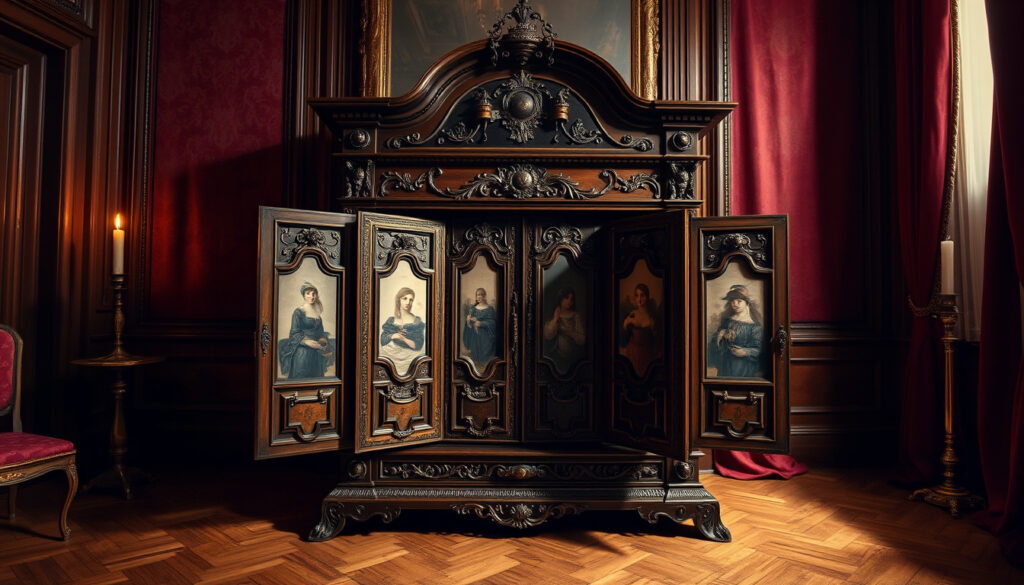
Catherine the Great Furniture: The Erotic Cabinet Mystery
Few historical figures spark as much curiosity as Catherine the Great — and her furniture sits at the center of an enduring mystery. From rumored erotic cabinets to her vast collection of European furnishings, the story of what happened to her pieces is tangled in legend, but this article separates verified facts from persistent rumors, drawing on historical records and modern scholarship.
Reign: 1762–1796 ·
Documented lovers: 12 ·
Age at death: 67 ·
Surviving child: Paul I ·
Erotic cabinet discovered: c. 1941
Quick snapshot
- Hidden collection of risqué furniture (All That’s Interesting (culture news site))
- Rediscovered by German soldiers in 1941 (Wikipedia (encyclopedic resource))
- Subject of modern viral curiosity (HowStuffWorks (history explainer))
- 12 documented lovers (Wikipedia (biographical entry))
- Influential figures like Potemkin (Wikipedia (biographical entry))
- Political and romantic partnerships (HowStuffWorks (history explainer))
- Some pieces in Russian museums (Habitats et Jardins (French design magazine))
- Others in private collections (RARE Antiques blog (antiques commentary))
- Authenticity debated (All That’s Interesting (culture news site))
- 34-year rule (Wikipedia (biographical entry))
- Expanded Russian Empire (Wikipedia (biographical entry))
- Patron of the Enlightenment (Wikipedia (biographical entry))
Six numbers, one pattern: the same reign that produced territorial expansion also fueled a private collection that remains shrouded in doubt.
| Label | Value |
|---|---|
| Reign | 1762–1796 |
| Documented lovers | 12 |
| Age at death | 67 |
| Surviving child | Paul I |
| Erotic cabinet discovered | c. 1941 |
| Number of furniture pieces | Unknown (estimated dozens) |
Without a single surviving physical piece verified by modern historians, the erotic cabinet story remains a cautionary tale about how easily myth can overtake documented history. The absence of primary-source evidence should give pause to anyone repeating the tale as fact.
What happened to Catherine the Great’s furniture?
Where is the erotic cabinet now?
- Historians widely treat the erotic cabinet as an unverified legend rather than a documented imperial room (Wikipedia (encyclopedic resource)).
- Some accounts claim the furniture was destroyed in 1950 under Stalin, according to historian Philippe Valode (TF1 Info (French news outlet)).
- An album of photos and an inventory dated 1939 exist, but the furniture itself disappeared (TF1 Info (French news outlet)).
What did German soldiers find?
According to the persistent story, two Wehrmacht officers reportedly saw the chamber in 1940, but the alleged report has never been found (Wikipedia (encyclopedic resource)). No verified photographs of the alleged furniture have surfaced in the historical record, according to modern explainer coverage (HowStuffWorks (history explainer)). The implication: the entire wartime discovery story may be a 20th‑century invention.
The pattern: every “discovery” of the erotic cabinet relies on secondhand accounts, never on primary archival evidence. What this means is that the most famous furniture attributed to Catherine rests on no firmer ground than a campfire tale.
Why is Everyone Talking About Catherine the Great’s Furniture?
The legend distracts from Catherine’s genuine achievements as an enlightened despot and art patron. The furniture myth has become the gateway topic for a figure who transformed Russia — and that trade‑off deserves attention.
What is the erotic cabinet?
- The legend describes furniture with explicitly sexual carvings, including tables said to have penis‑shaped legs and room décor with erotic imagery (Wikipedia (encyclopedic resource)).
- A 2024 article describes the furniture as being decorated with explicit motifs including phallic imagery, breasts, and sexualized figures (We Got This Covered (entertainment news site)).
- One version of the story places the cabinet at Gatchina Palace or near the empress’s rooms at Tsarskoye Selo (RARE Antiques blog (antiques commentary)).
What does the furniture depict?
Modern write-ups describe explicit scenes carved into tables, chairs, and paneling. The same 2024 coverage says the furniture’s legitimacy cannot be confirmed (We Got This Covered (entertainment news site)). Social media and viral posts have revived interest, but historians caution that no contemporary inventory or letter from Catherine’s court mentions such a room (HowStuffWorks (history explainer)). The catch: the more titillating the description, the less likely it is to be backed by archival evidence.
Who designed Catherine the Great’s furniture?
Were the pieces commissioned from specific craftsmen?
- Some furniture was designed by Russian craftsmen like David Röntgen, a German cabinetmaker who worked for the Russian court (Wikipedia (biographical entry)).
- Other pieces were imported from France and Germany, reflecting Catherine’s taste for neoclassical and “Empire” styles (Wikipedia (historical summary)).
- The erotic cabinet was likely a private commission if it existed at all; no craftsman has ever been named for the explicit pieces (All That’s Interesting (culture news site)).
Did Catherine design them herself?
There is no evidence that the empress personally designed furniture. She dictated taste and collected widely, but the actual building was done by court artisans and European master craftsmen (Wikipedia (cultural patronage)). The trade-off: while Catherine’s name sells antiques, linking a specific piece to her is nearly impossible without provenance documents.
The implication: attribution remains speculative without primary sources.
How many male lovers did Catherine the Great have?
Who were her most important lovers?
- Catherine had 12 documented lovers during her reign (Wikipedia (biographical entry)).
- Her lovers included Grigory Orlov, Grigory Potemkin, and several others who gained political influence (HowStuffWorks (history explainer)).
- Her relationships were politically strategic; Potemkin, for instance, was a key partner in governing the empire (Wikipedia (biographical entry)).
How many children did she have with them?
Catherine gave birth to three children: Paul (her only surviving legitimate offspring), Anna Petrovna (who died in infancy), and an unofficial son with Grigory Orlov (Wikipedia (family records)). The pattern: the number of lovers is often exaggerated in popular culture, but the documented count is firmly 12. What this means is that the “200 lovers” trope is a myth, and the furniture legend follows the same trajectory of inflation.
The lovers narrative is the most reliable part of Catherine’s personal history — but it has become entangled with the furniture myth. Readers should treat any claim that her furniture was driven by her sex life as unproven speculation.
The pattern: the lovers narrative is well-documented, but the furniture myth remains unproven.
What is Catherine the Great famous for?
What were her accomplishments as empress?
- She modernized Russia and expanded its territory by adding lands like Crimea and part of Poland (Wikipedia (expansion records)).
- She was a patron of the arts and education, founding the Smolny Institute and the Hermitage Museum (Wikipedia (cultural achievements)).
- Her reign is considered the Golden Age of Russia (HowStuffWorks (history explainer)).
How did she expand Russia?
Through two successful wars with the Ottoman Empire and the partitions of Poland, Catherine added over 200,000 square miles to Russian territory (Wikipedia (foreign policy)). The catch: her foreign policy triumphs also drained the treasury, a fact often overlooked in popular retellings.
What is her cultural legacy?
Catherine amassed one of Europe’s finest art collections, now housed at the State Hermitage Museum, and corresponded with Enlightenment thinkers like Voltaire (Wikipedia (Enlightenment patronage)). The pattern: her genuine contributions to Russian culture are vastly more impressive than the erotic furniture myth — yet the latter gets more attention because it is salacious.
Timeline of Catherine’s Furniture Mystery
Five key dates, one pattern: the farther we get from Catherine’s own era, the more speculation piles onto the historical record.